

Ancient Egypt through original museum photography, remarkable artifacts, hidden details, and archaeological discoveries. Based in Cairo, Egypt.
Cairo, Egypt
Joined June 2026
- Tweets153
- Following1
- Followers59
- Likes90




A pillow made of glass?
Tutankhamun's treasures included extraordinary headrests crafted from glass and ivory.
In ancient Egypt, these curved supports weren't just about sleep. They also carried meanings of protection and rebirth.
Tutankhamun's ceremonial armor was decorated with glass.
Tiny colored pieces were sewn onto fabric, creating a wearable royal garment not battlefield protection.
An extraordinary piece of ancient Egyptian craftsmanship.
King Tut's chair carried a symbol of a million years.
The figure carved into its back is Heh, associated with eternity.
Even royal furniture had a message beyond its function.
Tutankhamun’s enemies were literally beneath his feet.
Look at the footstool. Bound foreign captives were depicted where the king placed his feet.
Even his furniture made a political statement.
📸 BeyondNile | Grand Egyptian Museum

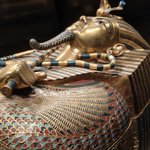
This is Tutankhamun’s middle coffin.
Not just a coffin an argument for immortality.
Every detail, from the false beard to the royal inlay, was designed to present the king as divine and eternal.

This cobra wasn't designed to hide from danger.
It was the danger.
In ancient Egypt, the rearing cobraknown as the uraeus symbolized royal authority and divine protection. It was believed to unleash fire against the pharaoh’s enemies.

Why was Tutankhamun given a beard he never grew?
Look closely at the long, curved beard on his solid-gold inner coffin.
This wasn't facial hair. It was a ceremonial false beard, linking the dead king to Osiris, the Egyptian god of the afterlife and rebirth.

Features a winged scarab holding a lotus and papyrus, flanked by rearing cobras (uraei), supporting a solar/lunar barque with the Eye of Horus (Wadjet), a gold crescent moon, and a silver disk depicting the gods Thoth and Ra-Horakhty.

This wasn't just a statue of Anubis. It stood guard at the entrance to King Tut's Treasury, facing outward as if watching for intruders.
Over 3,000 years later, the guardian remains. – at Giza, Egypt

Look at what King Tutankhamun’s jeweled falcon is holding ancient symbols of life, protection, and eternity. – at Cairo, Egypt

King Tut’s solid-gold inner coffin was stuck to the coffin around it.
In 1925, Howard Carter’s team applied heat for roughly three hours before it began to move.
Filmed at the Grand Egyptian Museum, Egypt.
#AncientEgypt #Tutankhamun