

Swing trader. Largest holdings in BTC, MSTR, ASST and SPCX.
Bitcoin Beach, El Salvador
Joined May 2023
- Tweets3.9K
- Following2.8K
- Followers6.5K
- Likes39.4K



Pinned Tweet
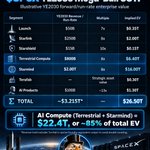
I built the most bullish YE2030 $SPCX valuation I could reasonably defend using statements from Musk and Shotwell, SpaceX & serious analyst work.
The result: $26.5 TRILLION of enterprise value.
I show the math & specify what Musk, Shotwell & analysts said & my assumptions 🧵
🤖 Made with AI
That didn't take long...

If Elon is correct about orbital compute eventually dwarfing terrestrial compute, it means that $BTC mining will also be done in orbit.
And that has a secondary benefit:
Terrestrial BTC miners have a short lifespan because as the ASICs become outdated, the cost to power them exceeds the revenue they generate.
Orbital BTC ASICs don't have that problem because the marginal cost of installed solar is $0.

Palmer is the next Elon.
@PalmerLuckey please IPO Anduril and Erebor.

Palmer Luckey’s Erebor surges to more than $7bn in deposits since launch ft.trib.al/nM9CSbn

Did she miss the part where BTC bottoms at the lower band of the power law?
Or the part where BTC bottoms at the peak of the prior bull cycle?
Don't confuse noise for signal.

Key point: the AI leader will ultimately be the company with the most computing capacity at the lowest cost
AKA: SpaceX

CATHIE WOOD THINKS A TESLA $TSLA AND SPACEX MERGER IS GOING TO HAPPEN
She sees the combination as part of Elon Musk’s much bigger long-term vision:
- Musk’s ultimate goal remains Mars, with businesses like global broadband connectivity acting as steps along the way
- SpaceX has already built a large and highly profitable connectivity business
- She says the AI leader will ultimately be the company with the most computing capacity at the lowest cost
AI models are like the gold miners during the gold rush. Most failed. But all the shops selling shovels and pickaxes got rich.
Anthropic and OpenAI are the gold miners.
SPCX, NVDA, INTC, TSMC are the shovel/pickaxe sellers.
Choose wisely.

Anthropic and OpenAI have no durable moat today.
Models are being commoditized quickly. Their revenue growth is impressive, no question.
But from an investment perspective, the bigger question is what happens when model performance converges, open weights get good enough for most enterprise workloads, and companies start running those models on leased or owned infrastructure.
If that happens at scale, pricing power and margins could look very different from what investors are underwriting today.
We’re already seeing it:

SpaceX has the biggest moat of any company. And it defends the largest untapped TAM of any industry.

SpaceX employee #13 @_Eric_Romo:
"The idea that launch prices are going to fall significantly in the next 5 years is nonsense."
"There are an awful lot of business models that are predicated on 'when Starship allows me to launch for $200 a kilogram…'"
"I think they’re all broken, and all those companies are going to fail."
"We’ve seen this play out already with Falcon 9 and the pricing around it, where the costs of Falcon 9 allowed SpaceX to deliver the Starlink constellation at a cost per CapEx that made them profitable."
"But they set the price in the market at something that just barely made it an okay investment to think about OneWeb or Kuiper or anything like that."
"They’re going to do the same thing on Starship, because why wouldn’t they?"
"Their internal costs on Starship are going to be whatever they need to be to deploy Starlink and orbital data centers, but they’re going to set the price so that anybody trying to do comms, anybody trying to do orbital data centers—the price is going to be too high."
"If you’re a third party relying on them for a lower price of access to space, I think you’re hosed."
@elonmusk
Recorded at @NYSE x @payloadspace Space Summit
Why is @NASAArtemis @NASAAdmin going to risk sendng humans to the moon after just 1 test landing with cold cargo?
Find the budget for more cold cargo test landings before attempting the human lander!
There is simply no need to take such a risky and rushed approach to returning humans to the moon after 53 years of inaction.
I am concerned about the plan for the next human moon lander.
The plan includes just 1 test landing with cold cargo before the moon landing w people on board.
After not stepping foot on the moon for 53 years, why rush it now?
@elonmusk and @Gwynne_Shotwell, make @NASAArtemis pay for multiple test landings with non-human cargo before attempting human landings.
Starship is years ahead of Blue Origin - there's no legitimate risk of being 2nd. Don't let NASA's budget control this risk. If they want the moon, they will pay for more test lunar landings.
Love this.
@ColeMacro is not scared.
Turn up the amplification.

IMPORTANT POST
Our industry became too focused on protecting downside risk and inadequately focused on maximizing Total Returns to the upside.
In my view, the entire purpose of our structured finance business model must be to maximize Total Returns for common equity shareholders. Our industry needs more amplification. Even at Strive, where we have the highest Amplification Ratio among Digital Credit issuers, when I look at the risk embedded in our capital structure relative to our amplification, I believe we have room to take it up another notch or two.
Building a rocket ship is extraordinarily difficult and requires underwriting and taking real risk. The mission requires not blowing up, but you need an engine powerful enough to reach the moon. Based on Amplification Ratio alone, I view the risk of true issuer failure from over-amplification as very low across our industry today. Amplification Ratio obviously cannot capture every risk, including debt terms, covenants, maturity walls, liquidity constraints, and other structural risks. But controlling for those risks should give issuers significant confidence to take amplification materially higher. That is exactly what we have done at Strive, and I hope others increasingly copy it.
I’ve written extensively about why Amplification Ratio will be the single most important driver of outright and relative Total Returns in a Bitcoin bull market. However, I believe incentives naturally push toward under-amplification, modest Bitcoin outperformance, and the safest possible path. My goal with this post is to light a fire and push our industry to think bigger, focus more aggressively on growth and Total Returns, and push the frontier of what our business models can achieve.
We have a shared mission across the industry to grow Digital Credit from a nascent asset class into a massive global capital market. That requires trusted issuers, deep liquidity, disciplined execution, and investor confidence. That is where we all should work together, but make no mistake about what will crown the fastest horse in a Bitcoin bull market: the engine.
Our mandate at Strive is to build the thing we actually want to own and recruit and retain exceptionally talented people who desire that risk and return opportunity and understand the business model that needs to be built. That mindset drove our execution in building a high Amplification Ratio, helped create strong liquidity, and is also why we are not satisfied with where we are. With Bitcoin under $100,000, our desire is to take Amplification Ratio higher from here.
If the Bitcoin bull thesis is right, amplification will be the most important thing. If the Bitcoin thesis is wrong, a few hundred basis points of cost of capital won’t be the difference between success and failure. The model itself will have failed.
I love capitalism. I love competition. I want more competition for the fastest horse. The next 10–15 years will be the Digital Gold Rush for Bitcoin.
Let’s act like it.
Couldn't agree more.
Except that I think you could even take it further, and reasonably claim that SpaceX is the most vertically integrated company. Period. AI or otherwise.
No other company, not even TSLA, has vertical integration at the scale that SpaceX is doing it.
I think people still dramatically underestimate what SpaceX has become.
SpaceX now owns xAI, Cursor, and Grok, while also controlling the infrastructure stack around it:
- Frontier AI models
- Massive compute infrastructure
- Starlink’s global communications network
- Starship, the lowest-cost path to putting enormous mass in orbit
- A planned orbital AI compute network powered by abundant solar energy
SpaceX has even said it expects to begin deploying orbital AI compute satellites as early as next year….
Very few AI companies control their own compute. None control a global satellite network and the rockets needed to build an entirely new layer of compute infrastructure in space.
Calling SpaceX a “rocket company” at this point misses what it has become.
It is the most vertically integrated AI company. Nothing else like it.
SpaceX is assembling an Avengers tier group of companies for its next phase into a fab and compute powerhouse.

Humans haven't been to the moon in 53 yrs.
The first Apollo moon landing with "one big step" was a worldwide event with over 500M people watching on TV.
Within the next 5 years, SpaceX will land rockets on the moon and mars.
Imagine what a spectacle that will be.
The top segment is going to consume the entire column soon.

SpaceX is becoming overwhelmingly commercial.
Elon Musk says:
• ~90% of SpaceX revenue this year will be commercial
• Government revenue in Q4 will be under 5%
For context, federal spending is roughly 25% of the U.S. economy.
SpaceX is not a government-dependent company.
It is increasingly a commercial infrastructure giant operating at global scale.

The pace of the AI-in-space race is accelerating.
This week, SpaceX launched Google’s first Suncatcher AI satellites, beating the early 2027 target by a quarter.

Our TPUs are headed to space!
Inspired by our history of moonshots, from quantum computing to autonomous driving, Project Suncatcher is exploring how we could one day build scalable ML compute systems in space, harnessing more of the sun’s power (which emits more power than 100 trillion times humanity’s total electricity production).
Like any moonshot, it’s going to require us to solve a lot of complex engineering challenges. Early research shows our Trillium-generation TPUs (our tensor processing units, purpose-built for AI) survived without damage when tested in a particle accelerator to simulate low-earth orbit levels of radiation. However, significant challenges still remain like thermal management and on-orbit system reliability.
More testing and breakthroughs will be needed as we count down to launch two prototype satellites with @planet by early 2027, our next milestone of many. Excited for us to be a part of all the innovation happening in (this) space!

I'm going to post this tomorrow. It's almost done. It's 9 pages at 12 pt font. The 2030 $ is huge. It's very defensible, though.
I'm working on a long post/thread walking through the bull case for SpaceX, and let me forewarn you, it is insane. If $SPCX can accomplish even half of the bull case, it will still be insane. Probably posting it tonight or tomorrow. Stay tuned.
Here's my SPCX YE2030 Sum-of-the-Parts Enterprise Value model.
xitter.cf/BedlamPres/status/2106…
It's conclusion: over $26T
I built the most bullish YE2030 $SPCX valuation I could reasonably defend using statements from Musk and Shotwell, SpaceX & serious analyst work.
The result: $26.5 TRILLION of enterprise value.
I show the math & specify what Musk, Shotwell & analysts said & my assumptions 🧵
If Elon is correct about orbital compute eventually dwarfing terrestrial compute, it means that $BTC mining will also be done in orbit.
And that has a secondary benefit:
Terrestrial BTC miners have a short lifespan because as the ASICs become outdated, the cost to power them exceeds the revenue they generate.
Orbital BTC ASICs don't have that problem because the marginal cost of installed solar is $0.
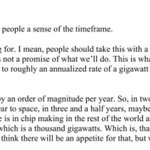
5. Starmind / Orbital AI Compute. This is the future valuation engine. Musk says SpaceX is targeting roughly 1 GW/year by the end of 2027 and hopes to scale orbital compute by roughly an order of magnitude per year (~10 GW/year by late 2028 and ~100 GW/year around late 2029). SpaceX’s filings likewise identify 100 GW/year of orbital deployment.
Musk has also said there is ultimately a path to 1 TW/yr of orbital compute deployment, although that is a longer-term aspiration rather than a firm 2030 target.
I assume only 50 GW of orbital compute is installed and externally monetized by the end of 2030 - well below the capacity implied if SpaceX approaches Musk’s deployment cadence. I make a second major assumption: that commercially monetized orbital compute can eventually achieve the same $30–50B/GW annual revenue economics Musk assigns to terrestrial compute. At the $40B/GW midpoint, 50 GW would support a ~$2T annualized run-rate at YE2030.
I apply the same 8x multiple used for terrestrial compute - without giving orbital compute an additional scarcity premium - implying ~$16T of EV.
For context, Morgan Stanley's much more conservative model reaches only ~2.7 GW in 2030, but then ~21 GW in 2032 and ~364 GW by 2040.

If you have been listening to big tech earnings calls for the past few years, you would have heard every one of them bragging about the size of their $NVDA orders.
Soon, they will be bragging about the size of their $SPCX compute deals.
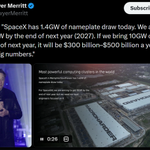
4. Terrestrial AI Compute. This is the current valuation engine. As of June 30, SpaceX reported ~1.4 GW of nameplate AI compute draw, up from just 0.4 GW a year earlier, and Musk says SPCX aims to reach ~10 GW by the end of 2027.
From there, I make one bullish assumption: SpaceX sustains roughly 10 GW of additional terrestrial capacity per year, taking it to approximately 40 GW by the end of 2030.
TD Cowen expects roughly half of new capacity to be leased to third parties, with the other half supporting SpaceX’s own AI development. So, assume 20 GW is externally monetized.
Musk estimates that AI compute can generate roughly $30–50B of annual revenue per GW. Monetizing 20GW at the midoint of $40B/GW results in roughly $800B of annualized terrestrial AI compute revenue.
At an 8x forward sales multiple, terrestrial compute alone implies $6.4T of enterprise value.


Better get used to this. $SPCX will be inking deals like this for the next decade.

$SPCX - BREAKING: Market Chatter: SpaceX's AI Unit in Talks to Lease Compute Capacity to Microsoft
The company plans to deploy around 420,000 Nvidia (NVDA) processors in November to meet growing demand, including a $1.1 billion monthly contract starting in December
