




Pinned Tweet
Why do I keep my focus on investments extremely narrow?
People asked what else I’m in, aside from $QNT. Short answer: not much, for very good reasons. Yes, I am aware of diversification.
But I keep the list small: some highly-researched crypto (with huge eternal thanks to my best buddy @MindCrypto_ ), some precious metal, and some carefully selected stock. (I could include two other essential investments: self-education and cultivation of mindset, but that's for another day).
I'll keep my other choices and the reasons behind them to myself for now.
The main reason for this strategy is simply hyper-focus, not particularly for technical or clever reasons.
If I own or pursue twenty investments, I don’t really get to know any of them and my attention becomes diluted. I skim headlines, feel busy, and probably still couldn’t tell you why I bought most of them (I made this mistake and learned a massive lesson from it when I was spread-betting some 20 years ago).
A carefully chosen and researched handful I can actually follow. What they do, what would prove me wrong, and when I’d sell.
Crypto is the somewhat speculative slice. Metal is the boring slice I don’t have to check every day. Shares will be businesses I can describe in a few sentences, not tickers I saw on a list.
Concentration is the risk. If I’m wrong on one of these, it matters. That’s why each one has to earn the slot, and why I’m not in a rush to fill it. The downside is obvious.
More to come on other areas I'm invested/interested in another day.
NFA - do your own research.

Beardy Investor retweeted

🧿💥 $SHX: Stronghold featured by the World Economic Forum! 👀
💰 Nearly $1 BILLION processed
🏦 4 banking partners handling live transactions
✅ 2 consecutive Nacha audits with ZERO findings
Real payment infrastructure. Real commercial activity! 🔥
initiatives.weforum.org/new-… 👇

Beardy Investor retweeted
🧿💥 I'm starting to see a much bigger picture emerging. AI is transforming information.
Propaganda and misinformation are becoming harder to identify.
Meanwhile, blockchain infra is quietly advancing.
Are we witnessing separate developments, or something bigger?
1/4 🧵
Beardy Investor retweeted

🇬🇧 NEW: UK banks received over 10,000 complaints about crypto transfer restrictions in 90 days, according to Stand With Crypto.
Lloyds, Barclays and NatWest topped the list, while six banks were listed as banning crypto transfers entirely.
ct.com/news/uk-banks-crypto-…

The Company is not the Coin
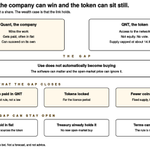
Quant can have a good year and $QNT can sit still. Those are not the same result.
The company sells software. Overledger is the layer a bank connects to. A bank can pay for that in pounds or dollars.
The UK work is live. The Clearing House has picked Quant for on-chain money. That is the company doing the job it is paid for. None of it requires a new buyer of QNT.
The coin is a separate rule. The published version for a developer on the live platform is a £100 yearly pass, settled in QNT, with the coins locked while the pass lasts.
There is a later idea that an operator locks QNT to run a trusted node. That is not switched on. Until access actually pulls coins off the market, the company’s work and the coin’s price are only loosely joined.
That is why the position stays small. I am not paid to hold it. A licence is for the bank or the developer. A node, if it comes, looks like a job for a checked operator, not a bag this size.
The only payoff for me is a higher price, and that price does not have to follow the software.
So I hold a modest line because the work is real, the supply is capped, and I can leave it alone if the link stays loose. I do not add because a bank named Quant.
I would add if the token rule starts to bite: more users settling in QNT, coins locked and staying locked, not a one-off headline.
Until then, the company can keep building and the coin can stay a small position I am content to hold.
Follow me if this series on what I hold, and why, is useful.
NFA - Do Your Own Research

For those who may not have quite understood my post and those astronauts who fear missing the moon…
Overledger is powered by QNT. A developer or customer buys a licence in QNT and pays for transactions in QNT.
Gilbert says the lockup approach has not changed, and he challenges anyone to show a mainnet Overledger transaction that did not use QNT.
He also says the part that decides whether that rule reaches the open market. Enterprise clients can pay in pounds or other fiat, and Quant handles their QNT for them, because it is easier for an enterprise to manage.
He says this has been the approach since the white paper.
That paper, the 2020 Overledger Network for Community document, already set it out.
On developer licences:
“Developers will be able to obtain an annual license to develop applications on Overledger through the purchase of QNT tokens equivalent to a fixed FIAT amount.
The license/key will expire annually and thus must be renewed using only QNT. QNT are locked for the entire duration of their license and are out of circulation.”
On enterprise:
“The Treasury - Enterprise has been live with clients since April 2019.”
And on the fees: “the conversion to QNT will be handled by the Treasury.”
Quant’s own 2021 announcement then put a number on the public path: an annual Overledger licence fee of £100, payable in QNT, for the live platform.
So both halves sit in the company’s own words. The standard path uses QNT, and the coins are locked. An enterprise can pay in ordinary money, and the Treasury handles the QNT.
The token is required inside the system. That is not the same as every new bank having to buy it on the open market.
If you strongly believe QNT is going to the moon, I truly hope you’re right. As a ‘simpleton’, I just do my best to research the facts not the hype.
I still DCA QNT but don’t pin my future on it. Nor do I do so with my other investments. Trading from the late 90’s taught me that valuable lesson.
Feel free to ignore my posts if you believe I’m wrong. I only do this for decent discussion, which doesn’t include wasting my time with keyboard warriors.
To anyone who appreciates these posts and reads them with an open mind, please continue to join me around the fireside discussion.
4
162

Two Punts, Not a Solo Idea
$QNT and $SHx are both on the short list. They are not the same bet.
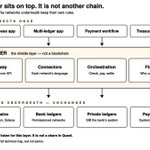
QNT is the access token for Overledger, Quant’s layer between bank systems, private ledgers and public chains.
The work is already live in a small way: UK banks have moved tokenised sterling on rails Quant built, and The Clearing House has picked Quant for on-chain money.
The coin is not a share in that company. A bank can pay in pounds. My hope is that access starts to lock QNT. Supply is about 14.6 million. Around $240, the market is roughly $3.5 billion.
SHx is the token attached to Stronghold, a payments business. It sits mainly on Stellar and is used for merchant rewards, liquidity for merchant financing, and a vote. Supply is capped at 100 billion.
The coin trades around half a cent, a market nearer $100 million. It has never yet traded at the $0.25 or $1 figures some investors hope for and quote. Those levels will need a many-fold rerate.
One is a small position on plumbing that banks are already touching.
The other is a cheaper, earlier punt that the payments company will pull its token into real use. I can explain both in a few lines.
That is why they are on the list. Neither pays me to wait.
NFA - Do Your Own Research
Beardy Investor retweeted
🧿💥 $QNT What if the biggest QNT story is the one most people aren't paying attention to? 👀
How many people are actually connecting the dots?
Beardy Investor retweeted

FTX’s collapse is now on Netflix.
Netflix just released the trailer for "The Altruists," a limited series about Sam Bankman-Fried.
The story follows SBF and Caroline Ellison's love story, the rise and fall of FTX, and the $8 BILLION fraud.
Who's watching? 🍿
Beardy Investor retweeted

Yesterday in London, our CEO @gverdian joined @TheFCA, @Tandem_Bank, @awscloud, @OpenPayd and @HLCGlobal at @InnFin’s FinTech as a Force for Good Forum to discuss operational resilience in an always-on digital economy.
3 takeaways:
➡️ Outsource capability, keep accountability
➡️ 24/7 money changes the risk profile
➡️ Build resilience in from day one
As Gilbert put it: “For the first time in probably 30 years, we’re able to design what we need for the next 30. It’s very encouraging to have so many banks and regulators at the table to do this together.”
#OperationalResilience #TokenisedDeposits #DigitalFinance #AI

A $240 Coin is not Automatically Expensive
$QNT at about $240 looks expensive next to a coin you can buy for half a cent. The sticker is the wrong comparison.
Price per coin is just the market value divided by the number of coins. QNT has a fixed supply of about 14.6 million. At $240 that is a token worth roughly $3.5 billion. $SHx has a cap of 100 billion.
At half a cent it is a market of around $100 million, depending on which supply figure you use. The cheap coin is the one with the huge pile. The pricey-looking coin is the one with the small pile.
Expensive means something else. It means the price is high relative to what the coin is likely to earn its holders. On that test QNT can be expensive at $240, because the published licence is £100 a year and holding the token does not pay you. But maybe not, if it shoots to the moon, like a lot of predicitions I read on X.
SHx can be expensive at half a cent if $0.25 needs a market of several billion dollars for a rewards token. Unit price does not settle it.
So I do not buy QNT because it looks scarce, and I do not buy SHx because it looks cheap. I buy a modest amount of each for a different job, and I judge the job against the size of the market, not the number on the coin.
NFA - Do Your Own Research

Live is not Finished
Live is the right word for what's happened. It is not the same word as finished. UK banks have moved tokenised sterling on rails Quant built.
A house purchase could release the funds at completion. A shop payment could release the money when the goods changed hands.
That is a real customer transaction, not a slide. In the US, The Clearing House has picked Quant for on-chain money, aimed at participating banks in the first half of 2027.
Further along than a white paper.
What it has not proved is a market. A handful of live payments is not millions of deposits. A selection is not a network that banks must use.
Neither announcement was about $QNT. The UK news was that banks had moved tokenised sterling on rails Quant built, including funds released when a house purchase completed.
The US news was that The Clearing House had picked Quant for its on-chain money project. Both named the company and the software (Overledger). Neither said banks would buy, lock or use the token.
Overledger is the product. QNT is the access token, and the announcements did not mention it.
The software can be in the building while the token rule stays loose. I still take the live work as the reason to hold a modest line.
The next thing that would make it more than a pilot is dull: more banks, repeat transactions, and access that locks QNT rather than a one-off headline. Until then, live is a start. It is a good start. It is not the whole story.
NFA - Do Your Own Research

Beardy Investor retweeted

🚨 HUGE: The UK is preparing to TOKENISE GOVERNMENT BONDS in a market that saw £303.7 BILLION in planned gilt sales in 2025/26!
No cryptocurrency has been selected, but look at who's already involved in UK financial tokenisation:
🔹 $QNT — Building tokenised banking infrastructure through the GBTD.
🔹 $XLM — A leader in tokenised non-US sovereign debt, with @StellarOrg technology tested in a Bank of England initiative.
🔹 $HBAR — Already used by Archax and Lloyds in a UK first transaction involving tokenised government bonds!
With HSBC leading the UK's digital gilt pilot, could one of these networks eventually play a role?
The opportunity is enormous. Who's your pick?


I Love Technical Analysis, But...
Charts show the last trade. They do not know the next headline. On a deep market, a line can matter because enough people trade it.
$QNT is thinly traded. That means there are not many coins sitting on the order book at the current price. A modest buy or sell moves the price further than it would on bitcoin or a large share, and a headline can gap it.
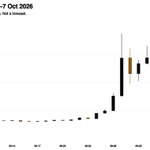
The late-September move came after the UK payments and The Clearing House news, not after a pattern completed.
The candles from 8 September to 7 October show a quiet range near $60, a spike through $300, then a wide choppy range. That is a headline hitting a small float.
A chart is still useful at the edges. After a vertical week, it is a reason not to chase. A quiet range is a reminder that nothing in the licence rule has changed.
It is not a clock, and it is not a price target.
NFA - Do Your Own Research


What Would Change my Mind?
A red week would not. $QNT can fall and the reason for owning it can still be intact. It can also jump for a month and mean very little.
I’d change my mind if tokenised bank money gets built and Quant is not the join. Another firm does the connecting, the banks do it themselves, or the pilots end and nothing replaces them.
I’d also change my mind if the token rule is dropped: access priced only in fiat, no lock, no reason for a new buyer.
But neither of those has happened. Are they likely to happen? Who knows.
The work is live, the supply is capped, and the open question is whether use starts to take coins off the market.
Until that is answered, it stays a position I’m happy to hold.
NFA - Do Your Own Research

What I’m Actually Watching For
I slightly lowered my expectations on $QNT this week, after reconsidering the facts avalable to me. Holding it does not pay me.
A licence would seem to be for the bank or the developer.
A node, if it arrives, would seem to be for checked operators, not for the size of bag I'm currently holding.
I will need to increase my bag somewhat to become a checked operator, which, if I decide is an intelligent move, I will begin by DCA.
The only payoff for me right now is a higher price.
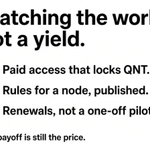
So I’m not watching the chart for a signal. I’m watching whether use turns into coins leaving the market. Paid access that locks QNT. A node programme that actually requires a stake, with the rules published.
Renewal, not a one-off pilot.
If the UK work and the Clearing House work stay real and the token rule stays loose, the company can still be doing the job I bought it for. My position would just be a bet that hasn’t yet paid.
That’s allowed. It isn’t the same as the thesis being confirmed.
NFA - Do Your Own Research

Beardy Investor retweeted

“Programmable Yen next?” isn’t a rhetorical question.
This isn’t some spontaneous pivot towards opportunity in Japan.
$QNT has spent years laying this groundwork.
And Gilbert has a habit of leaving breadcrumbs that lead somewhere real.
Rewind to 2017.
Japan was already in the room at the beginning of ISO/TC 307, the global blockchain standards work Gilbert helped create.
The group’s second plenary was held in Tokyo, with major Japanese technology companies including NTT and NTT DATA participating in Japan’s domestic standards committee.
Gilbert was chronicling it in real time:
xitter.cf/gverdian/status/849849…
xitter.cf/gverdian/status/930019…
Quant then filed for two patents in Japan, the first in 2018 and the second in 2021.
Both have since been granted:
➡️“Blockchain Communication and Ordering” Submitted: December 1, 2017 Granted in Japan: May 12, 2023
patents.google.com/patent/JP…
➡️ “Secure Multi-Distributed Ledger System” Submitted: November 20, 2020 Granted in Japan: January 14, 2026 patents.google.com/patent/JP…
All along, Quant was building an entirely separate track record with central banks.
In 2023, Quant joined the vendor team for Project Rosalind, led by the Bank for International Settlements.
Quant provided the underlying blockchain infrastructure, secure smart contracts, and interoperability between central bank ledgers.
Then in 2024, the BIS launched Project Agorá.
And this time, the Bank of Japan was directly involved.
By 2026, it had moved beyond theory: Agorá conducted real-value testing involving JPY (with the Bank of Japan participating) all using a shared programmable platform.
Considering Quant has already worked directly with the BIS on this exact class of problem, the overlap is impossible to ignore:
• Central bank money
• Tokenized deposits
• Programmability
• Interoperability
• Legacy financial systems
As the community likes to say, #AgoraInTheBagora.
On January 14, 2026, $QNT announced their strategic partnership with Dentsu Soken, specifically to bring tokenized deposits and programmable money to major Japanese financial institutions.
(Fun fact, this was the same day one of Quant’s Japanese patents was awarded.)
Dentsu Soken is not some small player — they’ve spent decades building mission-critical systems for a variety of Japanese banks.
Their StreamR settlement platform is also compatible with BOJ-NET, the Bank of Japan’s real-time gross settlement system, and Dentsu explicitly said it would use that infrastructure to help implement programmable payments with Quant.
A month after the partnership announcement, Gilbert was in Tokyo, “meeting clients and regulators” and speaking about tokenized deposits.
Quant and Dentsu held a joint session at GFTN Forum Japan titled: “The Frontline of Programmable Payments (Tokenized Deposits).”
Then today, we get the tweet.
Keep in mind Gilbert had tweeted “Programmable Dollars next?” in May 2025, only to see it come to fruition 16 months via The Clearing House.
The fact is $QNT has been in Japan’s standards orbit since the earliest days of the company.
They’ve accumulated Japanese interoperability patents.
They’ve partnered with institutions embedded in Japanese banking and connected to BOJ-NET.
They’ve worked directly with the Bank for International Settlements on programmable money.
They spent a week in Tokyo this year meeting regulators around tokenized deposits.
So when you know the history, the seemingly harmless question about programmable yen lands completely differently.
This story did not start with a tweet.
But it will likely end with $QNT at the center of Japanese finance.
