

Collaborative team working on the dynamics of bats, humans, and pathogens. For more info see https://xitter.cf/t.co/uqRbfHcGiz
Joined September 2017
- Tweets190
- Following280
- Followers1K
- Likes69




BatOneHealth retweeted

Prof Deeann Reeder illustrates how natural and anthropogenic impacts cause energetic stress in mammals such as bats, mice, birds... and how his contributes to viral shedding, and consequently, spillovers @BatOneHealth #OneHealth

Starting in 20 mins!
Countermeasures, strategies & policy opportunities for preventing pandemics at the source #PublicHealth
@DavidQuammen @mvankerkhove @rainamontana @abi_vanak @teague_o @IroroTanshi @PREZODE_Intl
@AtkinsonCenter
ecornell.cornell.edu/keynote…

Join us on Monday 26th.
Webinar on ecological countermeasures, strategies & policy opportunities for preventing pandemics at the source #PublicHealth With
@DavidQuammen, opening by @mvankerkhove from
@WHO and @rainamontana from @AtkinsonCenter
tinyurl.com/2vawmjhw
BatOneHealth retweeted

🚨🦇Please share widely 🦇🚨We have an exciting new funded PhD position going looking at the molecular adaptations underpinning immunity in bats. Interested in evolution, bioinformatics and/or viruses? Look no further -> findaphd.com/phds/project/mo…

BatOneHealth retweeted

Jan 13 @rainamontana
#OneHealth advocate, PI of @BatOneHealth
Investigating #DiseaseDynamics, pathogen transmission & spillover
@OneHealthUCD @EpiCenterUCD @CENDUCBerkeley @GorillaDoctors @PanditPranav @rlsdvm_epivet @Erika__Ganda @JoacimRocklov @khoney
calendar.ucsf.edu/event/eppi…

Our work shows that once you understand the ecology of the systems, the intervention may actually be quite simple.
You can find the full study on the @Nature website here:
"Pathogen spillover driven by rapid changes in bat ecology"
nature.com/articles/s41586-0…

As the world prepares for the next pandemic, we should invest in identifying & preventing the events that trigger it in the first place.
Incorporating more detailed ecological understanding of wildlife species into spillover investigations could help prevent future spillovers
This demonstrates a potential solution:
Restore and protect the trees that provide food for flying foxes in winter, in areas away from horse paddocks.
📷Vivian Jones

ALT Large numbers of silhouetted grey headed flying foxes (Pteropus poliocephalus) flying towards a mountain, against a dusk sky. Photo credit: Vivian Jones
Indeed, large winter flowering events have a protective effect on the risk of spillover and so are critical to the health of horses, people and bats.
One of the most valuable results was that Hendra virus spillover never occurred at times when winter flowering was abundant.

And importantly, the models were able to correctly predict the presence or absence of clusters of spillover.
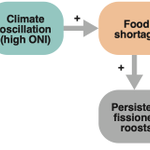
The highest risk of spillover was from bats in agricultural areas after a food shortage, when no winter habitat flowered and produced nectar.

The models also showed that climate-driven food shortages preceded clusters of Hendra virus spillovers from these new roosts.
But this risk dropped to nearly zero if flowering in remnants of winter habitat was abundant and bats fused back into large nomadic populations to feed.

The models confirmed that strong El Niño events drive food shortages for flying foxes, and during food shortages, large nomadic populations fission into many small populations in urban and agricultural areas.

The authors tested hypotheses that these processes were linked to Hendra virus spillover risk using Bayesian network models that could handle multiple scales of data, describe relationships between the various processes and generate conditional probabilities for spillover.
Historically, fissioned roosts would only persist for weeks. When the food shortage ended, bats would become nomadic again and feed in native forests. But over time, more and more bats have persisted in fissioned roost populations in human-dominated areas.
A recent companion study in Ecology Letters showed that the bats in these novel winter habitats excreted more Hendra virus than bats in traditional winter habitats, especially after a food shortage. xitter.cf/BatOneHealth/status/15…

New work by @danjbecker, @ali_bat, @rainamontana and others in @Ecology_Letters shows how historical ecology and recent food scarcity affect Hendra virus shedding from Australian flying foxes and spillover risks to horses:
doi.org/10.1111/ele.14007 #OneHealth
Large winter roosts of nomadic bats feeding in native forests became rare.
Roosts fragmented in urban areas.
Flying foxes shifted into new agricultural areas that did not provide native food over winter but allowed feeding on introduced plants, including those in horse paddocks

The study captured a rapid change in behavior of bats to this changing environment – from large nomadic populations to many smaller populations.
Previously, these behaviours had only been seen as very short-term responses to climate-driven starvation events
📷 Pat Jones

ALT A black flying fox hanging from one leg, in a relaxed pose, sleeping in the sun with green foliage in the background Photo Credit: Pat Jones. www.instagram.com/patjonesnaturephotography/
They show how flowering trees that provide nectar to flying foxes in winter have been extensively cleared for agriculture and urban development.
From 1996-2020, winter flowering became increasingly unreliable.

The authors collected and collated data over 25 years to describe the ecology & behavior of fruit bats (called flying foxes) in subtropical Australia.
Flying foxes are nomadic nectarivores that play a critical ecosystem role in pollinating Australia's native trees
The study, by @BatOneHealth authors Peggy Eby, @ali_bat, @rainamontana, @PeterPjh18, Andy Hoegh, and others, presents long-term data and models that predict spillovers.
The data suggest an effective way to prevent the next pandemic is by protecting & restoring wildlife habitats

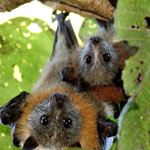
ALT A grey-headed flying fox adult female and pup peering through green foliage. Photo credits: Vivien Jones