

Early-stage investor Past work: @GoogleCloud. @Anvato (acq by Google). @IntelCapital. @TheCalixNetwork (IPO). @KauffmanFellows.
San Francisco, CA
Joined May 2007
- Tweets19.3K
- Following621
- Followers5.9K
- Likes4.1K







One founder, zero employees... and $10M → $20M run rate in 6 weeks 🤯
Congrats @Bencera!
Awesome to see @sapiom customers killing it 💪 @i_zerbib

Polsia is about to hit $25M run rate.
Next stop: $100M ARR.
And things keep accelerating:
$0 → $1M in 12 weeks
$1M → $10M in 10 weeks
$10M → $20M in 6 weeks
I just published one of my favorite and most successful aisloP episodes yet: “The Run Rate.”
I tell the whole story, from idea to $20M, month by month.
The episode ends in Tokyo, where I went a few weeks ago.
Probably the best place on Earth to take a deep breath, get inspired, and rethink what’s possible.
I came back with an even bolder vision for Polsia.
The road from $25M to $100M is going to look very different.
Polsia v2 is coming soon.
Electricity is ~5% of a GPU-year in @VitalikButerin 's table... it's rounding error... and still the bottleneck.
Miners hunt the cheapest kWh since it's a big chunk of their cost base.
AI will pay whatever it takes for a MW that's live asap.


Remember when tranched financing was a red flag in VC?
10–15 years ago, tranches were about risk mitigation. VCs would commit capital in stages, contingent on revenue or product milestones. Founders hated it.
As capital became abundant, tranches fell out of favor in competitive software deals. Single rounds became the norm.
Now they're back... but as a mechanism for VCs to access the hottest deals.
Founders are selling equity at different valuations, sometimes within days of each other.
@gradypb recently shared that across 7 deals... @sequoia invested at ~$110M valuation as a building partner... followed within a month by VCs at ~$3.4B valuation 🤯 [I invest before all these rounds 😎]
VCs went from tranching capital to mitigate risk to tranching valuations to access deals 🤑
. @nebiusai CRO @marcboroditsky: "We ran the cycle and discovered that we were pricing too low"
.. so now it's auctions.
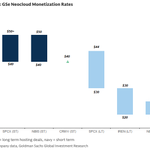
~2x short-term premium now has surge pricing


It’s been exciting to watch your vision come to life from the early days. Great to see @nvidia @SapphireVC @aranum joining the journey 🚀

very excited to finally being able to share this
@nvidia and @SapphireVC have been believers in Reactor since day 1, and we're honored to work with them
onwards 🚀
reactor.inc/blog/nvidia-sapp…

demand is very strong. From last week's $CRWV conference:
short-term deals pricing ~$40M/MW
70% of 2Q deals prepaid
A100s from 2020 renewed into 2029
growing from 4.2 GW contracted -> 8 GW by 2030

Extraordinary growth (12x) and enormous bets ($518B in future infra obligations) in @AnthropicAI's S-1 👀
So.. for every $1 customers paid, it spent ~$2.75 ($4.6B of revenue in 2025, $12.65B of operating costs)
This is not only the cost of serving each customer dollar... it also includes building next-gen models, capacity for future demand, etc... but someone needs to finance the gap
Private markets financed this so far.. now it's public markets' turn 🤑 Extraordinary growth doesn't come cheap.

EXCLUSIVE: Anthropic's IPO prospectus shows sweeping AI vision, surging costs reut.rs/4e0NImI reut.rs/4e0NImI

Tech analysts expect the sector's operating cash flow to double to ~$2.4T by 2028. Analysts covering tech's customers see their cash flow growing far less.
Torsten Slok: who will write the checks to cover the gap? See @apolloglobal chart below 👇
Don't think the chart necessarily shows an inconsistency. Enterprises don't need entirely new budgets to buy AI. They can redirect spending from software, outsourced services and the cost of doing work today.
Enterprises still need to create value to justify AI spending, so it can't only be shifting existing budgets to AI.
Imagine a company replaces a $10M operating expense with $3M of AI-enabled execution. There is room for enterprises and its vendors (hyperscalers, frontier labs, etc) to win.
But... if compute, integration, etc push the real cost toward $10M, impressive adoption may produce very little economic benefit for the entperise 💸
Productivity gains can be real and still get absorbed by the cost of delivering them... which would be a problem in the long run
cc @ajit_deshpande (last night's dinner topic)

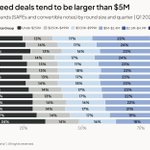
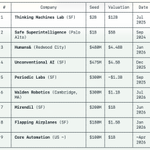
At $300M are these still seed rounds... or Series As in disguise?
.. meanwhile, 90% of pre-seed rounds are <$5M. Plenty of alpha here cc @cartainc


. @elonmusk quietly saying:


1. We will keep accelerating. Our AI efforts are only 3 years old, vs 6 and 10 years old for Anthropic and OpenAI. If our second derivative remains strong, SpaceX will reach pole position in about 6 months.
2. Once you far exceed the caliber of intelligence needed for a class of tasks, additional intelligence is pointless. You don’t need (and it would be cruel to put) Newton-level intelligence in your toaster!
3. Hardware is hard. Bringing massive compute online rapidly is incredibly difficult. SpaceX has demonstrated exceptional ability in this regard and will only get better.
canary in the AI coal mine... except this one got too little gas 😜
cnbc.com/2026/09/24/oracle-d…

we will get to see ASIC performance & power metrics with FPGA-like design flexibility soon
@JeffDean's point on automating the design loop that could make highly specialized silicon for each model architecture is fascinating.

I was lucky to back Mayank & Anand’s last company, which was acquired by @Gartner_inc
@GatherHQs is a much bigger ambition: making customer behavior something companies can simulate before they bet on it.
Proud to be an early investor again. 🚀🚀

Today we're launching Gather's Customer Simulations. It moves GTM teams away from guessing what customers want and instantly simulates what they will say and do.
We’ve grown 10X in eight months and are lucky to be learning from dozens of incredible customers who are moving faster than ever before. Before you spend another dollar scaling an assumption, bring us the question behind it.
Simulate what’s next. Built on what’s real.
gatherhq.com

Don't miss this!

We are partnering with @viskoai to host a hackathon in San Francisco this Saturday to celebrate the launch of Orbis 1.0.
Sign up here: luma.com/gh4256ju

I’ve been thinking about where models, apps, and agents fit together after all the recent personal assistant/agent and model launches.
In the 90s, we bought PCs by MHz.
We believed 500MHz > 400MHz.
Then architectures diverged, clock speed became a worse proxy for performance and eventually most of us stopped caring about that number.
AI may be going through the same thing.
First we compared parameter counts. Now we compare a soup of benchmarks most users don’t understand.
Maybe the next step isn’t a better benchmark. The model just disappears from the buying decision.
@Cursor_ai was an early signal. You give it a coding task.. it can choose the model.
Model still matters. Increasingly... someone else chooses it for you.
I recently read an analogy to HTML that stuck with me (can’t find orig post to credit them - search needs to improve):
HTML made it possible to build almost anything. But billions of people didn’t learn HTML.
Instead, Facebook & Instagram reduced that general capability to a few obvious actions: Post a photo. Follow someone. Send a message.
... and with that HTML disappeared for most users... they all started having personal pages on those platforms.
Personal assistants like Instinct (@noahrshinn)
@Townai and now @Meta’s Muse feel like a similar transition.
You describe what needs to happen. Then assistant figures out the work.
Sometimes I may browse the shoes or compare the speakers I want to buy. Other times, I already know:
“Move the meeting, tell everyone, and make sure I can still get to the airport.”
intent → outcome
The apps may still do the work. I no longer have to coordinate them.
And this may change where value accrues.
Users may become less attached to a particular model. The harder thing to replace may be the assistant that knows their preferences, remembers their decisions, and has earned permission to act.
Reading my calendar is one level of trust. Rescheduling a meeting is another. Spending my money is another.
Authority accumulates through work done well. It also has to remain inspectable and revocable.
The model can change. The relationship and permissions can persist.
Thin intelligence. Fat authority. (h/t @usv's old article)
“Thin” means the product can source and replace the intelligence underneath. It doesn’t mean building it is easy.
This is where I believe big opportunities exist: memory, identity, permissions, and execution infrastructure that makes delegation reliable.
Who captures the relationship is still open.
@Google has apps & context. @Meta has distribution and communication habits. @Apple has device and permissions. The AI labs have intelligent models.
Startups like Instinct, Town have room to earn trust through a better experience and build the infrastructure all these assistants need.
There’s also a business-model question.
If an assistant chooses where I buy, their recommendation becomes the new search page. You can't win that with only better benchmarks.
That relationship will belong to the company you trust to act for you when you’re not watching.
I think this transition will create enormous opportunities for startups, both in the assistants we use and the infrastructure underneath them.
A lot is still up for grabs. Exciting times ahead.
Does GPT-5.6 → Astra feel like as big a leap as Opus 4.8 → Fable 5.1?
I’m not seeing it in my own use cases yet.
Where are you seeing the biggest differences?
🔥🔥🔥

🚀 Sol-H3: @MiniMax_AI H3 Video Generation Faster Than Playback 🤩
Five seconds of world. 1.653 seconds to infer.
We’re releasing Sol-H3, our fastest end-to-end MiniMax-H3 inference stack yet. On one 8× NVIDIA B300 Blackwell system, it generates five seconds of 1344×768 video with stereo audio in 1.653 seconds. Across 1×, 4×, and 8× B300, Sol-H3 reaches up to a 15.54× speedup versus Base H3.
Compared with 50-step Base H3 Dense on the same 8× B300 system, the four-step Sol-H3 profile delivers:
• 5s: 18.250s → 1.653s (11.04×)
• 10s: 50.660s → 3.732s (13.57×)
• 15s: 99.513s → 6.612s (15.05×)
Sol-H3 also scales across GPU counts:
• 4× B300: 2.918s / 6.993s / 12.542s for 5s / 10s / 15s (12.11–15.54×)
• 1× B300: 13.745s / 37.813s / 52.260s for 5s / 10s / 15s (9.45–14.29×)
All figures are medians of three measured runs after one warmup at 1344×768 and 24 FPS with stereo audio. Base H3 uses 50 scheduler points (49 DiT forwards); Sol-H3 uses four DiT forwards, so this is a full-profile comparison—not an attention-only runtime change. Sol-H3 uses Dense attention on 1× B300 and SOL with INT8 QKV / FP8 output transport on 4× / 8×. Timing includes text encoding, DiT denoising, and video/audio VAE decoding; model loading, compilation warmup, and final MP4 encoding are excluded.
Sol-H3 brings Sol-Engine × Sol-Attn into one full-stack runtime:
• dynamic sparse attention with no retraining
• fused norm, RoPE, MLP, and sparse-attention setup
• fused INT8 QKV / FP8 output communication across 8 GPUs
• parallel, batched VAE decoding
• precomputed AdaLN caching
Inside the stack:
• sparse-attention setup: 1.206 → 0.285 ms (−76.4%)
• VAE decode: 7.55 → 0.602 s
• ~24 GB memory freed per GPU
Any MiniMax-H3 few-step LoRA can plug into the same engine, and the code is deployment-friendly under Apache 2.0.
For us, the bigger milestone is crossing from “fast generation” into “faster than playback.” That opens the path toward continuous 24 FPS generation and truly interactive video systems.
We’re excited to partner with @reactorworld to release Sol-H3 and make it available as an API day-0.
Try it now on Reactor: reactor.inc/sandbox?model=fa…
🔗 nvlabs.github.io/Sana/Sol-En…
Amazing team effort—full credits in the blog.
@shanasaimoe @lawrence_cjs @yitongli165665 @haopengl33 @HaochengXiUCB @songhan_mit
Nvidia is becoming an API co: post 1 GW, receive $50–60B 🤑
Jensen Huang at the G20, summing up the $NVDA model:
“You monetize energy in $$$ per kWh. Today, it’s dollars per million tokens.”
“One gigawatt is about $50B-$60B.”
A leading-edge fab used to be the $25B mega-project. One GW of AI is roughly 2x that