

Demystifying Golf Ball Performance | https://xitter.cf/t.co/4qnEtMNRll | #DimplesMatter
Joined February 2020
- Tweets1K
- Following1
- Followers8.7K
- Likes182




Looking to leverage years of golf science research, diligent golf ball testing, and expert data analysis?
Try Ballnamic today!
f.mtr.cool/6nycy7ap2h
Same swing. Same club. 20-mph headwind.
The longest of the 9 new balls carries 12.2 yards farther than the shortest.
That is a 7-iron into the green instead of a 6-iron.
See how your ball ranks at f.mtr.cool/vj6cphn9l2
New golf balls have arrived at Ballnamic for the fall! Check out the list of golf balls we have added to the database:
- Legato LTX 3085
- MaxFli Tour X LS
- 2024 Seed SD 01
- 2024 Seed SD 02
- 2024 Seed SD 05
- Snell PR3
- Snell PR4
- 2025 Tour Edge Exotics
- Vice Pro Air

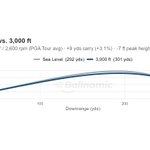
Same swing. Same ball. Sea level vs. 3,000 ft.
Driver: 292 to 301 yds (+9 yds)
7-Iron: 181 to 192 yds (+11 yds)
The ball goes farther, but flies lower at altitude. Peak height on the driver actually drops by 7 ft.


A PGA Tour player averaged 329 yards off the tee at 830 ft elevation.
At Black Desert Resort in Utah, 3,000 ft up, he averaged 369 yards in a round.
Same player. 40 yards apart. That's altitude.
There is no single altitude rule. There is no single wind rule.
Your swing and your ball respond to each condition differently.
WindPoint calculates this for your numbers, not a tour average.
Join the WindPoint waitlist today: f.mtr.cool/0i4a4vqzft
At this week's Presidents Cup, the International Team will pair two teammates with one ball for Foursomes. They alternate shots, playing the same ball down every hole.
One thing a captain has to consider when making his team's pairings: Which golf ball does each of my guys play?
Three pros play a ProV1x—three different production years. Same name on the box, a different ball inside.
The remaining nine pros on the team each play a different golf ball.
At this week's Presidents Cup, the United States Team will pair two teammates with one ball for Foursomes. They alternate shots, playing the same ball down every hole.
One thing a captain has to consider when making his team's pairings: Which golf ball does each of my guys play?
Team USA has 12 players. Only two pairs play the same ball.
Two pros play a 2019 Titleist ProV1x. Another two play a 2026 TaylorMade TP5x.
Every other player on the team plays a unique golf ball.
Both Solheim Cup teams have one ball that most players game (2025 Titleist ProV1), and a few players on a different ball. If two of them get paired together in Foursomes, one plays a ball that isn't their own. Off the tee, performance may be similar enough. Around the greens and on approach shots, they may see performance they're not used to.

The Solheim Cup puts the top American and European women against each other in match play, including Foursomes, where two teammates play ONE ball between them, alternating shots.
Team Europe has 12 players, so 66 possible pairings. Their bag splits into two camps instead of one big cluster: 5 players on ProV1, 3 players on ProV1x. That's 13 pairings already sharing the same ball.
Only 3 players are on a ball that nobody else on the team plays.
The Solheim Cup puts the top American and European women against each other in match play, including Foursomes, where two teammates play ONE ball between them, alternating shots.
Team USA has 12 players, which means 66 possible two-player pairings. One ball dominates the bag: the 2025 Titleist ProV1, played by 8 of 12 players. That's 28 pairings already sharing the same ball.
Only 4 players are on a ball that nobody else on the team plays: TaylorMade TP5x, Titleist Pro V1x, Callaway Chrome Soft X, and Callaway Chrome Tour X.
Don't know your exact ball speed, launch angle, and spin rate?
Do know your typical driver and 7-iron distance?
Great - Ballnamic can still make accurate recommendations for you!
f.mtr.cool/58jqgfizxj
Driver carry is one thing. But around the greens, ball selection can mean the difference between a ball that bites and one that bounces over the green.
Across the 14 new balls added in our Spring 2026 update, wedge spin ranged from ~9,200 to ~11,360 rpm in dry conditions. That’s a 2,160 rpm range from the same wedge.
f.mtr.cool/qjc83q21on
Listen to Marty Jertson talk with Shane Bacon about how Ballnamic powers a customized wind sheet for distances with each golf ball used.
Join the WindPoint waitlist: f.mtr.cool/bkgarbmlkx
Stop guessing about your golf ball. Find a ball that fits your game and play with more confidence.
f.mtr.cool/ptozdzamct
What’s harder than playing a round of golf in 30 mph winds?
Playing a round of golf in 30 mph winds with the wrong golf ball!
Don’t make golf harder than it needs to be. Get fit for a golf ball that can make golf easier.
f.mtr.cool/dinbpwtqrb
Did you know some golf balls are less prone to fliers?
Select "Often" for the flier prevention prompt in Ballnamic, which allows our smart algorithm to recommend balls that can reduce the chance of fliers.
Those WindPoint sheets that LKD says, "every tour player has access to," are about to be available to you. Join the WindPoint waitlist to be the first to get a wind sheet specific to your game.
ballfitting.com/windpoint/

In 2018, Shinnecock gusted 30 mph, and the course nearly came apart.
If we see it again this year, here’s the same driver swing in three winds:
🟠 Into 30 mph: 233 yds
⚪ Calm: 317 yds
🔵 Downwind 30 mph: 395 yds
That’s a **162-yard** difference on one swing. The wind could be a big storyline this week.
Distance, trajectory, spin, rollout – the wind changes all of it. WindPoint helps you understand how much. Join the waitlist to get early access.
f.mtr.cool/ujofsdzkvb
