
Investing in companies that don't make money @GoodCapitalVC
India
Joined February 2012
- Tweets3.3K
- Following1.4K
- Followers11.4K
- Likes8.2K







Pinned Tweet
If you need an investor that can put on their big boy pants and lead your round, call me.
Agents became capable faster than they became trustworthy. They can already book flights, buy things, file paperwork and write code, and the tasks we hand them keep getting bigger.
But before an agent’s actions can be trusted, agentic AI companies need to solve for these things:
1/ Identity: There is no clean way to distinguish an agent’s action from a human’s. Even on your own system, without proper logging, you can’t say with certainty what you did and what the agent did on your behalf. You can’t assign responsibility for an action, or decide whether to allow it, until you know who took it.
2/ Accountability: When an agent acts on your behalf and gets something wrong, it’s unclear who answers for it. It could be you, the company that built the agent, or the company behind the model. Our laws were written for people and for passive tools, and an agent doesn’t fit cleanly into either.
3/ Permission: Even when you’ve authorised an agent, the platform it’s acting on has to allow it too. Most businesses haven’t decided whether they want that. A large part of Amazon’s business is built on people browsing its site, through sponsored listings, reccos and upsells. An agent that goes straight to the purchase skips all of that, which is why Amazon has actively blocked them.
Models will keep improving, but agents will only scale once this plumbing is solved.
2026 has been an wild year for tech - even though i’ve felt this way every year for the last 3. the relentless pace of it all is insanely inspiring

💯
As soon as we sense ai-speak, we're tuned out.

I've sent a version of this to 10+ founders this month alone. Just because you can use AI, doesn't always mean you should
"Allow me to give some unsolicited advice: Investors are drowning in AI-generated cold emails and pitch decks. It is almost an automatic "delete-without-response" for me. It doesn't convey craft, or care in what you are building and comes across as low effort. I'd humbly suggest making your materials manually to ensure they best communicate your ideas in your voice. Others might disagree, so take this as a data point."
You can read the top 1% here as the prosumer market. For a consumer, an AI tool is a purchase, weighed against everything else they buy.
For a prosumer, it’s an input cost, weighed against an invoice/an hourly rate. So they'd always penetrate consumer-grade products first.

India's GDP per capita is around ~$2,800 today. That's usually the band where consumption starts to compound across countries like China, South Korea, Brazil, and I think it's a big part of why D2C brands have exploded here over the last 5+ years.
One category I'm v bullish on is appliances. The consumer durables market is on track for about $35 bn by 2030, with appliance growth stepping up from roughly 7% a year to 11%. This is also a "first-purchase market," not a replacement one - ie households are turning nuclear and buying a lot in the category for the first time, like air purifiers, vacuum cleaners, dishwashers etc.
That hands the advantage to whoever can reach + finance a household new to the category and design specifically for a first-time owner rather than an upgrader.
In the last couple of months, AI agents have gone from enterprise vocabulary to a mainstream consumer product, with several million people installing one for themselves.
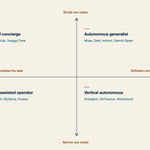
As the matrix below shows, I think the west rules the "autonomous generalist" category, where the use cases are broad and the software executes the task. This is because western agents assume an application or a browser on the other side.
India is approaching the same category differently, because a great deal of Indian commercial and institutional activity doesn't present one. It runs through telephone calls, messaging threads and counter staff, in several languages.
So Indian agentic startups have arrived at a combination: a person is still deployed at the end of every task, but the AI around them does the coordination, holding the case history, drafting each escalation, tracking what is still outstanding.
I believe the left side of the chart is where India has massive scale to unlock.

every agent today is built for the buyer - to choose, compare, place the order. wondering if we start seeing seller-side agent optimisation soon
if an agent is doing the action, someone has to make their product legible to the agent, which probably runs on a different set of discovery signals than the ones we've been optimising for

the case against vertical AI startups is usually that the TAM is small (especially in india) because people look at what that specific industry spends on software. by that math, every vertical will look tiny.
the number to anchor on should instead be: how much is the market spending on the people doing the tasks, the agencies picking up overflow, the contractors and outsourced teams filling the gaps?
what does the industry actually pay across the workflow to get the work done? that could be a much better judgement of the market.
every app has their own agent right now and there's no way it's going to last. it's super annoying.
Just make a way for my agent to talk to your app or you're going to get disintermediated once someone aggregates your supply.
all theses are dependent on pattern recognition, which by definition can't be forward-looking. a firm should be making varied bets before it solidifies a thesis. we also try to treat it as an ever evolving document

as @BadCapitalVC once told me - most theses are retrospective (they're an outcome of investing)
Arjun Malhotra retweeted

as @BadCapitalVC once told me - most theses are retrospective (they're an outcome of investing)

We're so glad to have doubled down on our conviction in Rio through this round!
Medicine on qcomm is a different beast - the consumer behaviour, the frequency of need and the sensitivity of what's being delivered all raise the difficulty bar well beyond other categories.
Their efficient use of AI, strong customer obsession and bottoms-up execution have already helped the team scale to ~30k orders/month, with 80% coming from repeat customers.
Super bullish on Amit, Ankur and the team!

#Exclusive: Healthtech startup Rio•ai raises Rs 43 Cr in pre-Series A led by Version One Ventures
✍️ @8M_Shailesh
entrackr.com/exclusive/exclu…


5/ The regulator has also moved with the market:
SEBI's reforms shortened listing timelines, let founder-promoters retain ESOPs post-listing & eased IPO eligibility for companies showing a path to profitability. The regulatory environment is now built to accept more listings.