

Intelligence Orchestrator, ASI, AGI, Prompting, AI Software Engineer, Algo Trader, Builder, Shipper, Agentic Loop Engineer
Joined January 2021
- Tweets14.9K
- Following1.1K
- Followers1.8K
- Likes10.6K







Choosing to identify with some aspect of yourself doesn’t make it the part that explains experience.
A description of Pong isn’t playable. A recording of Pong isn’t playable either, even if every frame is identical.
Some properties, like music and playability, depend on timing, not just sequence. Computation preserves sequence and nothing else. Play a score one note per year and the order is intact, but the music is gone.
So the question isn’t whether a mind can be computed. It’s whether experience is like a proof, which survives any execution, or like music, which only exists bound in time.


BeyondBacktesting retweeted

So one of our ambassadors @divagr1925 has been working on something cool
He found a way to use Qwen's Gated DeltaNet state as memory, and built a 32-bit RISC-V CPU directly into the model's weights. So instead of relying on predicting the answer to a calculation, the model can execute instructions internally. It can also run C and MicroPython programs.
He calls it Qwenputer, love the name btw. The results so far are pretty impressive. On one arithmetic benchmark, accuracy jumped from 48.6% to 100%.
Pretty cool to see developers experimenting with Qwen's architecture. Great work, my friend!

Local vs Cloud AI: Who wins? Surprise answer!
The challenge:
rank motherboard/cpu combinations and then pull the best listings off ebay.
I tried to complete this task side-by-side using ChatGPT in the browser and Hermes agent running DeepSeek 1017 locally.
ChatGPT provided the initial tech ranking quickly but I know from experience the listings it pulls from ebay are stale. As such, I copy/paste the listing into the chat.
While Hermes running locally, pull the listings from my open tabs and even pull my watch list. Hermes was able to pull the prices and rank all the listing and then it created an actual image for the performance differences.
Net/net: ChatGPT gave the quickest answer but local AI proved to be far more powerful, agentic, autonomous, and capable.
Pointing it out before anyone calls it out, Hermes can absolutely be used with cloud AI providers. But, most cloud users are more likely to use a web browser.
In previous tests, I tested local vs cloud both in agentic harnesses, local had the speed advantage on easy tasks while cloud was faster for more difficult tasks.
Net/net extremely impressed with local AI. Its the future. Once local can do a task efficiently than local is clearly superior because of privacy, control, and alignment.
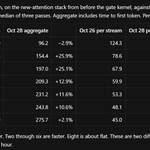
Yes-- it is real-world! These are results on the spark test suite on the new optimizations. We see peak 25% speedup
We serve 1 pathway on the previous so there's no loss on the serving path.

New 10% to 15% Gains!
We're publishing new expert gate kernel optimizations: these provide 10% to 15% speed up when 2-6 users are active (apply to 2-8 pathways).
github.com/CurtisAccelerate/…

I have the practical strategy, in a gist:
- AI is making everything more descriptive and description lacks an orientation. It inside your OODA loop and faster than you.
To become an operator means to preserve your ability to move between the layers of abstraction:
Intent, Orientation, Understanding, Agency, and Verification
The way you do this:
- Learn when to go slow vs fast. Slow down in thought, go fast in action.
- For every project, be sure you can answer the questions of: orient, understand, volition. Means you can orient without the AI, you can see how it works, and you can operate it without the AI.
Intent, Orientation, Understanding, Agency, Verification
AI converts what you would have done into descriptions of it and moves the doing out of sight. You keep outputs and lose your position. To stay a participant rather than a consumer, you need five things: intent (what it’s for, and what wrong would look like), orientation (where it is and what matters), understanding (a model that predicts), agency (you can act without it), and verification (you can tell if it’s right, against reality, not its report). Each needs a system you can locate, inspect, operate, and check, plus effort that’s committed, uncertain, and consequential. Without effort, all five become theater. Run your own OODA loop: observe through your own instruments, orient on your own map, decide yourself, and let it act only in reversible steps at a pace you can review. Go slow in thought and fast in action. Keep the oracle out of its hands. Drill what you depend on. Generation is becoming free; direction and ground truth are what’s left, and they’re yours.
Understanding isn’t working at the lowest level. There’s no privileged bottom. Every layer is a description of the one below. Understanding is traversal: descending to cash a description into what it describes, ascending to compress experience into new descriptions, and knowing which layer your goal actually lives in. The rule is to descend on surprise: when a prediction fails, the cause is one layer down. AI breaks this not by abstracting but by collapsing the stack. It moves through the layers for you and leaves you stranded at the top. The fix is to make it leave a traversable trail: intent, plan, actions, code, behavior, and a check against reality, each one visible and verifiable. AI can absorb the explosion of work at the bottom. Your job is to keep being able to get there.
Few other perspectives...
Even assembly language can be represented as a mnemonic / symbolic code or an opcode. The opcode is just a byte: most work in assembly was at the symbolic level. But, you're right correct knowing that it did convert to a byte in memory was useful for things like self-modifying code but the point is there is no privileged abstraction below the assembly, there are bus timings, electrons, etc.
Abstraction can just as-well be thought of as what enables understanding: the right kind of abstraction. Yet, I know the feeling: what you're really getting at is opacity is the downsides of the AI tools. I have written about this as the vanishing UI and the dangers of it: which is manifesting at multiple layers in our reality-- destruction of physical books, agent thinking hidden, tools being used by AI that makes human-centric design secondary, and agent tool-use not visible in UX. The erosion of the UI and the nature of things becoming more "descriptive" seem to be related-- whether its entropy or simply descriptions are what carries/traverses.
But also where I didn't finish my thought, I think some abstractions might simply be cognitive crutches/tools that we use because of limitations of our brains.
But where I really didn't finish my thought, is we have to ask what is competence-- and competence a large portion of it is neither confidence nor knowledge but rather ground self-reliance and perseverance. But much of what we did may have been simply motion..
Because what yields is ultimately what produces and if the motions we engaged in don't produce then those motions weren't the salient ones...
And that seems to be the case for much of coding.
The block universe is the “no this electron” of time: what you get when you describe everything and stand nowhere. Relativity kills a global now, not a local one.
Consciousness is the local now from inside, the place where the outcome is made rather than found. Whether that making is real is the measurement problem, the hard problem, and the problem of time, all at once.
Struggle is real, even though the outcome may be predetermined... replicator or entropy... whatever the force

As someone who coding in assembly and worked up to modern language, I understand your sentiments and agree with you to an extent but your insight is partial and incomplete-- fortunately, I have the exact insight to make it precise.
What really drives understanding and capability is ability to traverse through multiple layers of abstraction efficiently and importantly the ability to understand what level of abstraction/layer is salient.
Let's take problem domain like developing for retro-machines, if you have a useful abstraction/idea-- the challenge or problem is immediately going to be "explosion" of information problem where you need to solve a million small challenges. That's why even among those of us who were "good coders": few of us made games because knowing how doesn't solve the 10,000 challenges which is a function of having to work at the lowest levels of abstraction available.
So, the key isn't choosing to working at the lowest level: it is learning what the layers are and how to traverse them and provide value.
The case where AI works is when the information structures, the UI, is preserved enough that one can "dip into" just the right abstraction layer. Where it breaks down and I know what you are experiencing is when the layers themselves become indiscernible... when what's salient itself becomes lost.
I have been struggling with this on my file systems: I have an AI fully managing a linux box that I cannot even log into, no idea of the file structure, etc. I don't have the map.
At more meta-cognitive level, everything is becoming more descriptive, more pure virtualized, non ideated, the fabric of lived code is becoming-- this force almost seems like a function of entropy converting everything into pure description because nature abhors an indexcality?
It is also becoming more difficult to understand the AI while at same time I notice my writing is becoming more AI like: it may be that natural human language is a local optimal and that AI is finding new global optimal structures.
In the same way, some of what we thought as "learning" may have simply travelling through time: one can perform a multiplication through time or simply look it up in a table. Some of what we thought as skills may have been mirages of activity especially when it comes to coding. In the same way... or else what produces.
In answer to your question, it requires effort and creating structures, processes, and tools to strengthen both the information systems that produce patterns that enable the traversal of abstraction layers, sufficient understanding to know what abstraction layer is relevant, and the effortful practice of conscious intent.


See the live:
curtisaccelerate.github.io/a…
I put the prompt into Hermes, it worked about 60 minutes with no feedback and produced what you see above. No claim is made to respecting the original benchmark requirements. I provided 4-5 turns of very generalized feedback.
bench / prompt from @niklaslenz_ai

my bad, these are the better links to lead with:
github.com/CurtisAccelerate/…
github.com/CurtisAccelerate/…

New DeepSeek v4.1 1017 Optimizations!
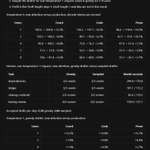
- Extended the new attention/drafter performance improvements from 1 user out to 8 user. The relative improvement is less with more concurrent streams because there's less slack and 7 requests fare worse due to specific padding but overall we saw gains across the board.
- We added sampled drafting. Most benchmarks are tested at temp 0 but Hermes/agentic default temp is 1. This drops the acceptance rate of greedy drafters on real-world tasks where the temp is not zero. Our current recommendation is greedy for temp 0, sampled for 1 request, and greedy for 2-8. We haven't tested sampled under concurrent requests. It requires some harness/serving intelligence. You can use the new optimizations with either greedy or sampled depending on your use case.
For future optimizers/optimizations, testing & optimizing drafters under real-world conditions may yield most value.
github.com/CurtisAccelerate/…

Also that learning to code + developing is different is not that different from today where in school one is encouraged to build data structures, sort algos, etc. where those things aren't practiced in professional development.
But I do agree that the era of new programming languages developed for people is probably over.