





Pinned Tweet
For a few years now, a group of us have tried to explain that the biggest challenge in African democracies like Ghana, Nigeria, and Kenya is not really the POLITICS.
The real mess is in POLICY. We call this KATANOMICS.
But we have done most of our explaining using essays. Everyone tells us, however, that reading nowadays is hard! People are too swamped and busy.
So, we are trying our hands at using videos and photos. 😊
First video:
youtu.be/cj9pUzTr2vQ
We are new to this so forgive the quality and focus on the message. But we are very welcome to all feedback. Keep them coming.
1. Ghana's Finance Minister says now that the government has delivered on stability, growth for jobs is next.
2. The latest IMF numbers look, at first glance, to give strong encouragement to his position. But, as always, there is nuance, and the Devil is in the Detail.
3. The IMF's October Statistical Appendix has a table featuring 43 countries with forecasts for both 2026 and 2027.
4. This is the same stable of reporting generating headlines about Ghana overtaking Ethiopia as Africa's 8th largest economy.
5. Sadly, most secondary reporting of the IMF data focuses on static snapshots instead of the projections and forecasts the same data enables.
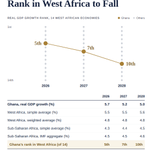
6. Ghana's 5.7% projected growth in 2026 and 5.2% in 2027 does indeed beat the sub-Saharan average of 4.5% for both years.
7. Small twist: West Africa's growth rate in 2026 is projected to be 5.3% and 5.2% in 2027, significantly higher than the sub-Saharan Africa average. Neighbourhood effect? Or Naija effect (check the PPP-weighted line in the attached)?
8. Hence why Ghana's top-10 status in sub-Saharan Africa puts it near the top 20% whilst its top-5 status in West Africa drops it out of the sub-region's top 20%.
9. Also, its IMF growth trajectory of 6% in 2025 to 5.7% in 2026 to 5.2% in 2027 suggests convergence with the sub-Saharan African mean but lower than the West African mean in 2028 (5.6% in 2028 for W/Africa vs 5% for Ghana). Downhill slope?
10. (Mauritania is outside the IMF's subregional classification and has to be imputed directly.)
11. Still, the October outlook is more favourable to Ghana than the April outlook, when IMF projected 4.8% for 2026 & 4.9% for 2027, compared with Oct's 5.7% & 5.2%.
12. Ghana is indeed projected to be Africa’s eighth-largest economy in 2026, at $128.64 billion, narrowly ahead of Ethiopia’s $127.15 billion. This is partly due to currency effects, as the GDP measure is in current USD.
13. Only that the same IMF projections put Ethiopia back ahead in 2027 and keep it ahead through 2031. Ghana’s lead over Ethiopia (and its eighth-place ranking) therefore lasts for 2026 only in this forecast.
14. Still good reason for Ghana's economic managers to celebrate.
15. The slightly more concerning issue is that DR Congo passes Ghana in 2028: $139.07 billion against $136.49 billion. Côte d’Ivoire passes Ghana in 2031: $166.81 billion against $164.26 billion.
16. One very useful way to interpret a part of this cross-trend is to distinguish how much an economy produces from what that production is worth when converted into (current) dollars.
17. Dollar GDP depends on three things: real production, domestic prices and the exchange rate used for conversion. The striking finding is that between 2024 & 2026, Ethiopia’s real output grows by about 19.2%, compared with Ghana’s 12.0%. Yet Ethiopia’s dollar GDP falls while Ghana’s rises. Hence why Ghana's top-8 status doesn't last.
18. Now you know why amidst the champagne-popping, the Finance Minister still said that Ghana will OUTPERFORM the IMF's projections.


In the past, countries designed national tourism strategy with three main moves:
- Audit raw assets (which had typically accumulated over years)
- Build infrastructure to convert the asset into a polished experience (the more "shiny luxury-looking" the more you could charge)
- Then deploy heavy CNN-style marketing
Times have changed.
Doha's Hamad Airport shows how some countries are taking the leap.
Checkout the video for "The Orchard". It is a "tropical rainforest" tucked into Hamad Airport.
Featuring over 300 sustainable trees, 25,000 plants, a 575-square-meter bio-pond water thingy, and a sweeping 85-meter grid-shell glass roof, this spot is a hit with overstressed travelers looking for an oasis.
Traditionally, an airport was just the gate. You got marks for how quickly you could process people out.
Qatar's Orchard flips this narrative by positioning the airport as the first touchpoint of the destination brand.
It also says that luxury is no longer defined by "shiny". It is defined by wellness, space, and feelings of wholesomeness. How best to deliver that than through a connection to nature (biophilic design)?
National tourism strategy must recognise changing trends.
First, national tourism brands are built from the bottom up via social proof. "Ordinary people" experiencing the flow and spreading the word.
A country’s brand is no longer what the Ministry of Tourism puts on a poster. It grows from the raw unedited footage that spreads across social media.
Second, that makes CREATIVITY central. Concepts must aim for distinction, memorability, authenticity, and connection. You can't just hire a top agency to do a brilliant one-off ad and move on.
In Bangkok airport, they have blended national cultural imagery with authentic Thai dance displays (see pictures in the thread.)
The right concept breathes, it evolves, it grows on you.
(Now, let me ruin this with a small political jab: that is why Ghana's National Cathedral was so unpopular in certain quarters. 😉 It lacked creative sophistication and distinction.)
In Bangkok's Suvarnabhumi Airport, the native folk dances blend into sacred historical art, and leaves the traveler charmed and soothed at the same time.


Bright Simons retweeted

Join us this Thursday, 22nd October, at Labadi Beach Hotel for the GGA 3rd Annual Lecture on:
🗣️ Democracy Under Pressure: Rebuilding Trust, Accountability & Institutional Integrity.
🎙️ Keynote Speaker: H.E. Prof. Yemi Osinbajo 🇳🇬
🔗 Register now: preregistration.online/4029
#GGA

Bright Simons retweeted

At the ongoing OECD Asia-DAC Dialogue, on the margins of the World Bank - IMF Annual Meetings in Bangkok, Thailand, Bright had the opportunity to address development cooperation leaders.
He urged the OECD to remember its own roots in the OEEC, when Europe, despite being on the aid-recipient side, organised itself to shape the flow and absorption of Marshall Plan resources from the US.
Today's developing countries deserve the same chance to shape development cooperation for their own transformation and take control of their destiny.


Bright Simons retweeted

🤖 AI and the Ghanaian economy: opportunity or disruption?
Join the Digital Economy Forum, in partnership with Hubtel, as Sam George, Dr. Theo Acheampong, Adam Watkins, Augustine Adjei and Bright Simons explore the future of AI in Ghana.
📅 October 21, 2026 | 8 PM
📻 Live on Joy 99.7 FM and JoyNews
#DigitalEconomyForum #AIandGhana #Joy997FM #JoyNews

Bright Simons retweeted

Do we vote for politicians because they can solve our problems, or simply because we see ourselves in them?
Ghanaian policy analyst Bright Simons argues that voters too often prioritise charisma, personality and a sense of belonging over a candidate's ability to deliver meaningful solutions.
“We vote for people because they look like us, they talk like us, we like them, we feel like they're on our side, and we don't look at the problems,” he said.
@BBSimons @Goldkeys
#GSWNews #BrightSimons #Ghana #Politics #Democracy #Elections
Bright Simons retweeted

It’s been about six years since I started paying close attention to policy issues in Ghana. It began around COVID-19, when I was following the data and the government’s response to the pandemic. I even learned some epidemiology to model Ghana’s COVID-19 trajectory.
I thought it would be a short-term thing. Six years later, I’m still following policy issues. 🤦🏿♂️
Bright Simons retweeted

🇬🇭 This must be a warning to the government: the voters who helped bring you to power may be the quickest to send you out.
In 2024, non-attached voters were significantly more likely to back the #NDC. They owe no party permanent loyalty.
Repeat the old mistakes, and expect the old verdict.
@OfficialNDCGh @NPP_GH

Bright Simons retweeted

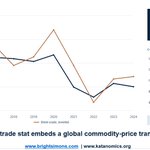
IMANI VP @BBSimons challenges the use of the intra-African trade share as the main indicator of continental integration, arguing that the statistic can move without reflecting real progress in regional production and economic cooperation.
brookings.edu/articles/intra…
#IMANI

Bright Simons retweeted
Meet Bright Simons 🌍 Social innovator, policy entrepreneur, and President of mPedigree, leveraging technology to transform supply chains and shape Africa’s future.
Recognised globally. Driving systemic change. Creating impact at scale. #Africa #GoodGovernance #democracy

Bright Simons retweeted

Magistral piece by @BBSimons , a must read.
« The most critical objective for African #trade should be #productiveintegration. By this, I mean repeated cross-border economic relationshipsthat create #additionalproduction, deepen regional value added, build firm and worker #capabilities, broaden participation, improve resilience, and strengthen #competitiveness in third markets.
In that light, there is no magic continental threshold of 20% or 25% of intra-African trade that automatically maps to that positive scenario. Meaningful thresholds would instead relate to what trade does and what it consists of. »

By kind courtesy of Brookings, we get to take another, closer, look at the issue of trade among African states:
brookings.edu/articles/intra…
Here is the lowdown:
1. You would hear a lot of people talking about how low trade among African countries is and has been.
2. They will often mention a number that is anywhere from 15% to 18%.
3. They will compare the number to the supposed equivalent in Europe (anything between 65% to 68% depending on source).
4. They will lament how insidiously bad this is.
5. Then praise God that the African Union and its agencies and affiliates have medium to long-term targets for boosting intra-Africa trade share (ranging from 25% to 50%).
6. In this piece, we warn about turning this stat into some kind of fetish.
7. Because when you look closely it turns out that things get arbitrary very quickly, and it doesn't always measure what we think it is measuring.
8. Due to peculiarities of the current economic structure.
9. We end by proposing some less sexy but more meaningful metrics for gauging African integration in a way that can still command some public and political attention.
10. While acknowledging that sexy statistics are very stubborn beasts to slay.

Bright Simons retweeted

Replace the intra-African trade share with a meaningful statistic about trade integration brookings.edu/articles/intra… by @BBSimons

No one in their right senses bets against Alhaji Aliko Dangote.
But for sheer love of modelling, we are going to do just that! Well, only on one small matter: his prediction of 10 million unique subscribers buying into the IPO of his giant Lagos refinery, which was extended from closing today to 27th Oct.
Our unproven model suggests that it would be hard to get past 2.8 million unique, valid retail subscribers, with an 80% range of 2.1 - 4.4 million.
That would still be roughly twenty times Nigeria's previous retail record (MTN Nigeria's 126,720 in 2022), a little over half of Saudi Aramco's 5.06 million, but well under a third of the 10 million Dangote is expecting.
- Chance of matching Aramco (4.9m real people): about 5%.
- Chance of 10 million real, unique Nigerian and African subscribers: effectively nil in this model.
- Chance that a headline of 10 million or more is announced anyway: very high. (And this is where the fun part is!)
The IPO managers may have a trick up their sleeve (wink). The 10 million subscriber count can be reached by counting applications rather than people, or by counting pension contributors whose funds bought shares.
How do we know that? MTN did the latter in 2022, turning 126,720 retail buyers into "6.6 million *indirect* Nigerian shareholders".
Using that approach, it should be very easy for Dangote to break even the “10 million subscribers” threshold without breaking a sweat, just by adding "indirect".
The offer will almost certainly be oversubscribed by value, but that has little to do with mass participation.
Nigerian Pension funds (₦31.3 trillion in assets, with a regulatory waiver to buy), a $400 million pan-African SPV, and high-net-worth investors can fill ₦2.15 trillion on their own.
On valuation, the ₦525 IPO share price asks buyers to assume that todays war-inflated margins become normal. As many analysts have pointed out, the price needs a through-cycle gross refining margin of $28 - 34 a barrel (about $32 in the central case) on a refinery doubled to 1.4 million barrels a day.
The company's 2026 guidance is $24.2. At that guidance, fair value is closer to ₦310 - 450 a share, depending on discount rate and cost assumptions.
But none of this kinda math really matters when it comes to the IPO demand. The real issues are disposable income, national levels of financial literacy, trust in capital markets, and various hygiene factors.
The Aramco IPO was the world’s largest recent IPO on subscriber numbers. Unsurprisingly, it is the one Alhaji, ever the impossibility transcender, wants to beat. Unfortunately, Aramco is the wrong yardstick.
It is true that every Dangote IPO design choice has aimed at maximising headcount rather than capital (only 3.3% of the enlarged company is on offer). $4 minimum ticket, 55 approved e-channels, no upfront CSCS account, bonus shares and a promise of priority for small investors, etc. All this rewards breadth. But there are gaps.
Aramco's 5 million+ subscribers were produced by a rich state with a mass-retail market, bank credit and political pressure.
Dangote does have a populous market, but it is not captive enough. Nor is there any equivalent of Tadawul’s decades of mass retail trading in Nigeria.
Of the 6 million CSCS accounts in Nigeria, about 10% are active. Unlike in Saudi, Nigerian banks aren’t lending into the frenzy either.
At any rate, outside India, I struggle to find a retail play that has drawn more than 6 million people.
Yes, Safaricom hit 4.5% of the Kenyan adult population so 8% of Nigeria’s for Dangote shouldn’t be too crazy. Except that you are not considering the economic pressures in today’s Nigeria.
Moreover, “mass equity ownership” is built over years. One mega-offer however magical its issuer can only climb so much of the distance. Britain went from 3 million individual shareholders in 1979 to 8 million in 1987 through a string of privatisations.
Like I said at the very start, no sane person bets against the Alhaji, but he is asking the system to do several years of onboarding in four weeks. Hence my reckless wager. Wish me luck!

1. Is Ghana out of the fiscal woods yet?
2. The exchange rate, inflation, policy rate, government borrowing costs, all seem to be pointing the right way.
3. Yet, banks are threatening to block new loans to government workers because the controller/accountant-general deducts loan payments from pay and holds on to them rather than remit to the banks.
4. Public sector workers feel hard done by.
5. Contractors, licensed cocoa buyers, and the "coalition of unpaid nurses" and "unpaid teachers from colleges of education" have been protesting for much of 2025 and 2026 about months-old ARREARS.
6. Howzat?
7. Is there a cashflow problem or not?
8. One answer sounds like "fiscal austerity". Government has more fiscal leeway than ever, they say, but it is being extremely prudent so that the country doesn't skid off the fiscal rails.
9. Finance Ministry mandarins talk about massive restraint on the debt markets, for instance.
10. Well, analysts are pointing to a pattern that suggests that this neat story isn't that simple.
11. We all remember DDEP. Most of us by way of trauma. After the government declared itself bankrupt in 2022, its long-term bonds were restructured.
12. For most casual observers of the fiscal scene, the pain of DDEP has led to government having to rely on short-term treasury bills and a recent bond issuance wasn't too encouraging.
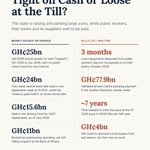
13. The truth, like I hinted, is more complicated. Between October 2025 and June 2026, the government issued about GH¢32.9 billion of domestic bonds. That is almost $3 billion.
14. Yet, only GH¢2.7bn (~$240 million), i.e. the lackluster showcase seven-year bond in April, went through the publicised sale.
15. Roughly GH¢25bn (~$2.2 billion) came from "taps" of the old restructured bonds, i.e. the DDEP bonds. There was no public individual notice for these issuances that the average investor would have seen. Another GH¢5bn went straight to the Bank of Ghana.
16. The Finance Ministry's bulletin calls the April sale the first issuance since the 2023 debt exchange, yet its tables show about GH¢22bn having been issued quietly in the preceding six months by "tapping" (i.e. reopening and selling) the old bonds and pacifying the Bank of Ghana with a "recapitalisation" bond.
17. Priced at the market yields of the time, the taps cost about 14.2 per cent (model-inferred), against 12.5 and 12.0 per cent on the advertised deals. That is to say those investors who got approached to buy got a better deal than those who bought into the more open and transparent April deal. Or the taps were placed nearer face value and someone else absorbed the loss. How to know?
18. The state took on roughly GH¢25bn of debt for about GH¢20bn in cash, a gap of around GH¢5bn, plus GH¢1.9 - 2.4bn in extra interest over the bonds' life. These are inferred estimates.
19. Of course, parallel pricing of state/public debt is now becoming familiar in Ghana. On 25 September, the Treasury paid 4.68 per cent on three-month bills, while the central bank paid 10.50 per cent on two-week bills a few days later. That week, the central bank borrowed about GH¢24bn and the Treasury about GH¢2.9bn.
20. The central bank's interest bill on these operations doubled to GH¢16.73bn in 2025. That GH¢8.1bn rise almost cancels the GH¢8.8bn of "savings" the Treasury claimed from its acclaimed "tight management" of fiscal policy.
21. Basically, similar to the effect we pointed out in 2024 when the government started issuing undercover bonds and selling on juicier terms to a select few investors, ordinary savers forced to rely on treasury bills are earning far less than rich institutions with access to these mouth-watering government debt products.
22. Howzat?

It gives me great pleasure to share this new ODI talk. In the video, I introduce the "triad of distractions" around AI safety, inequity, and employment concerns.
I argue that because all the current emphasis is on super-intelligent models going rogue, a strategic blindspot has grown around the possibly more dangerous phenomenon of "hazardous integrations".
1. We propose the "nkonsonkonson" model (from the ideography of Akan Adinkra) to re-center "integrations" as the "one ring" among the three dimensions of digital power (data, algorithms, and integrations) to rule them all.
2. AI costing is poorly understood, leading to a mischaracterisation of the technology's "productivity profile," and thus, very likely, its employment impact.
3. And, finally, the "equity" questions surrounding AI usually underweight the "civilisational" character of the fast-exploding new tech, and thus also the issue of "cultural intelligence."
Video in thread.
