

Energy, critical minerals & global supply chains. Focus on strategic resources and macro trends. Covering Vaca Muerta and the Lithium Triangle.
Joined February 2026
- Tweets1.1K
- Following101
- Followers2.3K
- Likes1.3K




Austral Research retweeted
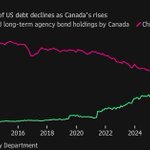
Canada quietly amassed nearly $600B of US Treasuries and housing-agency bonds, more than quadrupling its holdings in five years.
The mysterious surge is fueling speculation that China is shifting its portfolio around the world.
$UST #Treasuries #Debt #China


U.S. Treasuries have delivered their worst 10-year returns in roughly a century.
High-quality tech bonds have also sold-off, with the referenced U.S. investment-grade tech-bond index falling 9% over the past year while its yield rose from 4.5% to 6.2%.
Long-term bonds from major AI infrastructure companies now offer relatively high yields, including Oracle at 8.4%, Meta at 7.5%, and Google at 6.9%.
Meanwhile, many large investors remain heavily invested in U.S. tech stocks and underweight bonds, expecting Treasury yields to keep rising.
However, if the economy slows sharply or a credit problem emerges, Treasury yields could fall by 1–2 percentage points (flight to safety), according to BofA.
In the past, negative long-run returns were great entry points for stocks in 1939, 1974, 2009, and for commodities in 1933, 2018.
Time to start adding some bonds?

Canada quietly amassed nearly $600B of US Treasuries and housing-agency bonds, more than quadrupling its holdings in five years.
The mysterious surge is fueling speculation that China is shifting its portfolio around the world.
$UST #Treasuries #Debt #China
U.S. Treasuries have delivered their worst 10-year returns in roughly a century.
High-quality tech bonds have also sold-off, with the referenced U.S. investment-grade tech-bond index falling 9% over the past year while its yield rose from 4.5% to 6.2%.
Long-term bonds from major AI infrastructure companies now offer relatively high yields, including Oracle at 8.4%, Meta at 7.5%, and Google at 6.9%.
Meanwhile, many large investors remain heavily invested in U.S. tech stocks and underweight bonds, expecting Treasury yields to keep rising.
However, if the economy slows sharply or a credit problem emerges, Treasury yields could fall by 1–2 percentage points (flight to safety), according to BofA.
In the past, negative long-run returns were great entry points for stocks in 1939, 1974, 2009, and for commodities in 1933, 2018.
Time to start adding some bonds?
Austral Research retweeted
BofA: 10-year U.S. Treasury yields may need to approach 6% before investors meaningfully rotate out of stocks and into bonds.
The BofA's FMS found 76% of respondents expect the Fed to leave rates unchanged in October, while inflation expectations have fallen to the lowest since Jan'25.
Equity sentiment remains resilient overall, but a disorderly rise in bond yields and the potential for an AI bubble are now viewed as the biggest risks facing markets.
#Fed #Treasuries $UST

U.S. Treasuries have delivered their worst 10-year returns in roughly a century.
High-quality tech bonds have also sold-off, with the referenced U.S. investment-grade tech-bond index falling 9% over the past year while its yield rose from 4.5% to 6.2%.
Long-term bonds from major AI infrastructure companies now offer relatively high yields, including Oracle at 8.4%, Meta at 7.5%, and Google at 6.9%.
Meanwhile, many large investors remain heavily invested in U.S. tech stocks and underweight bonds, expecting Treasury yields to keep rising.
However, if the economy slows sharply or a credit problem emerges, Treasury yields could fall by 1–2 percentage points (flight to safety), according to BofA.
In the past, negative long-run returns were great entry points for stocks in 1939, 1974, 2009, and for commodities in 1933, 2018.
Time to start adding some bonds?
Austral Research retweeted
Of the $1.6T in 2027 AI capex, ~$1.0T flows through to S&P 500 revenue, and nearly $700B goes to $NVDA (almost 2/3 of the total that lands in the index).
That single driver explains ~5% of total $SPX sales next year and roughly 25% of the index’s sales growth.
#AI #Hyperscaler $SPX $NVDA

AI’s funding equation is starting to crack.
Hyperscaler's FCF is expected to turn negative in 2026 and getting worse next year, as AI capex heads past $1T. Meanwhile, semis prices hit 20-year highs and credit conditions tighten—most visibly in Oracle’s surging CDS.
Oracle’s 5Y CDS has gone from ~50bp to ~280bp in a year, and IG tech spreads are widening with it.
The AI buildout was supposed to be self-funding. It isn’t anymore.
Who will be the first on the hook?
$ORCL $MSFT $GOOGL $AMZN $META

Austral Research retweeted
US 10-year real yields at 3%, highest since GFC.
What could go wrong?

Higher interest rates have so far failed to slow the AI data-center buildout.
Despite 10Y yields rising about 125bps over the past year, consensus 2027 capex forecasts have moved higher, reflecting expectations that AI investments can generate returns above 10%, well above the roughly 4% Fed funds rate.
This weakens monetary-policy transmission and keeps upward pressure on yields until either policy rates exceed expected AI returns or those returns fall.
Lower oil prices after a Middle East deal could provide temporary relief, but fiscal deficits, heavy Treasury issuance and term-premium pressure still argue for higher for longer.
#DataCenter #AI #Hyperscalers #Bonds

BofA: 10-year U.S. Treasury yields may need to approach 6% before investors meaningfully rotate out of stocks and into bonds.
The BofA's FMS found 76% of respondents expect the Fed to leave rates unchanged in October, while inflation expectations have fallen to the lowest since Jan'25.
Equity sentiment remains resilient overall, but a disorderly rise in bond yields and the potential for an AI bubble are now viewed as the biggest risks facing markets.
#Fed #Treasuries $UST
U.S. Treasuries have delivered their worst 10-year returns in roughly a century.
High-quality tech bonds have also sold-off, with the referenced U.S. investment-grade tech-bond index falling 9% over the past year while its yield rose from 4.5% to 6.2%.
Long-term bonds from major AI infrastructure companies now offer relatively high yields, including Oracle at 8.4%, Meta at 7.5%, and Google at 6.9%.
Meanwhile, many large investors remain heavily invested in U.S. tech stocks and underweight bonds, expecting Treasury yields to keep rising.
However, if the economy slows sharply or a credit problem emerges, Treasury yields could fall by 1–2 percentage points (flight to safety), according to BofA.
In the past, negative long-run returns were great entry points for stocks in 1939, 1974, 2009, and for commodities in 1933, 2018.
Time to start adding some bonds?
Of the $1.6T in 2027 AI capex, ~$1.0T flows through to S&P 500 revenue, and nearly $700B goes to $NVDA (almost 2/3 of the total that lands in the index).
That single driver explains ~5% of total $SPX sales next year and roughly 25% of the index’s sales growth.
#AI #Hyperscaler $SPX $NVDA
AI’s funding equation is starting to crack.
Hyperscaler's FCF is expected to turn negative in 2026 and getting worse next year, as AI capex heads past $1T. Meanwhile, semis prices hit 20-year highs and credit conditions tighten—most visibly in Oracle’s surging CDS.
Oracle’s 5Y CDS has gone from ~50bp to ~280bp in a year, and IG tech spreads are widening with it.
The AI buildout was supposed to be self-funding. It isn’t anymore.
Who will be the first on the hook?
$ORCL $MSFT $GOOGL $AMZN $META
US 10-year real yields at 3%, highest since GFC.
What could go wrong?
Higher interest rates have so far failed to slow the AI data-center buildout.
Despite 10Y yields rising about 125bps over the past year, consensus 2027 capex forecasts have moved higher, reflecting expectations that AI investments can generate returns above 10%, well above the roughly 4% Fed funds rate.
This weakens monetary-policy transmission and keeps upward pressure on yields until either policy rates exceed expected AI returns or those returns fall.
Lower oil prices after a Middle East deal could provide temporary relief, but fiscal deficits, heavy Treasury issuance and term-premium pressure still argue for higher for longer.
#DataCenter #AI #Hyperscalers #Bonds
Austral Research retweeted
Citadel Securities: Scott Rubner reports retail traders returned to artificial intelligence bets, net purchasing $9.1B of US equities on the platform last week.
In the largest net buying week in 15, individuals acquired $2.6B of semiconductors, setting the third-best week of the past year, and $2.4B of AI infrastructure stocks.
Driven by directional conviction instead of volume, retail investors bought 2.7% more than they sold.
Following a cooldown in September, Rubner recommends October as a reload window for investors as corporate buybacks and earnings return, helping lift the Nasdaq 100 and S&P 500 to records.
The retail is all-in, while institutionals are on its way out.
$SPX $SPY $QQQ $SOXX

Hedge funds have aggressively reduced their AI exposure.
Net allocation to global AI stocks has fallen to 26.1%, down from 31.7% at the June peak, and now sits at the 49th percentile over the past year.
Meanwhile, the aggregate long/short ratio has dropped from 4.34 to 3.27, placing it in just the 7th percentile over the past year.
The AI trade remains a significant allocation, but positioning has been substantially cleaned up.
$NVDA $MU $AVGO $TSM $ORCL $CRWV

Austral Research retweeted
AI’s funding equation is starting to crack.
Hyperscaler's FCF is expected to turn negative in 2026 and getting worse next year, as AI capex heads past $1T. Meanwhile, semis prices hit 20-year highs and credit conditions tighten—most visibly in Oracle’s surging CDS.
Oracle’s 5Y CDS has gone from ~50bp to ~280bp in a year, and IG tech spreads are widening with it.
The AI buildout was supposed to be self-funding. It isn’t anymore.
Who will be the first on the hook?
$ORCL $MSFT $GOOGL $AMZN $META
Jefferies: The AI cash-flow squeeze.
The AI spending boom is starting to leave a serious mark on cash flow.
Jefferies notes that aggregate free cash flow across the four major hyperscalers collapsed from $60B in Q4 2025 to just $7B in Q2 2026.
Consensus expects it to turn negative at $13B in Q3, while quarterly capex is projected to hit $200B.
The spending is real. The cash generation is increasingly under pressure.
The next question is how much longer investors will tolerate the divergence.
$AMZN $META $GOOG $MSFT #DataCenter #AI #Hyperscalers

Austral Research retweeted
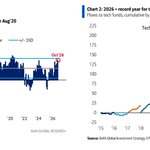
Investors are the most overweight on tech since Aug'20, with cumulative tech fund flows hitting a new record of nearly $200B year-to-date.


AI’s funding equation is starting to crack.
Hyperscaler's FCF is expected to turn negative in 2026 and getting worse next year, as AI capex heads past $1T. Meanwhile, semis prices hit 20-year highs and credit conditions tighten—most visibly in Oracle’s surging CDS.
Oracle’s 5Y CDS has gone from ~50bp to ~280bp in a year, and IG tech spreads are widening with it.
The AI buildout was supposed to be self-funding. It isn’t anymore.
Who will be the first on the hook?
$ORCL $MSFT $GOOGL $AMZN $META
Jefferies: The AI cash-flow squeeze.
The AI spending boom is starting to leave a serious mark on cash flow.
Jefferies notes that aggregate free cash flow across the four major hyperscalers collapsed from $60B in Q4 2025 to just $7B in Q2 2026.
Consensus expects it to turn negative at $13B in Q3, while quarterly capex is projected to hit $200B.
The spending is real. The cash generation is increasingly under pressure.
The next question is how much longer investors will tolerate the divergence.
$AMZN $META $GOOG $MSFT #DataCenter #AI #Hyperscalers
Investors are the most overweight on tech since Aug'20, with cumulative tech fund flows hitting a new record of nearly $200B year-to-date.
Austral Research retweeted
Credit markets are flashing WARNING SIGNS across the AI trade.
Oracle, 5-year credit default swap (CDS) spread has surged to ~263 basis points, while SpaceX's has risen to ~203 basis points, both at record highs. At the same time, CoreWeave's, 5-year CDS is up to a record 982 basis points.
This comes as tech companies have issued nearly $500 billion in new debt this year to finance AI infrastructure, with 9 US investment-grade bond deals worth at least $25 billion each.
The growing debt burden is colliding with uncertainty over whether AI revenues will justify the enormous spending.
As a result, investors are increasingly demanding higher compensation to take on credit risk.
Oracle's market-implied 5-year default risk has risen above 20%, compared with around 16% for SpaceX and more than 7% for Nvidia.
The pressure could intensify further, with Goldman Sachs projecting hyperscaler debt issuance to jump from $250 billion in 2026 to a massive $420 billion in 2027, as 35% of next year's capital spending is expected to be debt-funded.
The AI boom is now testing credit markets, as investors begin repricing the risks behind Big Tech's unprecedented borrowing spree.
$ORCL $SPCX $CRWV $NVDA

Oracle's $ORCL force majeure on Project Jupiter is a wake up call that energy infrastructure is now the binding constraint in the AI-data center supply chain.
The issue also puts pressure on the company’s debt structure, which was raised to finance its AI spending.
The $165 billion project sits within the $500 billion Stargate agreement, involving $ORCL, OpenAI, SoftBank, and others, and has systemic relevance for the broader AI ecosystem.
The project is expected to require 2.45 GW of capacity, an estimated power demand that could supply roughly 1.8 million households, making a dedicated gas microgrid supplied by Bloom Energy $BE critical to the facility's operations.
By issuing a formal force majeure notice to the facility's developer (Stack Infrastructure, backed by Blue Owl $OWL) $ORCL is seeking to defer payments on its debt obligations if the project does not come online as planned in 2028.
This comes as the company’s CDS spreads have recently surged to highs, trading well above those of other hyperscalers such as $NVDA and $MSFT.
This is only the tip of the iceberg, as the AI market rests on trillions of dollars in hidden debt and off-balance-sheet commitments.
#AI #Hyperscalers

Austral Research retweeted
Saudi Arabia plan to expand oil export capacity on its East-West pipeline, which runs to the Red Sea and avoids the Strait of Hormuz.
In the next 7–8 weeks, Aramco expects to temporarily add about 1.2 Mb/d by converting an existing natural gas line to carry crude (likely the old IPSA pipeline seized in 1990). The line must switch back to gas by May for summer power generation.
Longer term, Riyadh aim to raise the pipeline’s capacity from a current ~6–7 Mb/d toward 10 Mb/d within 2–3 years, mainly by upgrading pumping stations rather than building new pipe.
#oott #Hormuz #Oil

Abu Dhabi’s crown prince plans to put tens of billions into Fujairah ports and a second pipeline to roughly double UAE crude that never touches the strait of Ormuz.
Other producers are expanding the same idea.
Saudi Arabia’s East–West (Petroline) line to Yanbu on the Red Sea has nameplate capacity around 5–7 million b/d, but sustainable loading at Yanbu has been closer to 4–5 million b/d.
Saudi Aramco has talked about lifting Yanbu export capacity toward 5 million b/d and has discussed another 1–2 million b/d of pipeline capacity.
On top of that, Iraq has started work on the Basra–Haditha line (design capacity cited around 2.5 million b/d) and is looking at Mediterranean outlets via Syria or Turkey.
The build out doesn't remove the chokepoint, but it reduces its leverage significantly.
Goldman now estimates that enough pipeline capacity will be added in the region to insulate over 45% of pre-war Persian Gulf exports by end-2027 and more than 60% by end-2028 from any future Hormuz shock.
#oott #iran


Citadel Securities: Scott Rubner reports retail traders returned to artificial intelligence bets, net purchasing $9.1B of US equities on the platform last week.
In the largest net buying week in 15, individuals acquired $2.6B of semiconductors, setting the third-best week of the past year, and $2.4B of AI infrastructure stocks.
Driven by directional conviction instead of volume, retail investors bought 2.7% more than they sold.
Following a cooldown in September, Rubner recommends October as a reload window for investors as corporate buybacks and earnings return, helping lift the Nasdaq 100 and S&P 500 to records.
The retail is all-in, while institutionals are on its way out.
$SPX $SPY $QQQ $SOXX
Hedge funds have aggressively reduced their AI exposure.
Net allocation to global AI stocks has fallen to 26.1%, down from 31.7% at the June peak, and now sits at the 49th percentile over the past year.
Meanwhile, the aggregate long/short ratio has dropped from 4.34 to 3.27, placing it in just the 7th percentile over the past year.
The AI trade remains a significant allocation, but positioning has been substantially cleaned up.
$NVDA $MU $AVGO $TSM $ORCL $CRWV
Credit markets are flashing WARNING SIGNS across the AI trade.
Oracle, 5-year credit default swap (CDS) spread has surged to ~263 basis points, while SpaceX's has risen to ~203 basis points, both at record highs. At the same time, CoreWeave's, 5-year CDS is up to a record 982 basis points.
This comes as tech companies have issued nearly $500 billion in new debt this year to finance AI infrastructure, with 9 US investment-grade bond deals worth at least $25 billion each.
The growing debt burden is colliding with uncertainty over whether AI revenues will justify the enormous spending.
As a result, investors are increasingly demanding higher compensation to take on credit risk.
Oracle's market-implied 5-year default risk has risen above 20%, compared with around 16% for SpaceX and more than 7% for Nvidia.
The pressure could intensify further, with Goldman Sachs projecting hyperscaler debt issuance to jump from $250 billion in 2026 to a massive $420 billion in 2027, as 35% of next year's capital spending is expected to be debt-funded.
The AI boom is now testing credit markets, as investors begin repricing the risks behind Big Tech's unprecedented borrowing spree.
$ORCL $SPCX $CRWV $NVDA
Oracle's $ORCL force majeure on Project Jupiter is a wake up call that energy infrastructure is now the binding constraint in the AI-data center supply chain.
The issue also puts pressure on the company’s debt structure, which was raised to finance its AI spending.
The $165 billion project sits within the $500 billion Stargate agreement, involving $ORCL, OpenAI, SoftBank, and others, and has systemic relevance for the broader AI ecosystem.
The project is expected to require 2.45 GW of capacity, an estimated power demand that could supply roughly 1.8 million households, making a dedicated gas microgrid supplied by Bloom Energy $BE critical to the facility's operations.
By issuing a formal force majeure notice to the facility's developer (Stack Infrastructure, backed by Blue Owl $OWL) $ORCL is seeking to defer payments on its debt obligations if the project does not come online as planned in 2028.
This comes as the company’s CDS spreads have recently surged to highs, trading well above those of other hyperscalers such as $NVDA and $MSFT.
This is only the tip of the iceberg, as the AI market rests on trillions of dollars in hidden debt and off-balance-sheet commitments.
#AI #Hyperscalers
Saudi Arabia plan to expand oil export capacity on its East-West pipeline, which runs to the Red Sea and avoids the Strait of Hormuz.
In the next 7–8 weeks, Aramco expects to temporarily add about 1.2 Mb/d by converting an existing natural gas line to carry crude (likely the old IPSA pipeline seized in 1990). The line must switch back to gas by May for summer power generation.
Longer term, Riyadh aim to raise the pipeline’s capacity from a current ~6–7 Mb/d toward 10 Mb/d within 2–3 years, mainly by upgrading pumping stations rather than building new pipe.
#oott #Hormuz #Oil
Abu Dhabi’s crown prince plans to put tens of billions into Fujairah ports and a second pipeline to roughly double UAE crude that never touches the strait of Ormuz.
Other producers are expanding the same idea.
Saudi Arabia’s East–West (Petroline) line to Yanbu on the Red Sea has nameplate capacity around 5–7 million b/d, but sustainable loading at Yanbu has been closer to 4–5 million b/d.
Saudi Aramco has talked about lifting Yanbu export capacity toward 5 million b/d and has discussed another 1–2 million b/d of pipeline capacity.
On top of that, Iraq has started work on the Basra–Haditha line (design capacity cited around 2.5 million b/d) and is looking at Mediterranean outlets via Syria or Turkey.
The build out doesn't remove the chokepoint, but it reduces its leverage significantly.
Goldman now estimates that enough pipeline capacity will be added in the region to insulate over 45% of pre-war Persian Gulf exports by end-2027 and more than 60% by end-2028 from any future Hormuz shock.
#oott #iran

Austral Research retweeted
Higher interest rates have so far failed to slow the AI data-center buildout.
Despite 10Y yields rising about 125bps over the past year, consensus 2027 capex forecasts have moved higher, reflecting expectations that AI investments can generate returns above 10%, well above the roughly 4% Fed funds rate.
This weakens monetary-policy transmission and keeps upward pressure on yields until either policy rates exceed expected AI returns or those returns fall.
Lower oil prices after a Middle East deal could provide temporary relief, but fiscal deficits, heavy Treasury issuance and term-premium pressure still argue for higher for longer.
#DataCenter #AI #Hyperscalers #Bonds
Equity capital will continue to play a supporting role in funding the AI investment boom in 2027.
Hyperscalers and other AI infrastructure companies accounted for roughly $65 billion in follow-on issuance (post-IPO equity offerings) this year, around 45% of the US total.
In 2027, hyperscalers are expected to spend $1.2 trillion on capex and generate $1.1 trillion in operating cash flow. Debt is expected to fund about 35% of capex, implying over $400 billion in debt issuance, according to Goldman Sachs.
#AI #Hyperscalers $GOOG $AMZN $MSFT $ORCL $META
