

AA is the flagship journal of the Australian Archaeological Association Inc published since 1974. Follow us for authoritative research in Australian archaeology
- Tweets336
- Following90
- Followers856
- Likes13






ALT Book review slide by Veronica Strang, featuring the cover of Sentient Seas: Archaeologies of Seascapes and Maritime Rituals by Ian J. McNiven. The book cover has a blue ocean background and an illustration of a mythical sea creature. On the right, large white text reads “Book Review by Veronica Strang” against a muted blue-grey background.

ALT Book review slide by Simon Cox, featuring the cover of West New Guinea: Social, Biological, and Material Histories, edited by Dylan Gaffney and Martin Tolla. The book cover shows ceramic pots and cups arranged against a backdrop of a lake, green hills, and a cloudy blue sky. The slide has a dark green background with large white text reading “Book Review by Simon Cox” on the left.


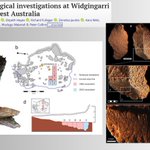
ALT Composite figure showing recent archaeological investigations at Widgingarri Shelter 1, northwest Australia. The figure includes photographs and excavation plans of the rock shelter and excavation area, a stratigraphic section showing the 1985 and 2022 excavation areas, and detailed photographs and microscopy of stone artefacts.


ALT Promotional graphic for an Australian Archaeology article titled “Terre pour leurs jardins (Earth for their gardens): What do Polynesians actually want from Polynesian archaeology?” The photograph shows an archaeological excavation at the École de Maputeoa in Rikitea, Mangareva, with a historic stone building and a group of young people gathered at the excavation site. Photo by James Flexner.

ALT Promotional graphic for an Australian Archaeology article titled “Paintings of Rainbow Serpents and other big creatures of Awunbarna, Northern Territory, Australia.” The central photograph shows a large red-and-white Rainbow Serpent rock painting on a rock surface, with a measurement line following the curve of its body and indicating a length of 6.88 metres. The figure caption identifies it as the largest Awunbarna Rainbow Serpent. Photo by Andrea Jalandoni.

ALT Figure from an Australian Archaeology article showing examples of Australian personal adornment incorporating macropod incisors, including circles, headbands, necklaces, forehead pendants and sidelock pendants. The figure accompanies the article “An assemblage of resin-mounted macropod incisors from Quinkan Country, Cape York Peninsula, Queensland.”

ALT Promotional graphic for an Australian Archaeology article titled “The mechanics and kinematics of freehand and anvil-supported flake retouching,” by Yinika L. Perston, Mark W. Moore and Lorna Bogdanek. The image shows multiple views of a stone tula adze from the Scarsdale 1 cache in Queensland, with coloured dots and markings indicating points of force application and retouching. The caption notes the adze measures 56.9 mm long and was retouched using an anvil technique.

ALT Figure from an Australian Archaeology article showing examples of traditional tula typologies and tula slugs from Marra Country, Northern Territory. Twelve stone artefacts are arranged in four groups labelled (a) to (d), showing different shapes, colours and forms. The caption identifies examples from Yilbilinji and Wanjini sites and notes that the photographs were taken by Christina Skujins. The article title, “Rethinking boundaries: Tulas on Marra Country and the northern reach of a Holocene innovation”, and the authors’ names appear above the figure.

ALT Cover graphic for Australian Archaeology, Volume 92, Number 2, August 2026, featuring a Special Festschrift for archaeologist Tim Maloney. The graphic includes a photo of Tim Maloney standing in an archaeological excavation, alongside a list of articles and an obituary dedicated to him.


ALT Image of bright blue rock paintings at Awunbarna (Mt Borradaile) in western Arnhem Land, Northern Territory, showing striking blue figures painted on a sandstone rock shelter wall among more traditional rock art colours.

ALT A promotional graphic for a recent journal article. On the left is the article title, *Counting on kin and Country, not just calories: Beyond subsistence thinking in GunaiKurnai zooarchaeology, southeastern Australia*, with the list of authors beneath. On the right are eight black-and-white illustrations of traditional *waribruk* markings on possum skins, arranged in a grid. A caption below the illustrations reads: "Illustrations of *waribruk* markings on possum skins, from Howitt (1904:742)."

ALT Bar chart showing Indigenous authorship in Australian Archaeology from 2015–2025, with a marked increase over the past decade and a peak of around 90% in 2023.

ALT This figure traces the chronological development of Art Panel A at Snake Rock, showing how superposition analysis identified multiple phases of image production. The earliest interpreted images appear in Phase 2, while the most recent belong to Phase 3b, revealing a long and dynamic history of artistic activity at this important Wiradjuri site.


ALT Alt text: Diagram showing the excavated skeletal remains of “Garli,” a millennium-old dingo burial from Kinchega National Park on Barkindji Country in western New South Wales. The figure maps recovered bones by body position and indicates whether elements were complete, partial, or fragmentary.