

Building Franklin — autonomous payloads for pharmaceutical research in microgravity. Data-first. Higher frequency. Off-world research for on-world benefits.
Florida, USA
Joined June 2026
- Tweets126
- Following163
- Followers34
- Likes607




```
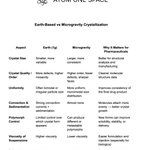
On Earth, convection and sedimentation tug at a growing protein crystal. In microgravity those forces largely drop away, so nucleation and growth leave a cleaner process record. That’s the physics Franklin-1 is built around.
Hopefully the weather clears up!

Roman is ready for liftoff tomorrow at 7:26 a.m. EDT!
The SpaceX Falcon Heavy rocket carrying NASA's Nancy Grace Roman Space Telescope stands vertical at Launch Complex 39A at Kennedy Space Center in Florida.

ALT NASA’s Nancy Grace Roman Space Telescope, encapsulated in a protective payload fairing atop a SpaceX Falcon Heavy rocket, is seen at sunrise, Saturday, Aug. 29, 2026, at Launch Complex 39A at NASA’s Kennedy Space Center in Florida. Photo Credit (NASA/Joel Kowsky)
Tomorrow morning I’m taking my daughter to the Cape to watch @NASARoman Nancy Grace Roman Space Telescope go up on a @SpaceX Falcon Heavy.
It is named for Dr. Nancy Grace Roman, NASA’s first chief of astronomy, the person who helped make Hubble possible.
Now a telescope with her name on it leaves the same pad family that sent people to the Moon.
Roman’s job is not one pretty picture. It is a survey. Hubble-class resolution, field of view about 100 times larger, a 300-megapixel infrared camera.
It will map how matter is arranged across cosmic time, measure how fast the universe is accelerating, and hunt for planets, including small ones and worlds that drift with no star at all. A coronagraph on board is a dress rehearsal for photographing other Earths.
What we get back is not a souvenir. It is a public map: galaxies by the billion, supernovae, black holes, a census of other solar systems.
First images are expected after it reaches L2 and checks out, targeted for early 2027. Scientists will be using that archive for decades.
I want her to remember that this is what her generation inherits, not a finished universe, a better instrument for asking the next question. The kids after her will treat Roman’s sky the way we treat Hubble’s. That’s the handoff.
Go Falcon Heavy. Go Roman!

Franklin 1 is how we get pharmaceutical process data from microgravity faster, so the benefits show up on Earth.
Sealed crystallization and formulation runs. Science packets down.
Off-World Research for On-World Benefits.
atomonespace.com

Following #SmallSat2026 remotely today. Research & Academia, Grand Ballroom.
Atom One’s Franklin 1 is a CubeSat path for protein crystallization and process work in microgravity. We complement sample-return programs; we don’t replace them.
Queued on the onboard-AI and edge-compute talks. Stream: smallsat.org
#smallsat26
Franklin gives you dedicated LEO research capacity at commercial smallsat economics. You define the data product and cadence; we fly the experiment and deliver prioritized science packets — no recovery required. Contact us today to schedule your first research mission.
What was once science fiction is becoming reality, faster than most people think.
Over the next five years the cadence is clear:
• 2026–27 — Crewed missions return beyond LEO. Commercial stations begin arriving. Robotic lunar landers multiply.
• 2027–28 — First commercial stations open. Human landing systems are tested. Boots return to the Moon, then land again the same year. Early lunar outpost elements arrive.
• 2028–30 — Multiple stations operate in Earth orbit. Lunar surface infrastructure expands. What used to be “missions” starts looking like the start of presence.
At the same time we expand the environments we can study:
LEO for clean microgravity. Lunar orbit for higher radiation and isolation. Eventually Mars orbit for the data long-duration life will actually require.
This is how explorers become a planetary-faring species. The next five years won’t finish the journey, they will make it irreversible.
Franklin payload integrated into a 12U CubeSat.
One unit shown here. The real objective is scale:
4–8 payloads on a single bus → a dedicated pharmaceutical research satellite.
Higher cadence.
Parallel experiments.
Real industrial access to microgravity — without waiting years for limited ISS slots.
This is the direction.
Off-world research for on-world benefits.

The ISS is valuable. It is also a bottleneck.
Higher cadence, smaller, autonomous research platforms are how more companies actually get access to microgravity data instead of waiting years for a slot.
Every major pharmaceutical company already spends heavily on R&D. The question is whether a fraction of that effort should also happen off-world, where the physics is different.
That’s the case we’re making.
#AtomOneSpace #Franklin #pharma #SpaceForHealth
I often get asked, "why should we be researching pharmaceuticals in space?" My response, "why are we not doing more of it?" I have written this out to make it simple to understand. This is where the R&D focus needs to be. No excuses! We deserve better medicines. @Merck @KEYTRUDA


We’re not trying to invent a new branch of medicine. We’re trying to give existing research a cleaner set of conditions to work under.
Higher quality data starts with removing variables we never get to control on Earth.
#AtomOneSpace #Franklin #pharma #OffWorldResearch
Regenerative medicine and protein work both improve when convection and sedimentation are removed from the equation.
That’s not speculation. It’s why the environment itself matters as much as the compound.
#AtomOneSpace #Franklin #RegenerativeMedicine #microgravity
Most of what we know about how drugs and cells behave comes from a single gravitational environment.
Testing the same compounds and processes in true microgravity isn’t a luxury. It’s missing data.
#AtomOneSpace #Franklin #microgravity #SpaceResearch
Very exciting . Cannot wait to see what you uncover!

Omg it's happening! Everybody stay calm! We're officially in our countdown to launch!
Roman is set to launch August 30 at 07:26 am EDT from @NASAKennedy.
Stay up to date on the latest launch details: science.nasa.gov/mission/rom…
The bottleneck in space-based pharmaceutical research isn’t the science. It’s how rarely we get to run the experiments.
Franklin is built to increase the cadence, more flights, more data, less waiting.
#AtomOneSpace #Franklin #microgravity #pharma
The value isn’t the orbit. The value is the data that only becomes visible once you leave Earth’s conditions behind.
#Microgravity #LowerEarthOrbit #AtomOneSpace
Cleaner fluid behavior. Different crystal growth. Altered cellular responses.
That’s what microgravity offers.
#microgravity #AtomOneSpace #Pharmaresearch