

Live 1:1 Math & Science tutoring | Grades 1–10, SAT & AP | Same tutor every session | Students in 8 countries | Built by educators, powered by human connection.
Joined August 2026
- Tweets148
- Following0
- Followers10
- Likes30







My experience with StartupStation (startupstation.in/) has raised serious concerns about compliance guidance, delayed responses, and exit charges.
I purchased their ₹8,000 plan, with quarterly payments of ₹2,000. I subsequently discovered an INC-20A compliance issue that I believe should have been explained to me earlier.
I also experienced delays in receiving guidance on PF and TDS. Now, after requesting an exit and auditor-related handover, I have been told to pay another ₹2,000 + government fees before receiving the requested documents.
I am willing to pay legitimate government fees. I am asking for a transparent breakdown of professional charges, clarification of outstanding obligations, and a proper handover.
I am escalating this through the National Consumer Helpline and the appropriate authorities.
StartupStation (startupstation.in/), please provide a written response and resolve this matter transparently.
@nch1915 @jagograhakjago
#ConsumerRights #StartupIndia #ConsumerComplaint

StartupStation (startupstation.in/) does not appear to have a verified X account, so this complaint identifies the business by its official website.
Asymptode Private Limited paid ₹2,000 for compliance services and wants to terminate the engagement without additional professional fees.
We have requested clarification on the disputed charges, coordination of the auditor's resignation, and a complete handover.
We are seeking assistance through the National Consumer Helpline.
@jagograhakjago
startupstation.in/
Yesterday's question: a price drops 20%, then rises 20%. Is it back where it started?
No. Take $100.
After the 20% cut: $80.
After the 20% rise: $80 + $16 = $96.
The second 20% is taken from a smaller number, so it adds back less than the cut removed.
Rule: the same % down and then up always leaves you below the start.
A new tutor can't know one thing in the first session: how this child makes mistakes.
Some rush the last step.
Some freeze when a question has words in it.
Some know the rule but lose it under time pressure.
A tutor who has worked with the child for weeks spots the pattern in a minute. A new tutor spends the hour finding it.
That is why every Asymptode student keeps the same tutor.
Your child keeps getting fraction questions wrong. Before more fraction worksheets, try three quick checks:
1. Which is bigger, 1/3 or 1/4? Many kids say 1/4, because 4 is bigger than 3.
2. Can they mark 3/4 on a line from 0 to 1?
3. Do they know 6 × 7 without counting?
If one of these is shaky, start there.
A shop cuts a price by 20%.
A week later, it raises the new price by 20%.
Is the price back where it started?
Answer before you calculate. Then check.
We'll post the answer tomorrow.
The students who learned most in Chi et al.'s 1989 physics study explained worked examples to themselves: why this step, which rule applies. Weaker learners mostly just read on. A good tutor asks the same thing: "why does that step work?" When did a "why" last unstick your kid?

Struggle is not always productive. Sweller & Cooper (1985) found novices in algebra learned more from studying worked examples than from solving the same problems cold. Good tutors fade support as skill grows. How do you decide when to let a kid struggle vs. show a step?


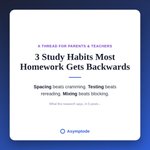
3 study habits cognitive science keeps confirming, and most homework routines still get them backwards. A thread for K-12 parents and teachers. (1/5)

3) Mixing beats blocking. Rohrer & Taylor (2007) found that shuffling math problem types during practice led to better test performance a week later than doing one type at a time. Blocked practice feels smoother but teaches less. (4/5)


