Space and Astronomy News. Subscribe to the daily podcast wherever you get your podcasts and the Newsletter via our website. Stay in the know!

Worldwide
Joined March 2009
Astronomy Daily retweeted
Allusionistics Sunspot Report September 18, 2026. “Is This The Solar Calm Before The Solar Storm?” Cycle 25 is now on the declining limb. The photosphere has gone quiet. • Numbered sunspot regions on the visible disk: 0. • Solar activity: very low for the preceding 24 hours. • Isolated low-level B-class flaring only from unnumbered plage. • Forecast 19–21 Sep: remains very low, slight chance of an isolated C-class flare. • 10.7 cm radio flux (Penticton): 096 observed today; predicted 095/095/095. • 90 day mean flux: 126. • Geomagnetic field: quiet. Peak solar wind ~490 km/s; IMF total 5 nT; Bz min −3 nT.
🤖 Made with AI
1
2
1
5
454
Astronomy Daily retweeted
The reusable Haolong-1 space cargo shuttle
28
155
27
1,055
221,110
Astronomy Daily retweeted
SpaceX
@SpaceXSep 17
Now targeting to launch Starship Flight 14 as early as Monday, September 28, pending regulatory approval
SpaceX
@SpaceXSep 15
Starship is preparing to go to orbit. Flight 14 is targeting to launch as early as Tuesday, September 22, pending regulatory approval → spacex.com/launches/starship…
634
1,712
363
13,499
2,106,546
Astronomy Daily retweeted
Mike Constantine
@MoonpansSep 18
Apollo 16 'Grand Prix' Rover Test on the Moon HD 60FPS Stabilised Full video on the Moonpans Youtube channel During the Apollo 16 mission in April 1972 the crew were tasked with putting the Lunar Roving Vehicle through a series of tests to asses its capabilities. Commander John Young drove the electrically powered rover through a series of maneuvers—including S-turns, hairpin turns, hard stops, and acceleration to "high" speeds of roughly 6–11 mph (10–18 km/h)—while Charles Duke (lunar module pilot) filmed it with a 16 mm camera from a safe distance. This video has been upscaled in quality, interpolated to 60FPS, Stabilised and synced with mission audio by Moonpans Original Source Footage: Apollo Flight Journal
12
47
3
302
10,407
Astronomy Daily retweeted
🔭We've got some exciting updates from the @NASARoman team ⬇️ They have begun activating and testing several instruments on the telescope that will allow scientists to explore wide swaths of the cosmos in exquisite detail! Keep up with Roman at go.nasa.gov/4xxDy3T
20
142
4
915
31,454
Astronomy Daily retweeted
Southern Hemisphere Milky Way galaxy view from the @Space_Station cupola. This 3s exposure series captured two of my favorite cupola views, the particularly dense Milky Way galaxy as seen from the Southern Hemisphere, and the bright, colorful lights of squid fishing boats (here, the bright blue and green lights off the coast of China, Thailand and India). Look at what the light did now!
69
450
61
2,034
181,985
Astronomy Daily retweeted
Astronomers are beginning to do something that would have seemed almost impossible only a few years ago: extract information about the weather on worlds many light-years away. Using observations from the #JWST, an international team has developed a statistical method that can identify the main physical processes driving atmospheric changes on distant objects, potentially giving us a new way to study weather on giant exoplanets. The researchers tested the technique on SIMP J0136+09, or SIMP 0136, a brown dwarf located about 20 light-years from Earth. Brown dwarfs occupy the mass range between giant planets and stars, and SIMP 0136 has a highly dynamic atmosphere dominated by enormous cloud systems. Because it is isolated and can be observed directly, it provides an unusually clean laboratory for studying atmospheric physics that may also operate on giant exoplanets. The team analysed time-series spectroscopy obtained with JWST's NIRSpec and MIRI instruments. As SIMP 0136 rotates, different regions of its atmosphere move into and out of view, producing extremely small changes in brightness at different wavelengths. Instead of immediately trying to reproduce those changes with a detailed atmospheric model, the researchers used Principal Component Analysis, or PCA, a statistical technique that searches for the dominant patterns hidden within a complex dataset. The result was surprisingly simple. Most of the observed atmospheric variability could be explained by just two main components, which the researchers associate with changes in temperature and changes in the vertical structure of the clouds. Together they appear to produce three recurring atmospheric states, with hotter regions generally associated with thinner clouds and cooler regions with thicker clouds extending higher through the atmosphere. These patterns also remained identifiable over more than a dozen rotations of the brown dwarf. The detailed appearance of the atmosphere evolved, as weather systems naturally do, but the basic physical processes controlling that variability persisted. This suggests that the atmosphere is not changing completely at random. Beneath its apparent complexity there is an organised structure that can be extracted from the light we receive. That is what makes the method particularly useful. PCA can rapidly tell astronomers which types of variability dominate the observations before they move on to much more computationally expensive atmospheric modelling. It does not produce a literal meteorological map like a weather satellite orbiting Earth, but it can separate different atmospheric behaviours from an unresolved object that appears to our telescopes essentially as a single point of light. Applying this approach to other brown dwarfs and directly imaged giant exoplanets could help astronomers investigate cloud formation, atmospheric circulation, temperature differences and heat transport under conditions very different from those in our Solar System. It is another example of how JWST is pushing exoplanetary science beyond simply detecting atmospheres and identifying molecules. We are gradually reaching the point where we can begin studying how those distant atmospheres actually behave and change with time. 👉 share.google/sdCHPniKTCcs3iW… Image: Artist’s impression of the extrasolar world, SIMP 0136
8
23
3
189
4,011
Astronomy Daily retweeted
NASA releases newest image of 'Eye of God' nebula. Also known as Helix Nebula, it is located 700 light-years away from us. Constantly watching us.
243
1,651
155
7,196
148,318
Astronomy Daily retweeted
Sunspot Dispatch September 14 2026 Cycle 25 is on the declining limb. The disk is not empty. It is not a quiet metric. Six numbered regions still punch magnetic flux through the photosphere while the smoothed number slides toward the 70s. That flux is the laboratory. Treat it as such. • NOAA/SESC sunspot number: 77 • 10.7 cm radio flux: 114 sfu • Sunspot area: 420 millionths of the solar hemisphere • September monthly mean so far: ~80.3 • Last 30-day mean: ~80.5 • SIDC estimated international number (fewer stations): 66 on the 13th. Use the NOAA number for operational work. Largest remaining area is 4527. Most spots sit in 4530. 4521 has already rotated over the west limb. One old region (4515) is due to return 14–16 Sep. Flaring has been low. Largest recent event was an M1.0 on 5 September. Last X-class was 4 July (X1.3). Today’s 6-hour max is B-class. C-class remains likely; isolated low-level M is only a slight chance through the 16th. That is the current energy budget. Do not invent M- or X-class events that are not there.
🤖 Made with AI
1
1
124
Astronomy Daily retweeted
Elon Musk
@elonmuskSep 14
700 Falcon flights completed. Congrats to the SpaceX Falcon team!
SpaceX
@SpaceXSep 13
Falcon completes its 700th overall mission
1,406
2,977
200
29,155
3,971,302
Astronomy Daily retweeted
Elon Musk
@elonmuskSep 5
Over 600 autonomous rocket landings so far
Most people don’t realize how insanely autonomous Falcon 9 already is Once Falcon 9 lifts off, almost the entire mission is executed by the rocket itself And the crazy part is This autonomy does not depend on generative AI It comes from brutally refined flight software, physics, sensors, control theory and advanced optimization.....improved across hundreds of missions Falcon 9 autonomously handles: → Liftoff and ascent through closed-loop guidance → Stage separation at precisely calculated conditions → Engine ignition and shutdown sequences → Orbital insertion and payload deployment → Booster boostback, entry and landing burns → Real-time guidance corrections during descent → Landing on a floating droneship hundreds of kilometers offshore → Autonomous flight termination if mission safety rules are violated A 70-meter orbital rocket launches itself, separates itself, puts a payload into orbit.....then the first stage falls back through the atmosphere and lands itself on a floating platform hundreds of kilometers offshore Physics, software, and hardware engineered to absurd precision Falcon 9 is one of the greatest autonomous machines humanity has ever built And SpaceX made it look routine
2,210
4,241
293
31,720
3,826,930
Be part of the bigger picture! 🌌 With more than a million individual pixels per pointing of Roman’s Wide Field Imager, there’s a spot for everyone in Roman’s first images, set to be released in the next few months. Grab your certificate and pixel number now: go.nasa.gov/AdoptAPixel
141
404
133
2,443
346,858
Astronomy Daily retweeted
🟠 As is well known, the star closest to the Sun is Proxima Centauri—a component of the Alpha Centauri system also known as Alpha Centauri C—located approximately 4.2 light-years away. However, this will not always be the case. In about 10,000 years, due to stellar motion within the galaxy, Barnard's Star will become our nearest neighbor, situated at a distance of 3.8 light-years. And that is not all: in roughly 33,000 years, Ross 248 will become the closest star, approaching the Sun to within 3 light-years. Then, another 10,000 years later, the status of our nearest cosmic neighbor will revert to the Proxima Centauri system. All these stars are red dwarfs with masses approximately one-sixth that of the Sun. Consequently, this "rotation" of our nearest stellar neighbors is unlikely to cause any significant effects on Earth or within the Solar System at large. However, in about 1.3 million years, the orange dwarf Gliese 710 will approach Earth to within approximately 0.2 light-years—effectively entering the confines of the Solar System. Such a close encounter could perturb the orbits of small celestial bodies and, in particular, trigger an intense bombardment of the inner planets by asteroids and comets. 🪐
24
74
3
372
23,632
We’ve got our starglasses on! 🤩 Roman’s Coronagraph Instrument has activated. This system of masks, prisms, detectors, and self-flexing mirrors will block out the glare from distant stars and directly image the planets and disks in orbit around them. go.nasa.gov/4gDy8hu
46
388
23
2,589
67,478
Astronomy Daily retweeted
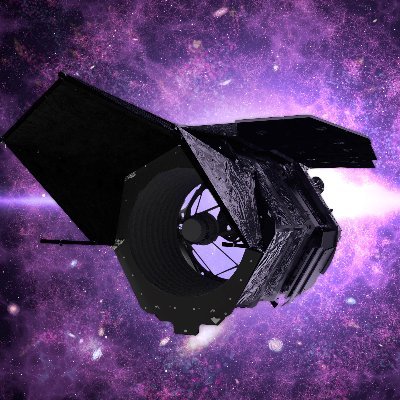
NASA’s Nancy Grace @NASARoman Space Telescope is now in space and beginning the journey to its operating location near the Sun–Earth L2 Lagrange point, roughly 1.5 million kilometres, or just under one million miles, from Earth. Roman launched on August 30, 2026, aboard a @SpaceX Falcon Heavy from Kennedy Space Center, and separated successfully from the rocket about half an hour later. It will spend roughly three months travelling toward L2 while engineers gradually deploy, activate, test and calibrate its systems and instruments. On August 31, the spacecraft completed its first planned mid-course correction, a short engine burn that refined its trajectory toward L2. L2 is one of five Lagrange points produced by the gravitational interaction between the Sun and Earth. They are often described as places where gravitational forces “balance,” although physically the situation is a little more subtle: in the rotating Sun–Earth system, the combined gravitational acceleration of the Sun and Earth allows a spacecraft near L2 to orbit the Sun with the same angular period as Earth despite being farther from the Sun. Roman will therefore not remain motionless at L2. Like the James Webb Space Telescope, it will follow a large halo orbit around the L2 region and will occasionally perform small station-keeping manoeuvres to prevent its orbit from drifting. L1, L2 and L3 are dynamically unstable, while L4 and L5 are stable. For an astronomical observatory, L2 is an extremely useful environment. The Sun, Earth and Moon remain roughly in the same general direction from the spacecraft, making it easier to keep them away from the telescope’s observing direction and to maintain a relatively stable thermal environment. At the same time, Roman remains close enough to Earth for high-rate communications and receives essentially continuous sunlight for electrical power. These advantages are among the reasons JWST also operates around Sun–Earth L2. Once Roman is commissioned, its main strength will be its combination of Hubble-class angular resolution with an enormously larger field of view. Its 300-megapixel Wide Field Instrument will survey large areas of the infrared sky rapidly rather than concentrating primarily on individual targets. Roman is expected to return around 1.4 terabytes of data per day, allowing astronomers to study the distribution and evolution of galaxies across cosmic time on an unprecedented statistical scale. Those surveys are designed to investigate some of cosmology’s central problems, particularly the nature of dark energy, the distribution of dark matter, and the growth of large-scale structure. Roman will also conduct extensive exoplanet studies, including gravitational microlensing surveys capable of detecting planets that are difficult to find with transit or radial-velocity methods. The observatory also carries a Coronagraph Instrument, primarily a technology demonstration, that will suppress starlight sufficiently to directly image and characterize some giant exoplanets. The technologies demonstrated by this instrument are particularly important because more advanced versions could eventually contribute to missions such as the proposed Habitable Worlds Observatory, whose long-term objective includes directly imaging potentially Earth-like planets around nearby stars. Roman’s coronagraph therefore has scientific value of its own, but it is also an important technological step toward much more demanding future observations. Roman’s journey to L2 is consequently not simply a transfer from Earth to a distant fixed point. It is the beginning of an extended commissioning process in which the observatory is being configured and calibrated while travelling toward a carefully controlled orbit around L2. NASA expects the transfer and commissioning phase to take roughly three months, with the first public images anticipated in early 2027. What I find most interesting about Roman is that its real scientific advantage is not simply obtaining sharper or deeper individual images. Hubble and JWST already perform exceptionally well in that regime. Roman changes the scale of the experiment: it combines high-quality space-based imaging with surveys containing enormous numbers of galaxies and stars. For cosmology in particular, that statistical power is what makes it such an important mission.
33
331
18
1,446
31,114
Astronomy Daily retweeted
You can track the new space telescope's current position in real time at: eyes.nasa.gov/apps/solar-sys…
48
740
50
4,245
199,144
Astronomy Daily retweeted
Elon Musk
@elonmuskAug 29
Starship Flight 14
SpaceX
@SpaceXAug 28
Full duration 33-engine static fire with the Super Heavy booster preparing for Flight 14
1,115
2,104
153
19,806
4,980,317
Astronomy Daily retweeted
You are looking at the first ever image of another multi-planet solar system.
174
434
21
4,849
153,850
Falcon Heavy’s looking sharp in the hangar before the real glow‑up begins with the launch of @NASARoman. Roman made its way to the hangar to meet its ride to space earlier this week.
SpaceX
@SpaceXAug 26
Falcon Heavy in the hangar at pad 39A in Florida ahead of Sunday’s launch of @NASA’s Nancy Grace Roman Space Telescope
33
311
21
2,097
90,029
.@NASARoman is GO for Launch! NASA and SpaceX mission teams polled “GO” during today's Launch Readiness Review. Liftoff of NASA's Nancy Grace Roman Space Telescope is targeted for 7:26 a.m. EDT Sunday Aug. 30 on a SpaceX Falcon Heavy from Kennedy! go.nasa.gov/3T2Wauu
42
352
32
2,041
246,147