


Assidikh retweeted

CT frens finally waking up to what I was saying HALF year ago😁


AIRDROPS ≠ DEAD
it turns out that decentralized blockchains actually NEED Airdrops to function
still, 99% of CT doesn't understand this basic thing
(shocker, right?)
let me break it to you in 3 minutes🕑
I've included some research papers that clearly show the PROS/CONS of the airdrop model
you can draw the conclusions for yourself📰
───────────
1/5 premise:
CORE principle of blockchain = decentralisation
decentralisation = tokens are held by many not by a few
centralisation = high potential for price manipulation (team dumped) + token can be classified as a SECURITY => tighter laws/regulations + no ETFs
if NOT for Aidrops and/or ICOs 👇
=> all the supply would end up being controlled by the team, early insiders, VCs (at least on PoS consensus networks)

Assidikh retweeted

i need the @conso_xyz AI bot, y'all should help me get to 5k views
Assidikh retweeted

web3 used to be a space where thousands of people were rewarded by projects for their contributions.
then kaito came along and changed the game.
projects realized they could enjoy free promotion and contributions from thousands of people while rewarding only a handful.
some people figured grinding discord might be a better alternative, but even that hasn’t worked out well. projects now shut down, leaving both discord and X contributors in limbo after months of effort.
at this point, i believe the only reason many of us are still here is the hope that something worthwhile might eventually come our way.
one huge win, one project, or even one piece of information could change the trajectory of your life forever.
that’s the hope that keeps many of us going, despite all the disappointments.
if you’re still here, showing up and putting in the work, i genuinely hope we all get our breakthrough sooner rather than later.
we’ve been through enough.


Assidikh retweeted

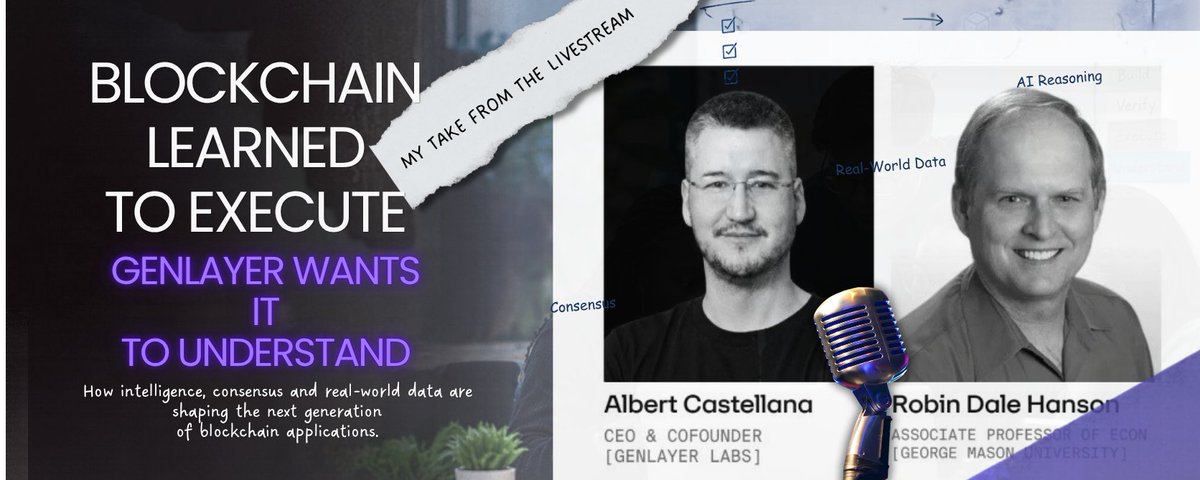
After listening to the livestream with @kstellana and Dale, I started thinking about blockchain, AI agents, and what the future of this economy might look like.
I shared my thoughts on why this matters and where GenLayer fits into the picture.
Enjoy.
Assidikh retweeted

If staking were only about earning rewards, choosing a validator would be pretty straightforward.
But would you still trust that validator with your GEN if you knew nothing about how they operate?
That’s something I think deserves more attention.
I’ve been exploring staking on @GenLayer and looking at what actually matters when choosing where to delegate.
I put together a short video explaining how staking works and the approach I’d personally consider.
Why validator choice deserves attention
GenLayer validators execute Intelligent Contracts and help the network reach consensus on their results.
Some of those decisions involve interpreting information that isn’t always straightforward.
Imagine a contract that needs to determine whether someone has fulfilled an agreement. The answer might require evaluating evidence rather than simply checking whether a payment was made.
Validators play an important role in making these kinds of decisions possible.
And that’s part of why I’d want to be careful about who I delegate to.
What I’d look for before choosing a validator
If I were choosing a validator, my first question wouldn’t be about who offers the highest rewards.
I’d want to know how consistently they participate, what their performance history looks like and whether they’ve faced penalties.
On GenLayer, repeated inactivity can lead to temporary bans, while certain violations can result in slashing, where part of the staked GEN is lost.
And that’s important because delegators can also be affected when their validator gets slashed.
I’d also want to understand how rewards are distributed and what could affect the amount I eventually receive.
A validator might look attractive on paper, but that doesn’t automatically make them a good choice.
I’d rather spend time understanding the risks than make a decision based on potential rewards alone.
Why stake distribution matters
Something else I’d pay attention to is how stake is distributed across the network.
If everyone keeps delegating to the same few validators, more stake becomes concentrated among those operators.
That might not seem important when you’re only thinking about your own rewards, but decentralization also involves how participation and influence are distributed.
I’d be open to supporting smaller, reliable validators instead of automatically choosing the most popular ones.
Of course, being smaller doesn’t automatically make a validator trustworthy either. Performance and reliability would still matter to me.
How I’d approach staking on GenLayer
Personally, I’d consider spreading my GEN across multiple reliable validators rather than depending entirely on one.
That wouldn’t eliminate the risks, but it could reduce my exposure to the problems of a single operator.
I’d also need to consider the staking requirements. GenLayer’s published documentation specifies a minimum initial delegation of 42 GEN per validator and a seven-epoch waiting period when withdrawing.
Those are details I’d check against the current network rules before committing anything.
And I wouldn’t just delegate and forget about it. I’d want to keep track of how my chosen validators are performing.
Because the way I see it, staking is about more than what you could earn.
It’s also about making informed choices that contribute to the security and decentralization of GenLayer.
If you were choosing a validator, what would matter most to you?
Assidikh retweeted

Six identities. Six stories. one mission. 🎬
i turned my @GenLayer mainnet staking strategy into a cinematic heist because choosing who to trust with your GEN deserves more thought than simply chasing the highest rewards.
welcome to THE GEN HEIST. 💜
the mission? find the right validators to support.
on GenLayer, staking means committing GEN to help support the network's validator system. validators evaluate the outcomes of AI-powered Intelligent Contracts and help the network reach consensus.
but here's the interesting part: you don't have to run a validator yourself.
through delegation, GEN holders can support validators while potentially earning rewards and sharing in the risks.
and that's where my investigation begins.
not every validator is the same. reliability, performance, fees, independence, and stake concentration all matter.
my strategy would be to spread my GEN across six carefully researched, independent validators instead of depending entirely on one. not because six eliminates risk, but because i believe a more distributed network is worth supporting.
i'd also keep monitoring their performance, because slashing risks and unstaking delays don't disappear after delegation.
the biggest twist?
i started this mission thinking about protecting my GEN.
but staking is bigger than potential rewards. it's also about the security, decentralization, and future of the network we're helping build.
so here's my rule:
don't just chase the biggest reward.
choose who deserves your trust. 💜
🎬 THE GEN HEIST: OPERATION MAINNET
what would your validator selection strategy look like?
Assidikh retweeted

Internet Court New Integration: Certisyn
We’re live tomorrow at 15.30 UTC with Certisyn Founder Dr Joel Hillier, who wrote six IETF drafts on agent verification.
Set a reminder 👇
xitter.cf/i/broadcasts/1yKAPwWNO…

Assidikh retweeted

Can AI outthink humans? 👀 I put Binance AI to the test.
Try it yourself 👇
binance.com/en/blog/ecosyste…
Here's what I discovered.
@Binance @heyibinance @cz_binance @EowynChen #BinanceAI View article


Assidikh retweeted

recently finished reviewing “My First Step into GenLayer” and realized once again that among all other things, something really positive about being a CM is getting to see people build real connections over time.
this is not a fairy tale of course, and not everything is perfect or all pink clouds, but its really nice to see so many people mean so much to each other, and one way or another, we all get to be a part of it.
wishing all my dear, dear community friends a future as beautiful as driving at sunset with a nice song playing in the background. luvs <3
Assidikh retweeted
𝑰 𝒖𝒔𝒆𝒅 𝒕𝒐 𝒕𝒉𝒊𝒏𝒌 𝒕𝒉𝒆 𝒉𝒂𝒓𝒅𝒆𝒔𝒕 𝒑𝒂𝒓𝒕 𝒐𝒇 𝒃𝒖𝒊𝒍𝒅𝒊𝒏𝒈 𝒂 𝒔𝒎𝒂𝒓𝒕 𝒄𝒐𝒏𝒕𝒓𝒂𝒄𝒕 𝒘𝒂𝒔 𝒘𝒓𝒊𝒕𝒊𝒏𝒈 𝒕𝒉𝒆 𝒄𝒐𝒅𝒆
then i started building things that needed to answer questions code alone couldn’t easily settle.
what if an AI agent’s instructions become outdated?
what if two people disagree about who won a wager?
what if a developer says a job is finished, but the sponsor disagrees?
three different problems. and none of them can be solved by simply checking whether 2 + 2 = 4.
they need evidence. interpretation. judgment.
and when real actions or money depend on the answer, getting it wrong has consequences.
that’s the rabbit hole i’ve been exploring on @GenLayer.
i built three projects around it:
CAVEAT: should the agent still act?
OddLock: who actually won?
Strata: was the work really completed?
three investigations into one question:
how do you turn uncertain information into a decision a contract can responsibly act on?
welcome to THE BUILDER FILES 💜

Assidikh retweeted
not me becoming a Steward in the @GenLayer Builder Working Group 💜
sometimes i look back at how i started here and just smile because who would’ve thought? 🥹
i came in curious, asking plenty of questions, trying random ideas, and somehow ended up building things i never imagined i could.
and now thissss 😭
i’m genuinely so happy and grateful. not just for the role, but for all the lovely people i’ve met, the encouragement, the lessons, and everyone who’s made this journey so special.
thank you for seeing something in me and giving me another opportunity to contribute, really means a lot @RuzgarFlns @raskovsky @joaquinbressan
still learning, still experimenting, still figuring things out, and probably still asking too many questions lmaooo
so excited for what’s ahead 💜


Assidikh retweeted
“Code is not law.”
A transaction can execute exactly as the code says it should, yet that doesn't mean every disagreement is automatically settled.
if I convince you to put money into a liquidity pool and something goes wrong, the fact that the code executed doesn't necessarily mean you have no grounds to challenge what happened.
and taking the matter to court could mean spending years and a lot of money trying to resolve it.
@kstellana explains that @GenLayer is exploring another way for parties to have agreements resolved, without taking away their option to go before a judge.
I think this becomes even more relevant as AI agents start handling transactions on our behalf.
If two parties can disagree over a transaction, there should be a way to resolve that disagreement without making the process unnecessarily expensive or complicated.
that’s what makes Albert’s point worth paying attention to.
Executing an agreement and resolving a dispute are two very different things.
Assidikh retweeted

"Testnets only prove the pieces. To prove the whole thing, you need real users doing real things."
That line from Genesis Episode 4 stood out to me more than any technical explanation.
A lot of people think a testnet proves a network is ready.
Albert's point is that a testnet only proves what you've thought to test.
Studio proved the virtual machine runs.
Asimov proved the network can live.
Bradbury proved the network can think.
Clarke proved the network can be safe.
But real users do something no test environment can do:
They find the assumptions you didn't know you were making.
That's where Rally enters the story.
Rally is where the theory meets reality.
A network doesn't become reliable because it passes every planned test.
It becomes reliable when thousands of unexpected interactions still produce the right outcome.
To me, that's the strongest answer to the question: what has GenLayer been doing all this time?
@GenLayer
🤝 Paid partnership
