

Leveraging AI access through content creation | Data Scientist | Python | Latin American
Joined June 2022
- Tweets2.2K
- Following109
- Followers1.4K
- Likes960




Pinned Tweet
✨DATA SCIENTIST ROADMAP✨
Long tweet on the required knowledge for becoming a data scientist from my experience:
1) Statistics fundamentals
1.1) Measuring probability
1.2) Combinatorics and Permutations
1.3) probability axioms
1.3) Conditional probability
1.4) Distributions
1.5) Random Variables
1.6) Expected Value
1.7) Central tendency measurements and sampling
1.8) Hypothesis testing
1.9) Boostrapping
2) Linear algebra fundamentals
2.1) Vectors
2.2) Operations between vectors
2.3) Cross product and Dot product
2.4) Matrix multiplication
2.5) Inverse Matrix
2.6) Linear Transformations
2.7) Gradient descent
3) Advanced SQL
3.1) Common DML operations
3.2) Common DDL and DQL operations
3.3) Joining tables (anti joining too)
3.5) Subqueries
3.6) Group by
3.7) Having vs Where
3.8) UNION
3.9) Temporal tables vs subqueries
3.10) Creating tables from queries
3.11) DB Engine architecture fundamentals
3.12) Query optimizer fundamentals and expected path
4) Intermediate level Python, Pandas, Numpy and Matplotlib
4.0) Python fundamentals:
4.0.1) Common data structures
4.0.2) Conditional flow
4.0.3) Iteration structures
4.0.4) Functions
4.0.5) Objects and classes
4.0.6) Packages, PIP and importing
4.0.7) Namespaces
4.0.8) Inheritance
4.1) Data collection (Models Lifecycle)
4.2) Data preparation (Models lifecycle)
4.3) Data wrangling and transformation (Models lifecycle)
4.4) Data plotting (Models lifecycle)
5) ML algorithms
5.1) Classic ML models: Linear Regression, Logistic Regression, Clustering, Random Trees, KNN, Support Vector Machines
5.2) N-fold cross validation
5.3) Categorical values handling
5.4) Normalization and Standardization
5.5) Checking for correlated features
5.6) Bias vs variance tradeoff
5.7) Important effectiveness metrics of each model
5.8) Fine tuning parameters and hyperparameters
6) Deep Learning
This is just ego talk. It is not constructive nor useful as a “review”
It doesnt specify whats wrong or how to improve it. This is the same as just saying “you are not at my level”
This quoted post is unavailable.
Quise hacer un follow-up a estas simulaciones, viendo el impacto de la cantidad de personas con la que puedes intercambiar stickers:
1. Los costos pueden bajar hasta 1/10 de lo que gastariamos siendo una sola persona
2. El peor y mejor caso se acercan, lo cual baja costos


yo NUNCA dejaria que un agente tome decisiones de EDA ni modelado por mi
Me suelo apoyar para ideas pero nunca nunca que haga esas cosas por mi porque el cientifico de datos tiene que tener un entendimiento de qué se definió y qué resultados se obtuvo
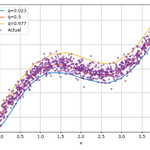
LA REGRESIÓN LINEAL NO IMPLICA UNA LINEA (GEOMETRICAMENTE)
el supuesto es que se es lineal con respecto a los parametros B0, B1…
No pide linealidad con respecto a las features necesariamente, permitiendo cosas como esto:

Aspiring Data Scientist retweeted

A usted no le importa el “derecho internacional” si hizo silencio ante la matanza de más de cuarenta mil iraníes durante los últimos meses. Usted no es un/a “feminista” si no dijo ni una palabra sobre Mahsa Amini. A usted no le importa la paz y la vida si jamás ha condenado el terrorismo financiado y promovido por los criminales ayatolás. A usted no le importa en lo más mínimo el pueblo de Irán si ahora, cuando por fin están recibiendo la ayuda que por tanto tiempo pidieron, ignora lo que quieren y piensan ellos, los oprimidos, y decide condenar esa ayuda.
Usted es, simple y sencillamente, un/a hipócrita que ni siquiera puede escudarse bajo su miserable ideología, pues dice ser de izquierda pero terminó apoyando una teocracia que desprecia a la mujer.
this is exactly my point all the time: Theres not a tool that beats making a good univariate and multivariate analysis, feature selection and multicollinearity filtering, defining a target that lines up with the problem to be solved with business focus, having an insights log..

Si eres un joven científico de datos, sigue aprendiendo las técnicas básicas.A lo largo de mis clases muestro justamente cómo las técnicas básicas aún son suficientemente buenas para muchos problemas, y en muchos casos, mejores que cualquier LLM.Veo jóvenes que piensan que sencillamente poner un LLM va a solucionar el problema, y eso no es verdad. Un LLM puede apoyar en ciertas tareas, pero la gran realidad es que las herramientas básicas siguen siendo fundamentales. No subestimes una regresión bien hecha, un análisis exploratorio riguroso o un modelo interpretable. Ahí es donde se construye el criterio que ningún LLM te va a dar.
Aspiring Data Scientist retweeted

Y'a rien à compliquer autant au départ
Ce qu'il faut faire :
- Tu vas sur Claude, tu prends une offre à 20 balles
- Tu installes ça et tu télécharges le tool desktop si t'es pas à l'aise avec un terminal
- Tu le démarres, tu lui demandes comment activer le mode plan (shift tab 2 fois)
- Ensuite tu lui parles de ce que tu veux construire, il va te poser tellement de questions que tu vas pouvoir clairement creuser ce que tu veux
- Tu démarres la construction et ensuite tu vas tacler les problemes : ah il me fait des dégradés laids, ah il mets des emojis, ah il découpe pas en features, ah il utilise pas la bonne techno...
- A chaque "ah", tu lui demandes comment régler ça et tu vas découvrir petit à petit les skills, les sous agents etc
Voilà, félicitations t'es en avance sur à peu près tout le monde et t'as même pas eu mal


Aspiring Data Scientist retweeted

Sé que esto va a alborotar muchas plumas aquí, pero el hecho de que hayas creado muchos productos de tecnología a lo largo de tu vida te da cero expertise para hablar de IA. He escuchado a CTOs con mucha experiencia tener las opiniones más absurdas sobre Inteligencia Artificial.
Y ni se diga de los desarrolladores que de pronto descubrieron RAG, piensan que ya saben IA y se autodenominan 'Ingenieros en IA'.
Solo están conectando cables. Si en verdad quieren ser expertos, existen paths de aprendizaje serios; con mucho gusto les puedo recomendar varios.
Aspiring Data Scientist retweeted

ML researchers just built a new ensemble technique.
It outperforms XGBoost, CatBoost, and LightGBM.
For years, gradient boosting has been the go-to for tabular learning. Not anymore.
TabM is a parameter-efficient ensemble that gives you:
- The speed of an MLP
- The accuracy of GBDT
Here's how it works:
In tabular ML, we've always had to choose between speed and accuracy. MLPs are fast but underperform. Deep ensembles are accurate but bloated. Transformers are powerful but impractical for most tables.
TabM solves this with a simple insight:
(refer the image below as you read ahead)
Instead of training 32 separate MLPs, it uses one shared model with a lightweight adapter. This small tweak gives you the benefits of ensembling without the cost of training multiple networks.
The results:
Against 15+ models and 46 datasets, TabM ranked 1.7 on average—ahead of XGBoost, CatBoost, and LightGBM. Complex models like FT Transformer and SAINT ranked much lower despite being more expensive to train.
I've shared the research paper and benchmarks in the next tweet.
Aspiring Data Scientist retweeted

Markov Chain Monte Carlo (MCMC) methods use a "random walk" from a Markov chain to draw samples from complex probability distributions. In machine learning, this is the engine of Bayesian inference, letting models find a distribution of plausible parameters to quantify uncertainty. In real life, this powers Google's original PageRank algorithm (a giant Markov chain) and is used in physics to simulate particle systems.
arxiv.org/pdf/2510.14165


Aspiring Data Scientist retweeted

Finally, Python 3.14 lets you disable GIL!
It's a big deal because earlier, even if you wrote multi-threaded code, Python could only run one thread at a time, giving no performance benefit.
But now, Python can run your multi-threaded code in parallel.
And uv fully supports it!
having an herman miller chair has changed my life. It has helped keep my posture in a natural comfortable position while preventing future diseases or injuries
100/100
They are expensive, but way more worth it

I just took my first course on datacamp, and to be honest, I don't know how I feel about their teaching method…
I feel like it heavily relies on memorization because it uses its own sandbox. Also, projects feel less tangible as you don't create your own files and project structure as you follow along
Maybe there're other course teaching methodologies they offer that I have not taken yet