

biotechnology stock investor
USA
Joined January 2025
- Tweets2.3K
- Following77
- Followers1.4K
- Likes2.4K




Pinned Tweet
I aspire to identify stocks that can be purchased now and held for a year to achieve long term capital gains. I seek to identify stocks that will at least double in value. I encourage you to consider these stocks yet do your own research before investing.
$AQST When Do You Expect an FDA Decision?
The FDA has issued a PDUFA date for Anaphylm of March 16, 2027. Many are expecting a decision well in advance of that date. What is your best guess for the month we learn of the FDA decision?
0%December
33%January
0%February
67%March
3 votes • 6 days$OCUL $KOD A Small Observation
I like to be attentive to subtle non verbal cues. One subtle but interesting moment at the Chardan's Heath Conference today. The analyst asks about $KOD. The analyst states, "Wall Street acted very favorably." What is interesting is the way he laughs as he says that.
My interpretation is that the analyst thinks the $KOD stock price rise after the study results is completely irrational. It is so irrational that the analyst can not help but laugh. He just can't bring himself to say those words with a strait face even though this is a serious fast-paced interview.
Pravin Dugal responds, "We don't consider them our competitors." The analyst gives a big exaggerated nod.
This analyst's nonverbal cues make a statement.
(Yes, Dugul artfully rips apart the $KOD study with just a few concise statements. Basically, implying - good luck getting this past the FDA. It took me a much higher word count to do the same. But, what is interesting here is how this analyst reveals his evaluation of $KOD.)
$OCUL All Is Going to Plan
Today's presentation simply affirmed that the Axpaxli submission is on track. Within a few weeks, we should get word of the FDA submission. A few weeks after that, the FDA will issue the PDUFA date. The FDA will indicate that they have accepted proceeding under the 505(b)(2) pathway.
That and the SPA should speed up the review. But, the speed of FDA action is not highly predictable. The big task for the FDA is digging into the data to confirm the findings of $OCUL. There is a good quantity of data that needs a close look. But, the SPA agreement means the FDA starts with a preestablished plan to evaluate overall efficacy.
Once the numbers are confirmed, I expect the approval process to go quickly. The next big task is labeling discussions. The key focus here is the durability label. The company is expecting a label that includes the phrase "6 months to 12 months."
When the review starts, I do not expect any big news until there is an announcement about FDA approval. This team is not going to give us a play-by-play about their FDA interactions during the review. All we will get is a vague statement like, "We respond to their questions and continue to have a good working relationship."
I know all of us will treat the release of the PDUFA date as big news. Yet, we also view the FDA accepting the application as a given. It just confirms what we expect.
After that we have a bunch of waiting to do. They can talk more about their rollout plan, but mostly we wait for news of approval.
$IOVA Today's PR
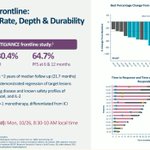
The ESMO announcement today signals that solid results are about to be released concerning TIL therapy for soft tissue sarcomas (DDLPS or UPS). It will be great to see the data which prompted starting a registrational trial.
I am already expecting NSCLC data soon that will prompt an FDA submission late this year or early next year.
The registrational trial for soft tissue sarcomas started accepting participants early this month.
(clinicaltrials.gov/study/NCT…)
My best guess is that it is going to take at least 18 months to have the data needed for an FDA submission. This initial submission would be for those who have exhausted all other reasonable treatment options. It would use ORR or PFS rather than Overall Survival. (They will gather OS data, yet not enough time will have passed since treatment to make it useful for the initial submission.)
ir.iovance.com/news-releases…
$DWTX Reflections on the Private Placement
5M raise at a price of $1.22 per share appears to be a good move. This will "extend operational runway through March 2027."
At the last quarterly they reported: "Cash on hand of $9.6 million provides operational runway through the Phase 2b readout in the fourth quarter of 2026."
Pain (CINP) trial topline data readout in November 2026.
If the trial results are good, this means that they do not need to do a large offering immediately after results are announced. This buys them time to negotiate with the FDA about the phase 3. Having clarity about the phase 3 lets them explore partnerships to fund the phase 3.
This also permits time to entertain buyout options. A buyout is less likely than a partnership. These funds do help them negotiate from a position of greater strength.
ir.dwtx.com/news/press-relea…

$OCUL $EYPT Eyepoint Results
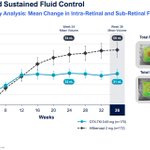
The first chart below shows the key outcome measure that sunk Eyepoint. The control group gained 6.1 letters. The treatment group added 2.5 letters. That difference was outside the confidence interval to be considered statistically equivalent.
The letters gained difference starts to appear at week 20 and grows at each reading through week 36. After that, the difference is maintained.
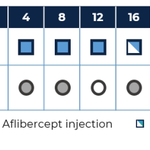
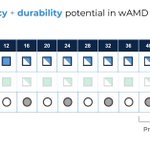
Week 16 is when the control group gets the first additional dose. The second dose of Duravyu is given week 32. (See second chart below for dosing schedule.)
It seems that early on, Duravyu is not delivering the level of medication needed. The groups do not equalize after that dose of Duravyu at week 32.
So, Duravyu offers fewer injections, but it is not matching the efficacy of Eylea.
(It is always possible that these results are the product of differences between the treatment and control groups. There is great patient variability in Wet AMD. If the study design does not control for that variability well, it increases the risk of the groups not being equivalent. )


$AQST The Irrational Market
This week, we saw a major selloff in biotech. For stocks like $AQST, institutions did not consider what the value of the company will be a year from now - they simply hit the sell button. Some of this selling, is driven by computer algorithms.
So, a few institutions or their computer programs say interest rates are high, we will sell 20% all our biotech stocks. This momentum builds like an avalanche. Selling prompt more selling.
Then, the task becomes guessing when things will hit bottom. I spend my time researching individual companies. That information does not offer any guidance when dealing with a market-wide biotech selloff.
In times like this, I buy more if I can. I make some modest shifts in my stocks based on what seems to be the best deal. Yet, most of what I do is wait.
For $AQST, I ask myself if any key fundamentals have changed related to this stock long-term. This stock holds up strong after rigorous evaluation. So, I wait for reasonable valuation to return.
I was not planning to sell a share until early 2027. Even then, it better be a great price or I will only sell trivial amounts. So, there is just this psychological challenge to get through. The fundamentals are fulling intact.
Yet, I do want to acknowledge that this selloff has not happened in a vacuum. The actions of the Trump administration with tariffs, the war in Iran, and heavy deficit spending have consequences. Regardless of where you stand politically, you need to have your eyes open and not be denial about what has happened and the heightened risks of this escalating over the next two years.
An individual stock is not an island to itself. There are serious issues beyond this stock that are real and tangible. I know that is not the most upbeat ending, but I value speaking truth. I can be both confident of my investment in $AQST and concerned about issues beyond this stock that will impact when I will be able to exit with a strong profit.
$COYA Reflections on Open-Label Extension
This extension study was expected, but it is great to see an official annoucment.
This additional data has the potential to be helpful. I would like to see what specific data they plan to collect and at what interval. To my knowledge, we have no data about responses in the second year of taking the medication. If the study results look good and FDA approval is granted, the FDA is going to require this kind of extended data. So, it makes sense to go ahead and get started.
For the moment, all that really matters is those results we will get in Q2 2027.
At the human level, offering persons the option of continuing the medication while we await the results is just the right thing to do.
ir.coyatherapeutics.com/news…
$AQST Canada Review Timeline
We are told to expect a Canada submission soon for Anaphylm. This could be a standard 10 month review or a 6 month Priority Review.
That approval will open up cash sales in Canada. This is certainly the kind of revolutionary product that can prompt cash sales.
Yet, what really opens the floodgates in Canada is approval by public health plans. After a drug is approved by Health Canada, it can take in excess of a year for the drug to be approved for coverage by public health plans.
Here is the priority review criteria:
canada.ca/en/health-canada/s…
They can make the case that "the new product represents a significant improvement in the benefit/risk profile over existing products." They can do that based on increased compliance in carrying the drug because of the portability advantages. They can present data about the improved speed of drug action.
They give it their best shot even though they are likely to be given the standard review timeline.
$AQST Reflections on the March 16, 2027 PDUFA Date
So, they were not given the quick class 1 timeline. That is disappointing. It was possible. Many of us were hopeful. An FDA functioning at the highest level could have done this. Yet, most of us were realistic. So, we get a cup of realism today.
Some will ask, "Can the FDA go faster and finish early?" The answer is they can do whatever they want to do. That means they can even go past the PDUFA date if they want.
Based on all the public information, the FDA should move fast because the volume of data to review is quite small. Therefore, they should approve this before the PDUFA date.
I am not expecting the company to provide any significant updates during the review process. The next message I expect to hear about this is that the drug has been approved.
The only exception might be the company indicating at some point that they are entering labeling discussions with the FDA. That signals that approval is coming soon.
During times when there are no interactions with the FDA, they will shift their attention to applications for other markets. Today they remind us that they are "on track to complete" the "New Drug Submission to Health Canada in Q4."
Many team members including those in manufacturing sales, and marketing will be making final preparations so that when approval comes they can jump into action.
$AQST Type 9 NDA - Libervant
Based on prior statements by the company, I was expecting that Aquestive would need to file a Supplemental New Drug Application (sNDA) for Libervant for those between 6 to 11 yrs.
Part of the interesting details from today's announcement is that they ended up going a different route and filing a Type 9 NDA. A Type 9 NDA allows the sponsor to submit the second indication prior to the approval of the original NDA.
In appears, they used this method because technically Libervant is not an approved drug until the 7 years of orphan drug exclusivity ends on January 10, 2027 for the competition. (It seems likely there was room for alternative interpretations given prior FDA approval, but this approach avoids any legal challenges.)
So they report that the Type 9 New Drug Application (NDA) is under review with the FDA to add ages 6 to 11 to the product’s label. The NDA has a Prescription Drug User Fee Act (PDUFA) target action date of March 29, 2027.
It would be interesting to know when this was filled and if they needed to provide additional data to support use for this age group. It seems possible that the FDA will make a decision well in advance of the PDUFA date.
Aquestive will likely be able to ramp up manufacturing quickly in the event of an early decision. Eton might not be as agile in moving up sales and marketing.
$AQST Deal with Eton Pharmaceuticals to Market Libervant
This was expected based on their recent statements and they delivered. This permits them to focus on the Anaphylm rollout.
investors.aquestive.com/news…
$AQST PDUFA Date
So, by the end of this week, we should get word of the PDUFA Date for Anaphylm. We will find out if it was designated as Class 1 or Class 2.
(I guess it is possible that the press release is delayed until Monday. Yet, that is just about the latest.)
$MDXH Shorts and Manipulation
Over the past month, most of my holdings of $MDXH have been out on loan to those shorting the stock. This afternoon was the third time this week that the stock was returned and taken off loan. (Yes, that means it was loaned out again twice.)
I am taking that as a positive sign that some shorts are stepping away or getting more cautious about how long they hold it. Maybe, we see reduced manipulation so this stock can begin to work its way to a less irrational price.
$TGTX Initial Results CAR-T for MS
They have been quite guarded about providing initial outcome data for their CAR-T treatment. Part of the explanation has been that the outcome measures require extended time to pass when the focus is MS. Now, we get word that the first round of data will be released.
It is early and there will be some other CAR-T competition. One I follow is $FATE. Next year, they are expected to begin testing an off-the-shelf Dual CD19 and CD38 for MS.
LATE-BREAKING ORAL PRESENTATION:
Presentation Title: First Clinical Evaluation of an Allogeneic CD19-Directed CAR T-Cell Therapy in Progressive Multiple Sclerosis: Initial Results From the Phase 1 TG-Azercel-101 Study
Presentation Date/Time: Friday, October 23, 2026 from 10:45 - 10:55 AM ET
Session: Late-Breaking Abstracts - Scientific Session
Abstract/Presentation Number: Toronto-LBA-229 / Oral O135
Lead Author: Daniel Ontaneda, MD, PhD, Professor of Neurology, Cleveland Clinic Mellen Center
(Full text of this abstract will be available 10/21/26)
$SPRY $AQST Neffy COGS (Cost of Goods Sold) Problem and the Anaphylm Advantage
Take a look at all the autoinjectors on the market. Most have their own proprietary devices. The exceptions have very reasonable licensing deals.
ARS does not own the rights to their dispensing device. That specific device is linked to their FDA approval. Aptar owns the sprayer system and specialized rubber plunger used in the Neffy device. ARS tried to switch over to another company's sprayer system. This resulted in Aptar and ARS suing each other. At this point, it appears Aptar has won the latest round of the legal battle.
ARS would need to make a clean break from Aptar to solve this. This would require getting a new device approved by the FDA. Until they do that, they must pay Aptar's inflated prices. After this legal battle, Aptar is unlikely to do them any favors.
ARS also has to make substantial royalty payments for the absorption technology used in their products. None of the autoinjectors require special formulations for the epinephrine to absorb. This adds notable costs to producing the product.
Soon, Aquestive is likely to enter the market with Anaphylm. The product does require advanced proprietary technology for epinephrine absorption. Aquestive fully owns the rights to this prodrug technology.
Aquestive has 20 years of experience as a manufacturer of drugs. They have produced over 2.5 billion doses of film format drugs. They will manufacture Anaphylm in-house. Anaphylm is a device-free product which reduces the cost of manufacturing.
Neffy has had to dispose of some of its product because they ordered well in excess of demand. With an external manufacturer, orders need to be placed far in advance. Aquestive can use more of a just in time manufacturing approach at their facility.
Neffy is working to cut their high administrative expenses. They have a long way to go there. One of the challenges is that their sales are child centric and are highly concentrated in the Summer. They have to staff up for those high volume months.
Anaphylm is likely to appeal to more adults. This should spread sales out more evenly across the year.
All of this means, that Anaphylm will enter the market with a huge low COGS advantage over every other product on the market. That will translate to profit. My best guess is that Anaphylm could generate roughly twice the profit for every unit sold of that for Neffy.
So, Anaphylm is a portability breakthrough and works faster than other products which means they can likely charge a premium. Yet, the product will cost far less to make than any other product.
People rarely talk about Anaphylm's COGS advantage, but a day is coming soon when this will show up in the financial statements.
$AKBA ASN Kidney Week 2026
This is an excellent collection of presentations. They are taking full advantage of this opportunity to convey their message to leaders in the field.
ir.akebia.com/news-releases/…
$COYA Results as Soon as Late-April
They stated today that "Topline data from the double-blind treatment phase are anticipated in early Q2 2027." Let's see if we can get more specific.
Twenty-four weeks from today is March 22. So if we add a couple of weeks to complete patient starts and 3 weeks for data analysis that takes us to April 26. 2027. That provides an estimate of the earliest date for topline results.
So, we are looking at a timeline of late April at the earliest and May at the latest.
ir.coyatherapeutics.com/news…