

Arutha is a policy think tank focused on economic research and communication with a special interest in public debt and taxation.
Sri Lanka
Joined August 2023
- Tweets1.2K
- Following9
- Followers788
- Likes22




Kachchatheevu is a small, uninhabited island located in the Palk Strait between Sri Lanka and India. Its economic value comes from the fishing grounds that belong to Sri Lanka, by mutual agreement between both countries. These waters support a large share of Sri Lanka’s fishing economy.
According to the Ministry of Fisheries’ latest statistics for 2024, the four districts of Jaffna, Mannar, Kilinochchi and Mullaitivu in the Northern Province –
i. Accounted for 52,500 marine fishing households - ~28% of the national total ii. Accounted for 58,080 active fishers – ~26% of the national total
iii. Produced ~70,900 metric tonnes of fish - 23% of Sri Lanka’s total marine catch of 308,430 metric tonnes
iii. Supplied 61% of the country’s wild-caught shrimp and 74% of its crabs, high-value products for both local and export markets.
India has ruled out any intention of reopening its agreements with Sri Lanka around Kachchatheevu and maritime fishing rights. This provides legal certainty over the fishing grounds around Kachchatheevu. The economic benefit to northern fishing communities, however, will depend on how effectively illegal trawling in Sri Lankan waters is controlled.
More than 1,000 Indian trawlers, mainly from Tamil Nadu, cross the maritime boundary into the Palk Bay and Gulf of Mannar, engaging in illegal fishing. Many use the bottom trawling method, which is banned in both countries. Northern fishers report reduced catches and depleted fish stocks as a result, which affects both their current incomes and future catches.
#srilankaeconomy #srilanka #india

India is worried about a food crisis. So should we.
Read our latest Lanka Dispatch Memo to find out more - arutharesearch.org/post/indi…
Excited about making operations and finance accessible and strategic for a growing team, we want to hear from you.
Apply now- arutharesearch.org/about
Deadline - 26th of October 2026.

Independence in name only? 🇱🇰
🔒 Time to lock our elections budget.
Read more in our latest Solutions Brief: arutharesearch.org/post/solu…
#srilanka #srilankaeconomy
"As geopolitical competition intensifies and Western governments become more deeply involved in major conflicts, through direct participation or support for allies, they are increasingly viewed not as impartial mediators but as parties with vested interests. The result has been the emergence of a more diverse set of diplomatic actors, with regional and middle powers such as Qatar, Turkey, and Saudi Arabia taking on mediation roles. Pakistan is among the latest to join this group."
Read more in our latest article: Meet the Newest Player in International Conflict Mediation - factum.lk/regional-geopoliti…

What should taxing wealth in Sri Lanka look like? 🇱🇰
Well-designed taxes, such as a property tax, can help ensure land and property are used efficiently across the island.
Read more: themorningmoney.com/articles…
For a deeper dive, check out our report, "Understanding Wealth Taxation in Sri Lanka." - arutharesearch.org/post/unde…

A preview of what you get every morning when you subscribe to The Macro Digest!
A daily dose of Sri Lankan economic news, delivered straight to your inbox!
Subscribe now - arutharesearch.org/subscript…


"Port City’s success was not guaranteed because Sri Lanka offered generous tax incentives previously, nor will it fail simply because those holidays have been shortened. Its prosperity depends on offering investors a space that is commercially viable, efficiently governed, and protected from unpredictable policy shifts."
Read more in our latest article: ft.lk/columns/Less-generous-…

The National Export Development Plan 2026-2030 has an ambitious target of increasing export revenues by 80% within 5 years. Export revenue from goods and services amounted to US$ 20 billion in 2025 and the NEDP aims to reach US$ 36 billion in export revenue by 2030.
Sri Lanka’s previous national export development plan from 2018-2022 was 42% below target with revenues in 2022 at only US$ 16 billion. The 2022 target was US$ 28 billion.
The NEDP 2018-2022 failed due to many reasons;
- Shocks such as the 2019 Easter Sunday attacks and the Covid-19 pandemic created major disruptions to the business environment.
- The deterioration of the economy from 2021 onwards due to the debt crisis continued to affect the business environment.
- Inter-agency coordination was weak and fragmented leading to delays and blocks on many policy initiatives.
- Sri Lanka did not secure any major trade agreements during this period to expand its market access successfully.
- The export sector struggled with high production costs and low productivity.
The success of the NEDP 2026-2030 would therefore depend on comprehensively addressing these barriers through systematic reforms.
#lka #srilanka #srilankaeconomy

The government is not required to make a decision to continue or exit the IMF programme next year as it is automatically scheduled to end in March 2027. The government can however enter into a new agreement with the IMF to signal its continued commitment to fiscal discipline and maintaining macro stability.
Sri Lanka officially received approval for a 48-month extended arrangement under the Extended Fund Facility (EFF) programme in March 2023. The amount approved was US $3 million to be paid in 8 tranches. The 48-month period lapses in March 2027. Sri Lanka has successfully fulfilled requirements and received 6 of the 8 tranches amounting to ~US $ 350 million each.
The 7th review is currently underway. If Sri Lanka meets the pre-conditions, it can successfully complete the programme on schedule by March 2027.

Here's a preview of what you get every morning when you subscribe to the Macro Digest!
Your daily dose of Sri Lankan economic news, delivered straight to your inbox!
Subscribe now: arutharesearch.org/subscript…


Fitch Ratings upgraded Sri Lanka's credit rating to B- from CCC+ on 22 September 2026. It is the first upgrade from any of the three major agencies since ratings were reset following the 2022–2024 debt restructuring.
S&P (CCC+ since September 2025) and Moody's (Caa1) have not yet moved in recent reviews, making the Fitch rating upgrade an upside surprise.
B- is still speculative-grade meaning that Fitch Ratings view a country as having a material risk of default with some margins of safety. Sri Lanka is now in the same band as Pakistan, Iraq and Angola.
This band can still attract investors. Pakistan, for example, raised $3 billion in a Eurobonds in September 2026. This gives a rough idea of the financing that Sri Lanka could seek when returning to global bond markets. While expensive relative to investment-grade peers, it is a functioning market rate rather than a highly distressed one.
Sri Lanka does not necessarily have to raise global capital market funds urgently as post restructuring external debt service obligations remain muted in the near term. As long as current fiscal and monetary policy is maintained and external circumstances do not materially worsen, Sri Lanka’s economic stability should remain in tact. However, Fitch expects the current account to decline to a 1.2% of GDP deficit in 2026 after 3 years of an average surplus of 1.5% - mainly due to higher energy prices.
The more immediate effect runs through the private sector. Sovereign ratings act as a ceiling: banks and major corporates are rarely rated above their own government. An upgrade tends to lift the ceiling for entities beneath it, lowering their own cost of external borrowing even without any change to their individual credit profiles. The net effect is a lower borrowing rates for external borrowing across the economy.

CBSL Governor says Fitch upgrade reflects Sri Lanka’s progress on economic reforms ift.tt/iEPYFnO

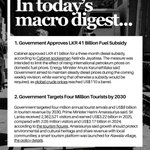
The Government has planned a LKR 41 billion fuel subsidy (Oct-Dec) to curb the impact of rising fuel costs. These subsidies like the Rs 57 billion fuel and Rs 15.3 billion electricity subsidies made in April protect households in the short term, but they run against the government's commitment to the IMF on cost-recovery pricing.
Cost-recovery pricing means charging enough to cover what it actually costs to provide fuel and electricity, so state-owned suppliers like Ceylon Petroleum Corporation and Ceylon Electricity Board don't run losses that the government ends up paying for.
So this new subsidy could complicate the ongoing IMF review.

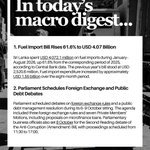
Sri Lanka’s fuel import bill has ballooned by 60% in the first 7 months of 2026 compared to the same period in 2025. In the first 7 months of 2026 fuel imports cost us $3.6 billion in comparison to $2.2 billion in the same period of 2025.
Despite prices at the pump having risen by ~25% and a QR-based rationing system that limits individual consumption, the ministry states that overall consumption has only reduced by 10%. This signals that Sri Lanka has not managed to curb its petroleum consumption significantly despite a global supply crunch. As tensions in West Asia escalate, and oil prices continue to rise to record levels, President Dissanayake has signalled potential fuel subsidies for October. The parliament also approved a Rs 17 billion supplementary estimate to provide electricity tariff relief to consumers.
Sri Lanka has failed to meet the cost-recovery fuel pricing since April and cost-recovery electricity pricing January. In June 2026, the government committed to the International Monetary Fund (IMF) to return to cost-recovery prices for fuel and electricity. A Rs 57 billion fuel subsidy and Rs 15.3 billion electricity subsidy were implemented in April.
The 7th review of the IMF programme is currently underway – the successful completion of targets and commitments would unlock ~$350 million into Sri Lanka’s economy as it battles stagnant exports, rising import costs and low tourism revenues.
Everyone deserves to understand the economy shaping their lives.
That's why we're launching The Macro Digest — a daily roundup of Sri Lankan economic news across English, Tamil and Sinhala media.
Subscribe now - arutharesearch.org/subscript…


Sri Lanka’s Luxury Property Boom Is Outrunning Its Regulations.
Read more:thediplomat.com/2026/08/sri-…
#economy #southasia #srilankaeconomy #colomboluxuryhousing #srilankarealestate


Does Sri Lanka need a Tax Ombudsman? With rising tax disputes, unclear rulings & frustrated taxpayers — could an independent watchdog fix the system?
Read more in our latest brief: arutharesearch.org/post/shou…