

Genevois expatrié; Assistant Professor, Tohoku University; Author: China's hierarchical vision of order in Asia https://xitter.cf/t.co/AF1mt5WQht; Sino-Japanese relation https://xitter.cf/t.co/md1yKlmVVf
Sendai-shi, Japan
Joined September 2012
- Tweets9.7K
- Following979
- Followers603
- Likes3.6K



Pinned Tweet
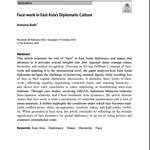
Very happy to announce that my article on "Face-work in East Asia's diplomatic culture" has just been published in the East Asia journal (and in open access!)
Link in the next post.

Antoine Roth retweeted

you'll hear lots of 'how do we pay for?' questions abt budget today.
my new report argue that UK government should use its new powers to mandate pension investments in Public Essentials Fund (PEF) and eliminate privatisation premium paid by citizens and local councils.

Great to see @DanielaGabor’s new paper for Mainstream out in the world.
It develops the analysis that she put to MPs at the first Mainstream Parliamentary Seminar, organised by @labourlewis and I, last December.
Read here: mainstreamlabour.org/publica…

Antoine Roth retweeted

🇺🇦 🇺🇲 The confrontation inside Trump's Ukraine peace negotiations is now coming into focus.
Le Monde reports that Steve Witkoff and Jared Kushner spent nearly three hours pitching Ukraine's presidential chief of staff, Kyrylo Budanov, a postwar economic arrangement built around restoring Russian oil and gas flows to Europe through Ukrainian pipelines.
The meeting took place on October 9 at the Shell Bay golf club in Florida.
Witkoff presented the proposal as a regional prosperity plan: Ukraine would collect transit revenues, Europe would receive cheaper energy, and Russia would regain access to commercial routes disrupted by the war.
Budanov saw something fundamentally different. According to a witness cited by Le Monde, he objected that the arrangement would recreate Ukraine's dependence on Moscow.
“Our model is not Belarus, but Poland!” he reportedly replied.
The meeting was interrupted, and Budanov called Zelensky.
When talks resumed, news arrived that Trump had announced a separate agreement with Putin involving Russian diesel. Le Monde reports that an irritated Witkoff then demanded that the Ukrainians accept the arrangement and stop striking Russian oil refineries, arguing that the attacks endangered the wider world.
A source familiar with the Ukrainian delegation described its members as exceptionally distressed by the encounter.
The account adds a revealing dimension to the commercial negotiations we have been tracking. The proposed Lukoil asset sale, Novatek's involvement in an Alaska LNG venture, the broader US-Russia list of business opportunities reported by the Financial Times, and now the proposed restoration of Russian energy transit through Ukraine all point to the prominence of energy deals in Washington's diplomatic approach.
These are separate proposals, with different participants and legal circumstances. But Le Monde's reporting exposes the strategic disagreement underlying them.
For Witkoff, restoring commercial flows appears to be part of the mechanism for producing a peace settlement. For Budanov, according to the account, those same flows threaten to restore Moscow's economic leverage over Ukraine.
The reported exchange also raises a question about sequencing: why was Kyiv being pressed to stop attacking Russian refineries while Russia continued striking Ukrainian energy infrastructure?
Le Monde's reconstruction relies on accounts of a private meeting. The reported exchanges have not been independently confirmed by the participants.
Source: Le Monde

Antoine Roth retweeted

A few notes on the Israeli elections:
- Ignore the early partial counts: Voting tally speed varies significantly across the country, for instance, results from many Arab towns are still pending. In the latest update of tallies Raam gained 2 more seats. The final votes to be counted are the "double envelopes" (primarily around 150,000 soldiers and active-duty reservists). Because this group is demographically distinct from the general population, with negligible Haredi and Arab representation, their votes typically cause late shifts in seat distribution.
- Exit poll adjustments: Overnight, TV networks updated their exit polls using real results from sample polling stations to adjust for late voters and those who misled pollsters. This shifted roughly three seats in favor of the Netanyahu bloc. Still, he remains short of the 61-seat majority needed to form a government.
- The leaders of the 3 of the opposition parties, Eisenkott, Bennet and Lieberman, have to break one of their core campaign promises, or Israel will head to another election in six months. In the interim, Netanyahu would remain caretaker PM leading a minority in the Knesset, which could allow the opposition majority to pass key legislation, including establishing a State Commission of Inquiry into the failures that led to the October 7th massacre.
- Netanyahu's strategy: The core promises from these three leaders were to exclude Netanyahu, exclude Arab parties, and exclude Haredi parties from a coalition. Netanyahu’s "victory" speech and political track record indicate he will not abandon his ultra-Orthodox alliance. Instead, he aims to pressure right-leaning opposition leaders to abandon their principles and join his government on his terms (much as Benny Gantz did previously, destroying his own political credibility).
- The consequences of racism: Netanyahu, the Right, and their media ecosystem have systematically delegitimized Arab political participation or reliance on Arab party votes. Currently, "The Democrats" is the only opposition party advocating for a joint Jewish-Arab coalition. The three right/centrist opposition leaders who reject Arab inclusion must now decide: bow to Netanyahu's narrative, thereby depriving themselves of power and giving Bibi another shot to win the elections in 6 months, or cooperate with Arab parties to have them support the government from the opposition. Such a government won't be stable, but it could get important things done for all of Israel's citizens.
Antoine Roth retweeted

Catnip for all the guerrilla Schumpeterians and Charles Tilly fans out there: this @peer_schouten essay in @thebafflermag on Central African supply chains, gold mining and armed groups presents an entire fiscal-cervisial theory of the modern state: thebaffler.com/salvos/the-be…

Antoine Roth retweeted

With 65.8% of polls reporting, we have a clearer picture of where this is going. The Netanyahu camp has 56, the opposition at 48 and the Arab parties at 16. The regressions I ran now average 55 for the Netanyahu bloc, 48 for the opposition bloc, and 17 for the Arab parties. This is looking like a FAR better night for Netanyahu and his folks than anyone expected. They are simply far more popular than we thought.

Antoine Roth retweeted

The @FT has obtained the lengthy list of “Business Deals” the US and Russia are discussing. ft.com/content/d703aaae-f607…


Breaking news: The US and Russia are discussing a potential return by American companies to the Russian oil market as part of wider talks to end Vladimir Putin’s war in Ukraine ft.trib.al/4gZrY6H

Antoine Roth retweeted

This is one of the most important pieces of social science on human and AI interaction that I’ve seen in some time. Experts follow agentic advice the vast majority of the time (causally), but only a tiny fraction credit the agent—majority think they came to decision on their own volition.
Reminds me of the classic Nisbett and Wilson study on people following outside influence without realizing it
“ But as more work is handed to AI—including AI safety research—these judgment calls are the main levers for people's own values to influence outcomes.
If people defer to AI without noticing, then "human in the loop" might provide less assurance than people expect.”

Antoine Roth retweeted
Neither bloc can form a government, and Netanyahu stays in office while everyone tries:
1) Netanyahu has no realistic route to 61. His bloc is the four religious-right parties plus Likud, and every party outside it ran on replacing him. To get there he would need defectors from Bennett or Lieberman, which both ruled out, or Ra’am, which Smotrich and Ben-Gvir would veto.
2) Eisenkot’s only path to a government runs through the Arab parties. Ra’am alone gets him to 58. He needs the Joint List as well, at least abstaining or giving outside support. That is the 2021 Bennett-Lapid model, but with a bigger dependency. Bennett and Lieberman have both been wary of relying on the Joint List.
3) The other way out is the Haredim. Shas plus UTJ is 14 seats, which would put Eisenkot at 66. But the draft is the issue that defines Lieberman, Bennett and the Democrats. A deal on exemptions would break his bloc from the inside.
4) The anti-Netanyahu parties plus the Arab parties come to about 69. That is enough to elect the Knesset speaker, control committees, and pass laws without forming a government. A bill barring an indicted MK from forming a government becomes possible.
5) Likud’s overperformance is mostly cannibalization. Likud gained, but its bloc is at 50. The votes came from inside the right, not from the center.
6) Stalemate favors Netanyahu. He stays caretaker PM through coalition talks and any repeat election. If nobody gets to 61, he governs by default.
The likeliest outcomes are a Bennett-Lapid-style government that depends on Arab support, or deadlock and another election with Netanyahu still in charge. The whole question is whether Eisenkot, Bennett and Lieberman will sit with Arab support. Exit polls here usually miss by a seat or two per party, so a small shift around the threshold could change the math.
Antoine Roth retweeted

Flávio Bolsonaro has left Brazil after losing to Lula, defying a Supreme Court travel ban while under investigation for money laundering. It’s an opening for São Paulo governor Tarcísio de Freitas, long seen as the right’s best bet against Lula, to lead the opposition.
Antoine Roth retweeted

So what are the five main questions we’re hoping will be answered by the exit polls at 10pm?
First, has the coalition indeed lost any chance of an outright majority?
Anything under 55-56 seats should settle that.
Second, who has the bigger bloc without the Arab parties and how wide is the margin between the entire opposition (including the Arab parties) and the Netanyahu bloc
Third, who is the largest party?
It’s either Likud or Yashar. And it shouldn’t really change the overall calculus as it’s about who has the bigger bloc. But the narrative of leading the largest party is important for both Netanyahu and Eisenkot’s claim to have a national mandate (even though they neither party is expected to win over 20% of the vote)
Fourth, which parties are hovering around the electoral threshold? If Amcha Yisrael or Reservists or YB or RZ are above/below it could change the overall balance between the blocs
Fifth, how many seats will either Arab party win? The answer to that could significantly affect Eisenkot’s prospects of forming a government


Antoine Roth retweeted

The controversial 2-hour delay in voting at some ballot stations in Brazil yesterday only resulted in 34,000 extra votes -- irrelevant, given Lula beat Bolsonaro by 4.43 million
Source: TSE (electoral court)
Antoine Roth retweeted

L’âge du pétrole est terminé, l’âge de l’électricité a déjà commencé.
Pour comprendre le monde après Ormuz, je vous conseille absolument de lire ce grand entretien avec @fbirol sur le nouvel ordre énergétique mondial.
legrandcontinent.eu/fr/2026/…

Antoine Roth retweeted

China's STAR 50 Index of leading tech firms is down 40%, losing $480 billion of market value.
These are mostly semiconductor-related companies, like SMIC and Cambricon, and not Alibaba, Tencent, BYD, etc.

In China, the AI bubble has already burst reut.rs/48foPk1

Antoine Roth retweeted

Necro-Economics: Death By Algorithm
Eyal Weizman in London Review of Books
Excerpt:
The killing of civilians and the destruction of civilian property can also be used as an act of terror and revenge. During the 2006 Lebanon War, Israel destroyed fifteen thousand buildings and a large part of the Beirut suburb of Dahiya, a stronghold of Hizbullah. In 2008, it announced that the destruction of cities would be the cornerstone of its deterrence. Gadi Eisenkot – then commander of Israel’s northern front, and, as I write, the man challenging Netanyahu in the Israeli elections on 27 October – explained that the ‘Dahiya doctrine’ would see Israel retaliate with ‘disproportionate power ... and cause immense damage and destruction’. Along with the explicit threat to target civilians, the use of the term ‘disproportionate’ is crucial here. It was meant both literally – Israel is using its overwhelming firepower without restraint to flatten urban areas – and legally: Israel is flouting the laws of war, in which the principle of proportionality is key. If the use of proportionality is taken to suggest support for the ethical, measured, rational waging of war, disproportionate action publicly demonstrates an unwillingness to be restrained by any legal or normative threshold and a genocidal willingness to kill civilians en masse. The Dahiya doctrine was applied in the massive rounds of terror bombing that Israel unleashed on Gaza in the winter of 2008-9, the summer of 2014 and again in the spring of 2021, in which thousands of Palestinian civilians were killed and tens of thousands of homes destroyed.
In between those assaults, another form of calculation was imposed on Gaza, with a relentless siege meant to keep Palestinians on the threshold of life. A military document called ‘Red Lines’ set the minimum number of calories required to sustain Gaza’s population at a level just above the UN definition of hunger (2100 calories a day for men, 1700 for women and a varying amount for children depending on gender and age). The total number of calories was translated into the tonnage required to feed Gaza’s then population of 1.5 million and thus the number of aid trucks allowed into the territory. The same went for megawatts of electricity and litres of fuel and water. What was seen as good behaviour was rewarded by an increase in the amounts coming in, any acts of resistance by the tightening of the siege, like a population-scale version of a Milgram experiment ...
Yet as one of NAZA’s interviewees confirms, with seventy thousand Palestinians designated as military targets and default collateral damage set at twenty civilians for every low-level operative (and more than a hundred for military and political leaders), ‘in this way you could kill the entirety of Gaza.’ As another interviewee explains, ‘the aim was quantity not quality,’ but – as Stalin said – ‘quantity has a quality all its own.’ Genocide is the sum total of individually targeted strikes. This is what the technology researcher Júlia Nueno Guitart, writing about the use of AI in Gaza, has labelled ‘individuated mass killing’. The killing of civilians and the destruction of homes and infrastructure was the intent, not the ‘collateral effect’, of the bombing; as technologists often say, ‘it was a feature not a bug.’
@weizman_eyal @LRB
lrb.co.uk/the-paper/v48/n20/…


Antoine Roth retweeted

One of the many potential biases in Song dynastic history: the court diarists were stationed too far away and, during audiences, often couldn’t actually hear the emperor, so would just report that he said nothing.


Antoine Roth retweeted

Ahead of the upcoming Quad Leaders’ Summit, might be worth revisiting whether the grouping can still be a ‘strategic filler’ for and a ‘strategic amplifier’ to ASEAN-led mechanisms—or has it been seen as a spoiler instead by some in recent years?👇🏻
Download: evanlaksmana.com/publication…

Antoine Roth retweeted

Small news item today
ohchr.org/en/press-releases/…

Antoine Roth retweeted

Counter-take: The logic of international solidarity - that what happens in Brazil (from Amazon protection to viral pandemics) matters for what happens in the United States - has never in history been more plainly important.
