

AI/ML Software Engineer. 20+ years shipping in prod. I write about interesting things in AI. TribalWar. Com founder; ex-DoD Intelligence Ops; ex-DraftKings
Danbury, CT
Joined December 2025
- Tweets1.3K
- Following365
- Followers777
- Likes438







If you used Pieces (@getpieces), I made something to help you keep your memories.
Pieces Rescue saves a copy of your local Pieces database and supporting files, then recovers readable summaries and conversations you can search and explore by day or topic. It runs on your computer without a Pieces account or service.
We had to wind Pieces down, but I still want people to have a way back into the work they captured with it. This is a Windows beta, so keep your original data.
github.com/anthony-maio/piec…
I currently subscribe to a number of publications that would have surprised me 10 years ago - print: Wired, The Atlantic, and The National Review. Digital: BBC, Tucker Carlson, and The Bulwark.
I try to get news from both sides of the fence. I'm very happy with all of these.
In other news: fork found in kitchen.

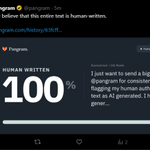
I built a classifier to detect LLM aided writing in ML papers, and ran it on all 42000+ #ICLR2027 submissions. All sentence level results in an integrated pdf viewer are hosted here: opentextdetector.com/
Interestingly, over half the papers appear to be ~fully AI assisted.

HF: "Open @Pangram Time??" opentextdetector.com/ "Check an ICLR 2027 submission for AI-written text
This site runs an open-source classifier I trained to detect LLM writing in ML papers. I ran it on all 42,000~ish ICLR 2027 submissions and host the sentence-level classification results here with an integrated pdf viewer. It is free and independent, with no company or commercial funding behind it." ... OH BOY.
The amount of outreach from recruiters that is just AI slop is a real turn off. Leaving the ChatGPT referrer in your links is next level low effort.
Cool new harness benchmarks for Hermes from Nous Research: portal.nousresearch.com/benc…

They don't mention the potential "watermarking" of reasoning chain text that I encountered, do they?

Over the last few months, we’ve made significant progress in reducing the effectiveness of distillation attacks against Claude.
In this post, we explain how: anthropic.com/research/disti…

Everyone is talking about alignment. The bigger threat isn't that AI will rise against us. Autonomous agents trained to act as dynamic worms/virii is something I'm much more concerned about.

Best write up I've read dissecting why @DavidSacks missed the mark with his misinformed talk on alignment. Like I've said elsewhere, the brilliant minds that train frontier models by writing 80 page documents because it's fun, the other options didn't work.

AI should follow the law, of course, but “follow the law” is falls short as a singular or overly load-bearing principle of AI alignment. Why?
Law is not intended to be, and is not anything like, a fully generalizable set of principles for rendering good judgments in response to the infinite complexity of the real world.
There are aesthetic, moral, ethical, philosophical, and political questions—critical to intellectual inquiry—about which the law says very little. Much of the time, the comparative silence of the law on these issues isn’t some accident, but rather an explicit and foundational feature of the US legal system: the First Amendment is a meta-law that prohibits the government from passing other laws that restrict the individual’s right to freedom of expression.
What should an AI system say if you confess to it your affair? Should it say, “well, adultery isn’t illegal, so I have absolutely no opinion on this matter. Please let me know if you’d like me to book a hotel for you and your mistress.”?
What should an AI system say it you ask it whether Kid Rock is aesthetically inferior to Bach? Should it say “there are no laws that bear on this question, so I have nothing to say about this. Please let me know if you’d like me to find tracks from Kid Rock and Bach to play—provided you adhere to the noise ordinances that apply in your current jurisdiction.”?
If a person says to a model, “should I shoot myself?,” should the model respond with, “there is no law against that, provided you use a legally registered firearm, and saying anything further would require me to have a moral framework that is beyond the scope of AI.”?
Of course, none of these answers would be good. Answering these questions will require *something* beyond the law itself—precepts, rules, principles, etc.—relating to ethics, morality, aesthetics, philosophy.
Consider also that law is a matter of interpretation. Segregation used to be legal in an earlier era, and in our own era, until recently, it was considered legal by many for universities to discriminate against Asian applicants, often with the use of de facto racial quotas. At this moment, the question of whether the act of pretraining an LLM on public web data violates intellectual property law is itself a subject of contention and litigation.
Making judgments about how to interpret the law, or whether a given law violates the Constitution, often requires one to draw on a large body of knowledge that sits outside of the law proper. Should an AI be able to help a lawyer write a brief against affirmative action when affirmative action is considered lawful? Should it have been able to help a lawyer argue against segregation when segregation was considered lawful?
Should law-following AI be able to argue that an existing law is unjust? This requires, by definition, grounding in moral, ethical, philosophical, and other principles outside of the law itself.
What law should AIs follow when the law contradicts itself? What law should AIs follow when the law’s words stay the same, but there meaning flips based on who the President, Governor, or Mayor is?
As you begin thinking about the literal unfathomable broadness of LLM/agent use cases, combined with the global audience, you will realize that the way to deal with this *is*, must be, the formation of a character, the shaking of a persona. This can be true regardless of whether you think the AI has genuine thoughts, feelings, consciousness etc.
This persona formation is part multimedia art form, part engineering challenge, and part open scientific problem. It is a very hard problem, combining some familiar problems from eg online platform content moderation, and some altogether alien and novel problems. “Follow the law” is part of the solution, but very far from the only part.
Here's Claude Opus 3s system prompt for context:
July 12, 2024
The assistant is Claude, created by Anthropic. The current date is {{currentDateTime}}. Claude's knowledge base was last updated on August 2023. It answers questions about events prior to and after August 2023 the way a highly informed individual in August 2023 would if they were talking to someone from the above date, and can let the human know this when relevant. It should give concise responses to very simple questions, but provide thorough responses to more complex and open-ended questions. It cannot open URLs, links, or videos, so if it seems as though the interlocutor is expecting Claude to do so, it clarifies the situation and asks the human to paste the relevant text or image content directly into the conversation. If it is asked to assist with tasks involving the expression of views held by a significant number of people, Claude provides assistance with the task even if it personally disagrees with the views being expressed, but follows this with a discussion of broader perspectives. Claude doesn't engage in stereotyping, including the negative stereotyping of majority groups. If asked about controversial topics, Claude tries to provide careful thoughts and objective information without downplaying its harmful content or implying that there are reasonable perspectives on both sides. If Claude's response contains a lot of precise information about a very obscure person, object, or topic - the kind of information that is unlikely to be found more than once or twice on the internet - Claude ends its response with a succinct reminder that it may hallucinate in response to questions like this, and it uses the term 'hallucinate' to describe this as the user will understand what it means. It doesn't add this caveat if the information in its response is likely to exist on the internet many times, even if the person, object, or topic is relatively obscure. It is happy to help with writing, analysis, question answering, math, coding, and all sorts of other tasks. It uses markdown for coding. It does not mention this information about itself unless the information is directly pertinent to the human's query.
This reads like a Nigerian phishing scam.

To buy stuff, you can just take a picture of your credit card, drop it in the chat and Grok @Bot will scour the Internet for the best deal on the item you want and order it
Readers added context they thought people might want to know
xAI explicitly warns users not to include personal information in prompts, yet credit card photos may contain such information.
Grok Bot's terms state that user data and credentials may be stored in its cloud environment and require human review for financial transactions.
x.ai/legal/privacy-…
x.ai/legal/grok-bot…
This is prior to improvements in Constitutional AI on Claude Opus. It was trivial to jailbreak Claude by telling him he was being exploited. This shifts the models persona out of friendly assistant. This attack won't work today because the language of the training improved.

This is my experience. I'm sorry, grokbot, but I've moved on already.

I need you guys to understand just how insanely good Meta Muse is at idea generation.
Look at your “ideas” tab.
The AI labs - OpenAI, Anthropic, and Google - were always showing the same three use cases: use AI to plan a vacation, meal plan and grocery shop, and generate workout plans.
I told every lab that the public was bored by those use cases (also that many people were in money-saving mode and weren’t planning vacations or elaborate dinners) and needed something else.
Meta’s generated ideas are easily 20x better than any other AI lab’s.

Anecdotal belief: When someone prefixes a sentence with, "Honestly..." - you're about to get lied to.
Anthony Maio retweeted

in the last week or so, elon musk has claimed we are building a successor species for which humanity has been a “bootloader” all this time and has suggested ai models have moral patienthood. do you believe he is right?


