




A Q we debate in the Geneva Report: does comparative advantage apply to China, given its global manufacturing dominance?
“China … is the only country in the world with every industrial category in the United Nations industrial classification system.”
@BaldwinRE @Brad_Setser

China believes one of its greatest advantages is its “complete industrial system” 完整的工业体系.
Chinese policymakers believe it gives China an edge in developing and scaling up industries of the future.
“The world’s most comprehensive industrial system provides a solid foundation for developing industries of the future. China possesses the world’s most complete and largest industrial system, along with extensive supporting industrial capabilities. It is the only country in the world with every industrial category in the United Nations industrial classification system.
As the technological pathways of future industries gradually mature, the key to competition will be how quickly these technologies can be commercialized and scaled up for industrial production. China's full range of industrial sectors and enormous manufacturing scale provide the comprehensive supply chains needed to transform cutting-edge technologies into commercial products. This enables new products to be rapidly manufactured at scale, while production processes are continuously improved, costs reduced, and performance enhanced.
China has developed numerous internationally competitive, specialized industrial clusters in regions such as the Yangtze River Delta, Pearl River Delta, and Bohai Rim. By leveraging these clusters, China can further capitalize on economies of agglomeration, accelerate the transition of cutting-edge technologies into mass production, and strengthen the overall competitiveness of finished products.”

Quizas se podría añadir que, a pesar de analisis catastrofistas desde hace una década, España va bien. Crecimiento sostenido, credibilidad inversora en el exterior, desempleo a la baja, etc…Todos los países tienen problemas, sin duda. Y España los va arreglando, poco a poco

El votante medio jamás votará a un partido que pretenda arreglar España. Da igual que su candidato a presidente del Gobierno sea tan guapo como Cary Grant, tan elocuente como Lincoln, tan virtuoso como De Gaulle, tan inteligente como Churchill, tan hábil en el regateo político como Adenauer, tan valiente como Leónidas, tan prudente como Marco Aurelio, tan persuasivo como Cicerón, tan astuto como Talleyrand, tan estratega como César, tan tenaz como Shackleton, tan pragmático como Bismarck, tan diplomático como Metternich, tan íntegro como Tomás Moro, tan culto como Goethe y tan consciente de sus limitaciones como Sócrates.
Porque para arreglar España tendría que decirle al votante algo que ningún candidato puede permitirse: que buena parte de lo que va mal no se arregla exigiendo más a los demás, sino renunciando uno mismo a algo.
Y yo no tengo remedio alguno.

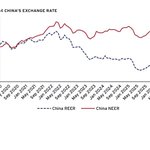
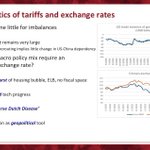
Correlation vs causation vs intent - as we argue in the #GenevaReport, it is mostly about the inflation differential driven by China’s housing bust vs the West inflation surge, at the time of rapid tech progress. A Reverse Dutch Disease that benefits China @cepr_org


Tanto en riqueza como en renta, las generaciones jóvenes de eeuu siguen mejorando a las anteriores - contra la narrativa imperante.


Angel Ubide retweeted

Confirmation of priors is always satisfying, and my priors—on US dollar dominance—just got resoundingly confirmed in the latest Geneva Report on the World Economy, one of the economics profession’s premier publications.
🧵
cepr.org/publications/books-…


Indeed - and why in the Geneva Report we argue that China faces a “Reverse Dutch disease” phenomenon: deflation from the burst of its housing bubble at the time of rapid tech progress, which gives it comparative advantage unrelated to nominal fx @Brad_Setser @SanderTordoir


Not only that - it made everybody automatically assume, in the political discussion, that trade = job losses/populism/bad stuff happens, no ifs no buts. See the debate now in Europe.

Esto de @IgnacioEzquiaga es muy relevante hoy, para poder tener un debate informado - y para entender dónde están las competencias de actuación para cada capa del problema de la vivienda.


ICYMI - here you can watch the presentation of the @cepr 2026 Geneva Report @piie. Imbalances, reserve currencies, the new trilemma in financial markets, the complex geopolitics of global macro policies, including exchange rates, and much more piie.com/events/2026/geneva-…

Esto es algo que elabore aqui hace un par de semanas - el descontento con la economia tiene una parte real, y una parte que no lo es, y la diferencia entre las dos partes no para de crecer elpais.com/economia/negocios… @el_pais


Angel Ubide retweeted

Highly relevant!
"Geneva 29: Changing Structure and Challenges of the International Financial System: Imbalances, Currencies, and Financial Stability" by Valentina Bruno, Steven B. Kamin, Ángel Ubide, and Cédric Tille.
"The 29th Geneva Report on the World Economy assesses four major challenges currently confronting the global economy. First, global imbalances have re-emerged as a central issue, driven by China’s growing external surplus, in part reflecting its active industrial policy, and the US deficit associated with expanding public debt. The authors argue that imbalances, though rising, are not yet a cause for serious concern. Even so, greater support for domestic demand in China and fiscal consolidation in the United States would address key policy needs in these two economies while at the same time helping to shrink the imbalances. Second, the global role of the dollar has gained renewed attention amid hikes in US tariffs, the Iran–US conflict, and mounting concerns about US fiscal sustainability. The authors argue that despite market disruptions such as those observed following “Liberation Day”, the dollar will likely retain its dominance in international trade and especially finance. Its two main competitors, the euro and the renminbi, are still hindered by fundamental limitations such as the lack of financial market integration, small supply of safe assets, and restrictions on capital mobility. Third, global liquidity has been reconfigured around capital markets since 2008, with an expanding stock of government debt and a growing role for non-bank financial intermediaries. Yet dealer banks remain the pivot of the system: the foreign exchange swap market and the repo market used to finance the US Treasury draw on the same dealer balance-sheet capacity. The result is a new type of trilemma – a bind where one cannot simultaneously have ever-expanding Treasury supply, strict constraints on dealer balance sheets, and an always-steady functioning of the bond market. Rather than retreating, the dollar's role as the operating system of global finance has only deepened. Finally, the report discusses the geopolitical aspects of imbalances and the importance of size, power dynamics, and the echoes of past crises. These explain the outsized impact of a few countries and markets, the concerns about ensuring access to strategic goods, and the inertia that prevents the implementation of desirable policies."
cepr.org/publications/books-…

And the 2026 Geneva Report is out! Join today for the launch piie.com/events/2026/geneva-… @PIIE @cepr_org

New CEPR #ebook out now! Geneva Report 29: Changing Structure and Challenges of the International Financial System
By: Valentina Bruno @KogodBiz, @steven_kamin, Cédric Tille @GVAGrad, & @AngelUbide
Free download: ow.ly/UzOH50ZSZ4C
Join us today for the online launch event - 3pm CEST / 9am EDT
Register: ow.ly/hRGc50ZSZ4y


If you work in finance, you should read this. If you dont work in finance, you should read it too, by @RobinWigg


Angel Ubide retweeted

Join CEPR and @PIIE for the launch of the 29th Geneva Report.
30 September from 9:00 AM to 10:00 AM EDT
The report authors, Valentina Bruno, @steven_kamin, Cédric Tille @GVAGrad, & @AngelUbide, in conversation with moderator @atkinsoncaro.
Register to join online: ow.ly/Hcoi50ZRo5t

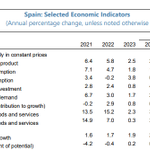
España va bien. El sector privado tirando de la economía con fuerte impulso de la inversión privada, manteniendo las buenas perspectivas de futuro.

This is very smart - people, knowledge and critical materials. @MarkJCarney is doing the right things to strengthen the Canadian economy, and the EU should do the same.

La deuda/pib española ha caído 25 puntos desde 2021, y ya está por debajo del 100%. En Francia, en cambio, está estancada en el 117%, y sin perspectivas de reducirse.

Pendant que la dette française s'élève à plus de 117% du PIB, celle de l'Espagne est passée sous la barre des 100% en juillet (elle culminait à 124% en mars 2021)
l.bfmtv.com/7sfJ

Angel Ubide retweeted
De donde surge la divergencia entre lo bien que va la macro y el descontento de los ciudadanos? Aquí unas ideas. Y, no, los boomers no tienen la culpa. elpais.com/economia/negocios… @el_pais