

Investor relations for funded startups.
Austin, TX
Joined June 2014
- Tweets6.6K
- Following1.2K
- Followers818
- Likes18.4K


Pinned Tweet
You may want to check out the newly launched Journal of Privat Markets Investing. The lastest journal launched by the original Institutional Investors Journals (now @PM_Research_), JPMI will quickly become THE resourse for best investment practices within the 'Alts' space. It's a spin-off from II/PMR's Journal of Portfolio Management, Edited since '86 by Frank Fabozzi, and will be Edited by Mr. Fabozzi's protege (my observation) - Prof. Michael Imerman.
AngelSpan retweeted

"We have 5 years until Social Security is bankrupt."
David @friedberg on why Brad Gerstner's (@altcap) Trump Accounts for children are great for America:
"The idea is right. It's a 401(k) for everyone."
"Social Security needs to flip into being a 401(k) for everyone, tomorrow."
"When you look at how much is going to get paid out and what the pay-in rate is, Social Security runs out of money in five years."
"It's got $2.7T in it today. It's a fucking treasury."
"They should sell that treasury, take that cash, and go buy the S&P 500."
"And then everyone that has Social Security should get an account, and they should get their money, and it should buy the S&P. And it can also buy private stock, and whatever."
"And we should do the same for all government employees and get them off of these pension plans."
"These pension plans are poison."
"The fundamental problem with these pension plans is that they will ultimately end up bankrupting the states, or become Ponzi schemes where people get screwed because they're expecting retirement benefits and they don't get them, and they're going to get bailed out somehow anyway."
"They should all be flipped to retirement accounts. They should all be flipped to 401(k)s."
"Everyone in America should get the same thing: 401(k) you own a piece of these equities in America, and we all participate together in the growth of America. And then everyone's incentivized to see businesses succeed."

BREAKING: David @friedberg on America vs Socialism
FULL INTERVIEW
Exposing the underlying problems no one wants to talk about.
How the bottom 50% got left behind.
"I don't blame Americans for finding themselves in the situation that they're in. I blame the bad policy that brought us to this moment."
"Americans should feel good about America. We just have to fix the policies."
"This can't just be a CCP psyop. It's coming from a place of hurt, of turmoil, of fundamental struggle."
"I'm saying everyone is right, but we need to be honest about what has happened to get us here & what the right path is to get us out of it."
We cover:
› Real wealth data: $183T total US net worth, $8T held by billionaires, $4T by the bottom 50%
› The 1982 Social Security mistake that cost the bottom 50% an extra $37 trillion (vs bankrupt !!!)
› Why capital gains & labor taxes should reverse
› Wealth tax as asset seizure
› Invest America for Children, a 401(k) from birth, & flipping Social Security into equities
› Joe Lonsdale: paying taxes that actually work
𝐓𝐈𝐌𝐄𝐒𝐓𝐀𝐌𝐏𝐒
(00:00) David Friedberg, CEO at Ohalo Genetics & Co-Host at All-In
(01:11) Is California functionally bankrupt?
(02:28) The real reason Americans can't afford anything anymore
(12:13) Why a wealth tax is really government theft
(21:22) Why blaming billionaires is a political strategy, not a solution
(25:33) How Socialism grows like a virus
(30:40) Inside Trump Accounts: a 401(k) for every American
(34:22) Why rational arguments can't compete with viral outrage
(40:56) Jeff Bezos's radical fix for the wealth gap
(45:47) 5 years till Social Security is bankrupt
(46:35) Is AI actually coming for your job?
(50:29) The K-shaped economy
(55:39) Five things America needs to fix to survive
(59:21) David's research process
(1:02:54) "It's about making Americans feel good again"
AngelSpan retweeted

🚨 BREAKING: Victor Davis Hanson Drops a Fiery Truth Bomb! 🔥
“We didn’t storm the beaches of Normandy… didn’t bleed and die in the trenches of World War I… didn’t sacrifice everything in World War II… JUST TO BE LECTURED BY NEWCOMERS on why America is ‘racist’ and ‘flawed’!”
Do you think Hamilton and Jefferson fought and died for YOU?
250 years of American blood—from Gettysburg to Belleau Wood to Iwo Jima—only for first- and second-generation arrivals to march in and declare:
“Your Constitution is garbage. The Founders were racists. When we take power, we’re tearing it all down.”
ENOUGH.
This is OUR country. We built it. We defended it with our lives.
If you come here, assimilate—or go home.
What do YOU think, America? Drop your thoughts below! 👇
@VDHanson #AmericaFirst #NoMoreLectures #DefendTheFounders
AngelSpan retweeted

The strongest organizations don't hide problems better. They make it easier for people to surface them.
- Virginie Delorme


I would suggest we need natural leaders, courageous leaders, principled leaders. Not self-appointed ones. Those that lived their principles. First principles. Timeless principles.

America needs a natural aristocracy.
Aristocracy just means “rule by the best” and Joe Lonsdale argues that it is an idea that is unduly demonized. Artificial, hereditary aristocracies are indeed a corrupting force, but to reject the idea that the most competent should rule is equally dangerous. By rejecting Aristocracy altogether, we don’t unleash democracy we get bureaucracy: a geriatric slop that will suffocate a civilization if not eradicated. This is what is plaguing America today.
@JTLonsdale is the closest thing you’ll find to a Roman senator, someone who acts courageously in politics, commerce, and the military informed by a classical understanding of virtue. And this interview will tease out Lonsdale’s political philosophy that underlies all of his ventures: Palantir, UATX, Cicero and 8VC.
Timestamps:
1:50 Change Requires a Demanding Philosophy
3:17 America’s Problem: No Aristocracy
8:34 In a World of Machiavellis, Be a Cyrus
10:51 The World Can’t Afford Our Absence
21:43 Democracy Dies in Bureaucracy
30:48 How Cicero Institute Writes Philosophy Into Bills
32:38 Measuring Who Gets Help First
44:04 When Buyers Become Too Powerful
50:04 The Philosophy Behind Palantir
This is really important, and why diversification and staging your investments over multiple rounds is so important not only to manage the downside, but to capture and lean into the upside.

Maybe it's time to start adding the 'LC' label to business models that pursue Limbic Capitalism. danieldashnawcouplestherapy.…

AngelSpan retweeted

There’s also evidence of “widespread misbehavior” as well!
"This is the first study that seeks to document the downside of the current pattern of VC contracting, where VCs receive very large amount of discretion in exchange for a mere promise not to misbehave. We cannot measure the extent of VC misbehavior itself, but we can study the tip of the iceberg – litigation – showing allegations of widespread VC misbehavior."
nber.org/papers/w13641

AngelSpan retweeted

“This place seems like exactly the kind of learning place that Charlie Kirk was trying to turn every American campus into.” — @SteveDoocy @foxandfriends
AngelSpan retweeted

VC is the only job I know where you "do" mostly nothing for years, are wrong on most of things you do actually do, and can then return hundreds of millions of dollars seemingly by accident.
AngelSpan retweeted

venture capital went from weirdos at the fringes of society investing in semiconductors to harvard educated spreadsheet jockeys doing occult excel macros to value brick and mortar private equity rollups at software multiples because the deck said "ai" 25 times.
We chose to be better....or not. There is a way to get our
innovation leadership back. But it requires applying some innovation to how we fund innovation. See joe-26467.medium.com/how-gov…

The biggest scandal is that top Silicon Valley VC firms went to China and “taught them how to do early stage investing.”
Venture capital is American Dynamism. “It is the thing that allows America to be dominant in the global economy.” And we just gave it away.
“VCs went over there and shared information, shared limited partners, shared all of the aspects and the functions of how you build an incredible legacy defining venture firm.”
Twenty years later, China has a full-stack tech ecosystem aligned with the CCP.
The real scandal is not just Apple but Silicon Valley itself.
@KTmBoyle
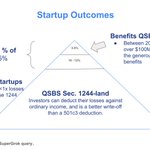
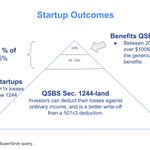
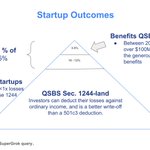
Everyone is now writing about QSBS Sec. 1202, which was made even MORE generous for those few investors that won the 'venture lottery'.
However, only approx. 3 - 5% of investors in startups will actually benefit.
Yet the original QSBS law - Sec. 1244 - impacts more startups' fundraising and early investors' opportunity to de-risk their investment.
Yet QSBS Sec. 1244 hasn't been modernized since 1978.
Is this just a lack of awareness from our Policy-makers, or is it the impact of lobbying by vcs?

More great work by @credistick.

"All models are wrong, but some are useful"
The post quoted below has ruffled enough feathers to require further explanation:
TL;DR for the lazy: The implication is simply that a trend towards larger portfolios is likely to lift the median to top quartile performance of venture capital.
This is a general observation, not a recipe for success. Nobody is trying to make the case that diversification is always and strictly better, or vice-versa.
Before going further, I think this quote (and the others below) from Daniel Kahneman summarises many of the responses:
"What we told the directors of the firm was that, at least when it came to building portfolios, the firm was rewarding luck as if it were skill. [...] The illusion of skill is not only an individual aberration; it is deeply ingrained in the culture of the industry. Facts that challenge such basic assumptions — and thereby threaten people’s livelihood and self-esteem — are simply not absorbed. The mind does not digest them. This is particularly true of statistical studies of performance, which provide general facts that people will ignore if they conflict with their personal experience."
(source: "Don't Blink! Hazards of Confidence")
Unequivocally true: Portfolio construction is a poorly understood topic, and too many GPs (and LPs) blindly follow the common wisdom about concentration without giving it proper thought.
There are factors the model cannot represent as a simple reflection of probabilities, and many of them are counter-intuitive or require deep analysis:
For example:
- Overconfidence is the most well-studied bias in investing, and is endemic to venture capital. It is a large part of what leads the majority of investors to believe they can pick well and concentrate.
More here: xitter.cf/credistick/status/1940…
- Overconcentration manifests as broadening the distribution of returns with a negative skew. That's exactly what we see in VC: it has the widest distribution of returns and the worst median.
More here: xitter.cf/credistick/status/1939…
- Diversification is shown to benefit fund performance by enabling investors to take more idiosyncratic risk per investment, which is fundamentally the source of outperformance. Concentration drives consensus.
More here: xitter.cf/credistick/status/1934…
A lot of the group-think around concentration versus diversification is based on the assumption that concentrated firms must be better at picking because they spend more time per investment.
This is fundamentally untrue, as is described in Kahneman's article. When faced with difficult judgements on limited information, people will habitually change the question to something simpler.
That is, if investors spend more time on decisions where that extra time doesn't actually yield access to more useful information, they're likely to construct a process that produces greater confidence rather than greater accuracy.
"The confidence we experience as we make a judgment is not a reasoned evaluation of the probability that it is right. Confidence is a feeling, one determined mostly by the coherence of the story and by the ease with which it comes to mind, even when the evidence for the story is sparse and unreliable. The bias toward coherence favors overconfidence. An individual who expresses high confidence probably has a good story, which may or may not be true."
In venture capital this typically manifests as overconfidence in founder-focused human capital, which produces predictably bad investments (and missed good ones).
More here: xitter.cf/credistick/status/1844…
The distribution of outcomes in venture capital, and the unpredictability of those outcomes, means it is fundamentally a portfolio discipline more than it is a picking discipline. The only point at which that changes is when an investor has enough genuine experience to consistently beat the odds — which is very rare.
Just as every pitch to LPs somehow demonstrates top quartile performance, every investor believes they can beat the odds. ~90% of VCs lose that fight.
Finally, there is another important element to this portfolio construction question: reserves.
I don't have anything written on this topic (yet), but I know two people who have:
First is @AngelSpanInc's brilliant paper on 'Process Alpha' in venture capital.
Essentially, his proposition is that a diversified portfolio with a robust follow-on strategy can reap the benefits of both strategies: broad exposure to more potential outliers, and the ability to concentrate. It is represented in the diagram below.
"Poker players and statisticians sorted this out years ago, and the economics of gambling and venture capital are similar: If you are wrong (particularly at the seed stage of investing), you lose all your money. A recognized optimization framework that is instructive as to how much investor capital to deploy at each stage of the startup life cycle (or funding round) is called the Kelly Criterion, also referred to as 'The Scientific Gambling Method'"
(source: "Process Alpha: How to Construct and Manage Optimized Venture Portfolios")
Another great read on this topic is from @LauraLPThompson of @SapphirePrtnrs. It covers multiple angles on reserve strategies, with some interesting math, but there's one particular quote that is relevant to this theme:
"Reserve dollars have to be concentrated into winners to improve fund performance and there usually aren’t many of them. Early-stage venture remains a power-law business, and many portfolios come down to one or two winners."
(source: "Dirty Secret: Venture Reserves are Not Always a Good Thing")
To conclude a post that is already too long:
"Diversification versus concentration" is a complex and multivariate question. There is no "right" answer, and certainly not one that can be reached by a simple model of distributed outcomes.
However, the general understanding of this topic and the underlying factors is shockingly poor, which speaks to the institutional insecurity of venture capital and the unwillingness to engage in self-scrutiny.
If you are a GP, you owe it to your LPs to be a student of venture capital. Read the research, familiarise yourself with the data. Build a well-informed and rational strategy. Do not engage in group-think.
If you are an LP, you are paying GPs significant management fees to invest your money. Learn how to find competent investors, and then don't get in their way if they have a rational strategy.
Beware anyone who blithely dismisses questions like these; they are charlatans.
To finish with another great quote from Kahneman:
"In general, however, you should not take assertive and confident people at their own evaluation unless you have independent reason to believe that they know what they are talking about. Unfortunately, this advice is difficult to follow: overconfident professionals sincerely believe they have expertise, act as experts and look like experts. You will have to struggle to remind yourself that they may be in the grip of an illusion."

AngelSpan retweeted

Please raise taxes on the rich in NYC @ZohranKMamdani... we need more founders and investors in Austin!

AngelSpan retweeted

This 9 min video is the most brutally honest portrayal of the world of venture capital investing!
Q: "40% of all venture funding raised finally goes to Google, Facebook & Amazon"
https://xitter.cf/t.co/8GB60BlOtu via @TWistartups #VentureCapital #technology #startups #valuations #markup
You need to know WHAT the data is telling you, regardless of how it was collected/availed. This has been well settled in the public investing markets. More data doesn't improve outcomes. The right data, in the right hands, does. That last part will always be the most important component of decision-making. Not how easy it is to accumulate data.

Bob McGrew (Head of Research OpenAI) explains why proprietary data no longer provides companies with a competitive advantage in the AI era.
Finance companies once believed their years of accumulated data would give them an edge. They planned to train specialized models on top of GPT or Llama using their exclusive information.
The results shocked them. Their industry-specific models performed worse than the next generation of general purpose models. The ability to synthesize new information proved more valuable than memorizing old data.
McGrew introduces the concept of "embodied labor" - the human work behind data collection. Companies spent years having employees call customers, analyze case studies, and gather information through manual processes.
This accumulated knowledge required massive time and money to build. It represented thousands of hours of human effort that companies thought couldn't be replicated by competitors.
But AI changes everything. Instead of years of customer calls, AI can conduct comprehensive surveys instantly. Rather than manual case analysis, AI processes thousands of examples in hours.
The core insight is that value wasn't in the data itself but in the labor required to collect it. Since AI makes that labor essentially free, the advantage disappears.
Companies can no longer rely on their proprietary data as a protective moat. Any competitor can use AI to replicate years of data gathering almost instantly.