
Charles William Elliot Professor of Education, Harvard Testing, Measurement, Psychometrics, Statistics @andrewdeanho.bsky.social
- Tweets3.3K
- Following934
- Followers4K
- Likes2.7K





ALT Promotional poster for a Wellesley College talk in the Quantitative Reasoning & Education series. The title is ‘Beyond the Test Score: Making Sense of Educational Statistics,’ featuring Andrew Ho, Harvard Graduate School of Education. The poster says the talk will examine predictable fallacies in quantitative reasoning about educational testing and measurement, using examples involving test scores and statistical communication. It describes the presentation as a three-part story and lists the date and location as Thursday, October 15, 5:00 p.m., Knapp Atrium, Pendleton East. The event is open to the public and sponsored by the Quantitative Reasoning program, with support from the Wellesley College Department of Education.


ALT Screenshot of an NCME webpage announcing a public webinar titled ‘Why Educational Measurement Matters in the Age of AI,’ presented by the NCME Communications Committee on October 9, 10:30–11:30 a.m. EDT. The description says the webinar brings together leaders in educational measurement, assessment, learning analytics, and AI in education to discuss how the field can contribute to modern AI. It lists panelists Andrew Ho of Harvard University, Kristen DiCerbo of Khan Academy, and Alyssa Wise of Vanderbilt University, and notes that the session will be moderated by Seyedahmad Rahimi. A ‘Register Now’ button appears above an ‘About the Presenters’ section with biographical text and headshots of the three panelists.

ALT Promotional banner for AIME-Con 2026, NCME’s conference on AI in Measurement in Education. The graphic shows the event name, ‘Pittsburgh, PA, USA,’ a colorful line-art skyline of Pittsburgh with bridges and buildings, star-shaped graphics, and the NCME logo.

ALT Screenshot of an NCME program listing for a coordinated paper session titled ‘AI Competencies in Educational Measurement: Expanding the NCME Foundational Competencies.’ The session is scheduled for Wednesday, October 7, 1:45–3:15 PM in Commonwealth 1. The description explains that the 2024 NCME Foundational Competencies framework largely treated AI as part of technical, statistical, and computational competencies, and that the session will consider what measurement professionals should know and be able to do with AI, how to teach those skills, and how to assess them. It lists presentations on AI-integrated assessment, expanding existing competencies, credentialing AI competency, and technical AI competencies such as error detection, fairness, and bias. Chair: Kadriye Ercikan, ETS Research Institute. Discussant: Andrew Ho, Harvard University.

ALT Screenshot of an NCME webpage titled ‘NCME Endowment Matching Challenge by Past President Andrew Ho.’ The page says that each month through the new year, an NCME past president will match member donations to the NCME Endowment dollar for dollar, up to $500. It describes the endowment as a permanent fund supporting measurement excellence and integrity for future generations. The page includes a portrait of Andrew Ho beside the NCME logo and a reflection explaining his decision to launch the matching challenge and support the endowment.


ALT Photo of a stage during a Harvard Graduate School of Education community kickoff event. A slide on the large screen reads ‘Performance by Jonathan Dely,’ identifying him as a jazz trumpeter and student in the Education Leadership, Organizations, and Entrepreneurship program, with the date August 24, 2026. Onstage, a jazz ensemble includes a pianist at a grand piano and keyboard, a trumpeter, a double bassist, and a drummer at a drum kit.

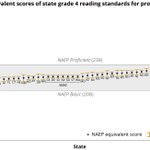
ALT Chart titled ‘Figure 1. NAEP equivalent scores of state grade 4 reading standards for proficient performance, by state: 2022.’ Each state is shown as a blue dot with yellow error bars (±2 standard errors), ordered from lowest to highest NAEP-equivalent cut score. A shaded band marks the NAEP achievement levels, labeled NAEP Basic (208) near the bottom and NAEP Proficient (238) near the top. States, or groups of them like ‘SBAC’, are labeled throughout. The plot shows wide variation across states, from the lowest scores on the left to the highest on the right.


ALT Screenshot of a match listing for FIFA World Cup 2026™ showing the Final scheduled for Mon, Jul 20 at 4:00 AM. The teams displayed are Spain (flag on the left) versus Argentina (flag on the right).


ALT The 3-4-5 Triangle of Measurement Mnemonics from Ho (2026), summarizing assessment communication mnemonics. At left, text reads: ‘The 3 Ws (Ho, 2022): Who is using Which scores for What purpose?’ At right is a triangular diagram labeled ‘The 4 Quadrants of Testing Purpose’ along the base, with the triangle’s corners/edges labeled Context, Evidence, and Relevance. Above the triangle is the heading ‘The 5 Cs of Validity Evidence (AERA, APA, & NCME, 2014).’ Large numerals 3, 4, and 5 emphasize the three frameworks.

ALT Screenshot of a Massachusetts legislature webpage summarizing a briefing by the Joint Committee on Education held Tuesday, June 30, 2026 on innovative and more effective approaches to K–12 assessment and accountability in Massachusetts. The page lists discussion topics (current assessment/accountability status, innovative approaches, and recommendations for actions by DESE and/or the legislature) and names invited experts and stakeholders, including Dr. Andrew Ho (Harvard Graduate School of Education) along with other education and policy representatives.

ALT Screenshot from the International Meeting of the Psychometric Society (IMPS) 2026 detailed program (all times in KST), showing the Wednesday, July 22 schedule. A block titled ‘Advances in Psychometrics and Measurement’ begins at 12:30pm in B125, Ballroom, The Commons, chaired by Dr. Daniel Bolt. The listed talks include: ‘Proficiency-Related Slipping and Guessing’ (Daniel Bolt and Lionel Meng), ‘A reliability-corrected adjusted R-squared for latent regression’ (Paul Jewsbury and colleagues), ‘Accounting for Skewness in Psychometrics: The Bayesian Skew-Normal IRT Family’ (Jorge Bazán), ‘Two Watches: Measurement Error Models for Discrepant Test Score Trends’ (Andrew Ho), and ‘Measurement model evaluation: Beyond statistical models’ (Mark Wilson and Yukie Toyama).


