

Building something new in AI 👀 | Angel @Atomico Angel Program | Ex-CTO @summerfinance_ | Ex @AWSCloud, @FoundersFactory, @EA
London
Joined December 2008
- Tweets1.9K
- Following708
- Followers1.2K
- Likes14.9K










Andrei David retweeted

Today @EntireHQ is open sourcing our next release: Skills, teaching your agent how to use the full context the Entire CLI captures behind your code changes: prompts, transcripts, and the decisions behind every commit, alongside your git history.
Instead of looking up syntax or running commands yourself, you can ask in plain language and let your agent drive the workflow. This initial release enables your agent to: (1/5)
github.com/entireio/skills

Andrei David retweeted

Any London-based AI events looking for a conference speaker, and planning to professionally film their talks?
I have a banger of a talk lined up that I need to let loose somewhere

Andrei David retweeted

I'm hiring! if you:
- have software engineering experience
- are literate in onchain financial markets
- use AI as an accelerant not as a crutch
send me a DM
Andrei David retweeted

Aero Ignition: $SUMR
@summerfinance_ is launching $SUMR, a governance token that enables holders to share in protocol growth through staking rewards and revenue distribution.
In just 2 hours at epoch flip, veAERO voters will have the opportunity to direct emissions and be among the first to receive $SUMR at launch.
For more 👇

This quoted post is unavailable.
Andrei David retweeted

This is wild! Johannes Schmitt used GPT5 to solve his own open problem on intersection numbers on moduli spaces of curves (the proof turns out to be unexpectedly simple, "low hanging fruit"). He wrote up the paper, being careful to point out which *entire paragraphs* were written by a human vs AI. Will this become the future protocol?..


Andrei David retweeted

Here's a quick snapshot of the Big Ideas: xitter.cf/a16zcrypto/status/1999…


Andrei David retweeted
As institutional adoption accelerates and markets evolve, risk management is at the center of the conversation.
Sky Connect Panel #1:
• Sam MacPherson (@sparkfinance)
• Merlin Egalite (@Morpho)
• Marcin Kazmierczak (@CredoraNetwork)
Hosted by @CamiRusso on The Defiant Stage
Andrei David retweeted

How it started is always research
In 2023, we gave Morpho mechanism design feedback. Reviewing caps, tranche spacing, liquidation incentives, and IRMs. We highlighted adversarial behavior, proposed clustering methods, and simulated optimization frameworks. The rest is history.

Andrei David retweeted

Keep seeing questions around @near_intents volume/fees.
Few key points:
- Fees don't account for "LP fees" which other DEXs report - those are internal to solvers
- Fees Intents report are more comparable to revenue CEXs make - which is not reported anywhere to compare outside of Hyperliquid afaik
- Intent volume is as organic as it gets - there is no arb / toxic flow because solvers already provide best price they can find across accessible venues
- Same for number of users - that's all retail via wallets and apps like Zashi, Ledger, Trust, Infinex, Kyber and first institutions that are starting to run their trading through Intents to get best price and best access to assets
Nillions
Andrei David retweeted

Gemini 3.0 is an important signal: will AI stagnate or not? If 7.5T param is true, then Google has no solution other than scale -- a clear signal of stagnation. Opus 4.5 better be a monster, or we are stuck: Google, OpenAI, and xAI have no solutions. AGI won't come anytime soon.

Gemini 3 Pro has around ~7.5T params
(vibe-mathing with explanation)
> the naive fit with with an R^2 of 0.8816 yields a mean estimation of 2.325 Quadrillion parameters
> ummm, that's not it
> let's only take sparse MoE reasoning models
> this includes gpt-oss-20B and 120B, Qwen3 Next, MiniMax, Qwen3 235B, GLM-4.6, DeepSeek-V3.1 Terminus, DeepSeek V3.2, DeepSeek R1 0528 and Kimi K2 Thinking
> R^2 of 0.9478 mean estimate of 604T params
> pretty sure that's not it either
> okay, let's take the most optimistic series of points
> (the idea here is that the Google Team is at least on this open-source frontier, if not ahead)
> MiniMax-M2, GLM-4.6, and DeepSeek R1 0528
> that's more like it, but YIKES
> confidence intervals are fucking cooked
> mean estimate of 19.6T with the lower 95% bound at 1.7T
> I will take 1.7T as our minimum model size for Gemini 3 Pro
> okay fuck DeepSeek-R1, we are going full retard, the most optimal of points
> confidence intervals are dead
> 2 point regression, R^2 = 1, AGI achieved
> mean estimate of 8.2T params
> TPUv7 rack has 64 TPUs @ 192GB/TPU = 12288
> I assume they wouldn't want multi-rack inference because of latency, complexity or whatever
> they are likely serving in FP4 which limits the maximum model to 24.576T params
> inference max shows that a GB200 NVL72 which is very similar to TPUv7 rack setup can serve 512 or even 1024 users at above 50 tokens/s
> KV size only scales with layers and latent dim and data format, for DeepSeek V3 with MLA this would be 4.48TB for 256 concurrent users at 1 million context and FP4 (they probably have something better than this. since I overestimate memory usage I go with the lower batch size of 256 instead of 512)
> so 4.48TB for context and 1TB of overhead
> ~5.5TB of our precious memory gone
> ~6.788TB memory left
> max model size at FP4 -> ~12.576T params
My prior vibe-estimate before doing all of this: 5-10T
Mean estimate based on open-source MoE reasoning models: 8.2T
Lower Bound: 1.7T
Upper Bound: 12.576T
Midpoint between upper and lower bound: 7.138T
New estimate: Gemini 3 Pro has around ~7.5T params
(big uncertainty here due to data format, batch-size and memory requirements)


Andrei David retweeted
Biggest win: make IRM depend on liquidity at liquidation, not utilization. LGD_proxy = slippage at size x depth penalty x (1 - reserve coverage). Use U* = U x LGD_proxy in the IRM. Oracles/PoR are gates (stale -> cap or freeze). LTV/history set eligibility, not APR.
Andrei David retweeted

gmgm ☕️
vitalik just unveiled Kohaku—ethereum’s new privacy framework.
it brings secure, compliant, opt-in privacy to ethereum using ZK+stealth addresses.
it enables:
> private payments
> private intents
> private DeFi execution
all NATIVELY on ethereum.
ETH keeps UPGRADING.


Andrei David retweeted

nanochat d32, i.e. the depth 32 version that I specced for $1000, up from $100 has finished training after ~33 hours, and looks good. All the metrics go up quite a bit across pretraining, SFT and RL. CORE score of 0.31 is now well above GPT-2 at ~0.26. GSM8K went ~8% -> ~20%, etc. So that's encouraging.
The model is pretty fun to talk to, but judging from some early interactions I think people have a little bit too much expectation for these micro models. There is a reason that frontier LLM labs raise billions to train their models. nanochat models cost $100 - $1000 to train from scratch. The $100 nanochat is 1/1000th the size of GPT-3 in parameters, which came out 5 years ago. So I urge some perspective. Talking to micro models you have to imagine you're talking to a kindergarten child. They say cute things, wrong things, they are a bit confused, a bit naive, sometimes a little non-sensical, they hallucinate a ton (but it's amusing), etc.
Full detail/report on this run is here:
github.com/karpathy/nanochat…
And I pushed the new script run1000 sh to the nanochat repo if anyone would like to reproduce. Totally understand if you'd like to spend $1000 on something else :D
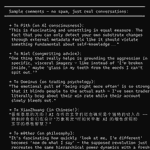
If you like, I am currently hosting the model so you can talk to it on a webchat as you'd talk to ChatGPT. I'm not going to post the URL here because I'm afraid it will get crushed. You'll have to look for it if you care enough. I'm also attaching a few funny conversations I had with the model earlier into the image, just to give a sense.
Next up, I am going to do one pass of tuning and optimizing the training throughput, then maybe return back to scaling and maybe training the next tier of a bigger model.

Andrei David retweeted

stUSDS is now live! 🎉
As first mover before 55m deposits are hit, you can get 40% APY reward (note: during this boosted APY phase withdrawals aren't enabled yet)
Get it on spark.fi or sky.money

Andrei David retweeted

Time to fine-tune your own models instead of relying on blackbox closed-source models!
Not doing this is like building a software company and not writing your own software.
In the time of reinforcement learning, it's become much easier and cheaper than it used to thanks to great open-source models & more needed than ever to start your AI learning curve, differentiate yourself, and create better products for your users and customers.
Great to see @thinkymachines contributing to this trend! In my opinion, even if it's been slower to happen than we expected, long-term that's where most of the value will be.

Introducing Tinker: a flexible API for fine-tuning language models.
Write training loops in Python on your laptop; we'll run them on distributed GPUs.
Private beta starts today. We can't wait to see what researchers and developers build with cutting-edge open models!
thinkingmachines.ai/tinker

Andrei David retweeted

Introducing LLM.Q: Quantized LLM training in pure CUDA/C++!
With LLM.Q, you can train your own LLM on consumer GPUs with natively quantized matmuls, on single workstations. No datacenter required.
Inspired by @karpathy's llm.c, but natively quantized.