

Ancient history, archaeology, and artifacts. Lost worlds, sharp facts, and stories buried in time.
Joined February 2024
- Tweets3.7K
- Following444
- Followers5.5K
- Likes20.5K




Pinned Tweet
Fifteen tablets returned to the Iraq Museum show that Ur III Mesopotamia, famous for counting every sack of grain, also had royal estates running on their own paperwork. One belonged to Princess Šat-Eštar, on the border between Umma and Girsu.
ancientcontent.com/p/urs-oth…

Ancient History Lab retweeted

The man carved on this black granite sarcophagus was a professional dancer, and he made sure we would know it.
His inscription names him as Djeho, son of Petekhons, and records what he did. He danced at Memphis on the day the Apis bull was laid in the ground, and at Heliopolis at the festival of the Mnevis bull. He was buried around 346 BC with his profession written into the stone beside him.
Then there is the figure on the lid. It stands 120 cm, cut in profile, unclothed, and a clinical assessment published in 2023 reads its proportions as consistent with achondroplasia.
That is the part worth pausing on. Egyptian funerary art idealises almost without exception, smoothing every owner into the same correct body. This sarcophagus does the opposite. It gives Djeho the body he actually had, at the height he actually was, in the hardest stone available.
Ancient History Lab retweeted
Northern Spain emptied its hillforts in one generation around 400 BC.
New radiocarbon work shows where it started.
Why it happened is still open.
Short documentary on the castros of Asturias and Galicia, out now for subscribers.
You're unable to view this Tweet because it's only available to the Subscribers of the account owner.
Ancient History Lab retweeted

In 297 AD, the Jin Dynasty general and folk hero Zhou Chu died in battle. When archaeologists excavated his ancient tomb, they analyzed the metal belt plaques ornamenting his burial attire.The laboratory results revealed an impossible metallurgical anomaly: the belt pieces contained aluminum.
The Technological Paradox
Pure aluminum does not occur naturally in its elemental state, and industrial extraction via electrolysis wasn't invented until the 1820s. Yet, chemical analysis of the tomb's belt ornaments indicated the presence of aluminum alloy components. #Archaeology
#AncientHistory
#Metallurgy
#AncientMystery
#HistoryThread

Ancient History Lab retweeted

Look closely at these 4 pics at Gobekli Tepe. How many partially buried T-Pillars do you see?
Many people are disturbed to learn that there has been NO attempt to excavate any of these Pillars in the last several years. They’ve could unearth them TODAY if they wanted to. But for reasons unknown, they’ve been left to gather dust.
What carved depictions are waiting to be seen on these pillars? How are we supposed to learn anything from them when they haven’t been excavated? Make this anti-archaeology make sense….??


Ancient History Lab retweeted
Five clay dogs, each smaller than your palm, guarded a doorway in Ashurbanipal’s palace at Nineveh around 645 BC.
Each one was painted a different colour, and each had its orders pressed into its side.
Loud is his bark.
Catcher of the enemy.
Expeller of evil.
Biter of his foe.
And the white one, Don’t think, bite!
The full story of the guard dogs of Nineveh is below for subscribers.
You're unable to view this Tweet because it's only available to the Subscribers of the account owner.
Ancient History Lab retweeted
Post-Amarna Egypt gave its gods the face of the reigning king. The granite Khonsu from Karnak carries exactly that face, which is why Egyptologists place it in the reign of Tutankhamun or of Horemheb and have never settled which.
The god himself was named for movement. Khonsu means the traveller, after the moon crossing the sky each night, and the Egyptians also trusted him to heal. The Bentresh stela tells of his image being carried abroad to drive an affliction out of a foreign princess.
At Mizyn in Ukraine, 18,000 years ago, carvers copied the hidden pattern inside mammoth tusks onto the ivory figurines they made from them.
Inspiration, or a template?


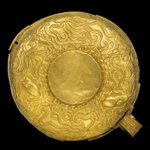
The gold cup from the tholos tomb at Dendra was found lying on the chest of the dead, with six sealstones and four rings placed inside it.
Octopuses are raised across the bowl from a single sheet of gold, and the whole burial was arranged as one composition around the body.

Ancient History Lab retweeted
13th-Century BC Bronze Sword Discovered in Italian Volcanic Lake Still Retains Sharp Edge
Underwater archaeologists excavating Lake Mezzano, a volcanic crater lake in Lazio, Italy, have recovered an exceptionally preserved 13th-century BC bronze sword with a intact cutting edge. Dating to the Late Bronze Age (contemporary with the reign of Ramesses II in Egypt), the artifact was retrieved from the lake's unexplored southern shore alongside an array of bronze weapons, pins, and an intact razor.
The find represents the third Bronze Age sword recovered from the submerged site, which houses a prehistoric pile-dwelling (palafitte) settlement continuously inhabited between 1700 and 1150 BC. The close association of the sword with a bronze razor parallels elite warrior burials across Bronze Age Europe, suggesting the deposit may represent a high-status ritual offering to the waters. However, burnt traces on nearby structures indicate it could also stem from a catastrophic fire or lake-level shift.
Video: SABAP provincia Viterbo ed Etruria Meridionale
Mixed blessings of a changing climate. How do we keep ice in place and find those ice age items...
xitter.cf/HistContent/status/210…
A Stone Age Arrow Surfaces in Jotunheimen, Norway
In three weeks this summer, the Secrets of the Ice team recovered 48 prehistoric arrows from the Langfonne, Storfonne and Handklefonne ice patches. The oldest is a slate arrowhead, 5,000 to 6,000 years old, still carrying fragments of its wooden shaft and traces of its original binding. Alongside it came a complete 3,600-year-old arrow tipped with freshwater mussel shell.
For most of the project's 20 years, finds dated to the last two millennia. Now the oldest ice is melting, and the oldest objects are surfacing with it. The archaeologists expect most of these ice patches to vanish within two decades.
Every arrow rescued is a hunt remembered. The race is on.

ALT Slate arrowhead. Approximately 5,000 years old. Reindeer (domesticated reindeer) can be seen on the ice patch in the background. Photo. Åsa Rommetveit Celius, Innlandet County Municipality, Secrets of The Ice.
The "handbag of the gods" on the Nimrud reliefs has a name. Assyrian ritual texts reveal what it held and which hand carried it.
ancientcontent.com/p/the-han…
Ancient History Lab retweeted
Just published for subscribers: Enoch walked with God for 365 years before disappearing. A century of scholarship traces his story back to Babylon, where a king was seated on a golden throne by the sun god before the Great Flood.
Subscribe for just $3/month to unlock the full article and gain access to exclusive Ancient Content research.
You're unable to view this Tweet because it's only available to the Subscribers of the account owner.
Ancient History Lab retweeted
Every culture remembers a flood. We tested the oldest of those stories against the evidence and found where a real memory of the Ice Age survives 👇
You're unable to view this Tweet because it's only available to the Subscribers of the account owner.
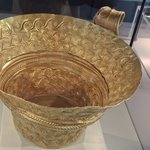
This gold cup from Tholos Tomb 3 at Peristeria in Messenia was hammered from thin gold sheet some 3,500 years ago.
Its running spirals are raised from the metal itself. It is on view in Athens through October 31 in the Pylos of Nestor exhibition.

ALT This gold cup from Tholos Tomb 3 at Peristeria in Messenia was hammered from thin gold sheet some 3,500 years ago. Its running spirals are raised from the metal itself. It is on view in Athens through October 31 in the Pylos of Nestor exhibition.
Ancient History Lab retweeted
Every account of Pompeii states the eruption happened on 24 August, 79 AD. That date comes from one letter, written 25 years after the event, and the surviving copies of that letter disagree by up to three months.
In 2018 a wall inscription dated 17 October turned up, days before the eruption. It briefly rewrote the history books. Then the evidence got more complicated again, and the debate is still open.
One of the most famous dates in ancient history rests on a single letter that nobody has ever agreed on how to read.
This statue was broken in the Persian destruction of Miletus in 494 BC.
Nobody discarded her. Nobody reused the stone. The sanctuary staff sealed her behind a brick wall inside her own shrine, kept there as the permanent property of the goddess she had been given to.
A votive offering did not stop being sacred when it broke. It just had to be kept safe instead of used.

When fishermen pulled this statue out of the Aegean in 1995, marine encrustation completely masked the bronze beneath. Restorers spent years picking away thick layers of mineral deposits to expose the crisp, chiselled fringe along the hem of her cloak.
Looking at the smooth metal on display today hides the reality that this statue spent over two millennia acting as an underwater reef. It leaves you wondering how many other masterworks are sitting on the seabed right now, looking like ordinary rocks to passing boats.

Most ancient bronze statues lost their glass and ivory eye inlays centuries ago, leaving hollow, ghost-like sockets. This head survived with its original white ivory and dark pupils intact, giving the expression an unnerving, focused intensity.
The drapery below the neck was attached much later during the Renaissance to make the fragment displayable in papal collections. Stripping away those 16th-century shoulders leaves a bare portrait head that feels remarkably modern in its psychological weight.
