






Ammonia has no carbon in it, so burning it on a ship releases no carbon dioxide. That is a big reason it is a leading candidate to clean up shipping, which produces about 3% of the world's CO2.
But carbon is not the whole story. A recent scientific review points out that ammonia also has a nitrogen footprint. Small leaks during production, storage and refueling, plus exhaust gases like nitrous oxide, can warm the climate and harm sensitive ocean areas if they are not controlled.
The good news is that this is manageable. Tight tanks, careful transfers, capturing vapors and good exhaust cleanup keep the climate benefit intact.
For us, it is a reminder that safe storage and delivery are not only about safety. They are part of what makes ammonia a clean fuel in the first place.
frontiersin.org/journals/mar…

Hydrogen is a clean fuel, but it is hard to move. It is very light, takes up a lot of space, and is costly to ship over long distances.
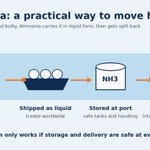
Ammonia offers a practical workaround. It carries hydrogen in every molecule, turns liquid with modest cooling or pressure, and is already shipped around the world every day. At the destination, a cracker splits it back into hydrogen and nitrogen.
In the Port of Antwerp Bruges, Air Liquide has been running what it calls the world's first industrial scale ammonia cracking pilot since November 2025. It handles 30 metric tons of ammonia a day, and the cracking step itself releases no direct carbon dioxide.
The climate benefit still depends on how the ammonia is made. And the whole chain only works when ammonia is received, stored and delivered safely, from the port to the people who need the hydrogen.
industrylinqs.com/hydrogen/2…

A new fuel is only as safe as the people who handle it.
Mineral Europa, the world's first ammonia powered dry bulk ship, is now on its maiden voyage. Before it sailed, its ship manager trained crew and shore teams on a 3D digital copy of the vessel, a fuel system simulator, refueling practice and emergency drills. Senior officers also joined the yard and sea trials to learn the ship firsthand.
Design work started back in 2018, when rules for ammonia as a marine fuel were still being written. Tanks, double wall piping, ventilation, leak detection and emergency shutdown were planned as one system.
That lesson reaches well beyond ships. Equipment matters, but trained people and clear procedures are what keep ammonia storage and delivery safe every single day, at ports, on farms and in factories.
angloeastern.com/news-and-in…

Ammonia prices can move fast. In China, liquid ammonia fell almost 13% in a single week, to about 2,617 yuan a metric ton in the week to October 16.
The reason is simple. Plants that had been shut for maintenance came back online around the same time, while demand from fertilizer makers stayed near its seasonal low. Some producers are now building up inventory, and prices are still about 18% higher than a year ago.
Swings like this are part of the ammonia business. The buyers and sellers who ride them out best have safe storage close to where ammonia is used, so they can buy when prices dip and still deliver on time when farms and factories need it.
marketpulsescope.com/news/ch…

Many data centers rely on diesel generators to keep the lights on when the grid fails. As AI pushes power demand higher, cleaner onsite power is becoming a real question.
One option being tested in Japan: IHI has started trials of a 6,000 kW ammonia fueled engine for power on land, built on its ship engine work and aimed at data centers, industrial parks and remote sites that run on diesel today. It can switch between ammonia and conventional fuel, and the tests go beyond the engine to fuel supply, exhaust cleanup, and systems that contain and neutralize ammonia inside the enclosure if a leak ever happens.
That is the real lesson. Clean power at a data center only works if the fuel arrives on schedule and is stored and handled safely on site, every single day.
ammoniaenergy.org/articles/l…

Most talk about ammonia powered ships is about giant ocean carriers. River barges matter too.
A German research project is working on ammonia power for inland waterway vessels. Fraunhofer IMM is developing a cracker that turns ammonia back into hydrogen to feed a 200 kW gas engine, while partners design a lightweight tank shaped to fit the free space on board, so a barge can carry more fuel.
What stands out is the approach. Storage, fuel handling, the engine, controls and safety are treated as one system instead of separate parts. That is how a carbon free fuel becomes practical on rivers and in ports: safe storage and delivery have to be designed in from day one.
hydrogen-worldexpo.com/exhib…

Every fall, American farmers face the same bet: buy next year's fertilizer now, or wait for spring and hope prices come down.
This year the bet is harder. Fertilizer costs as much as 20% more than a year ago, prices jumped after the Iran war started, and few people see relief coming soon. Crop prices are also lower than during the 2022 spike, so more farmers are paying with loans instead of earnings.
Much of that fertilizer is nitrogen, and nitrogen fertilizer starts as ammonia. When global supply gets squeezed, storage and reliable delivery close to the farm matter more than ever. They give buyers room to choose when to buy and make sure the ammonia is there when the field is ready.
marketplace.org/story/2026/1…

A 30,000 ton cargo of ammonia has left Nanjing, China for Morocco, the first commercial voyage on a new shipping route to North Africa.
Why does that matter? Morocco is a major fertilizer maker, and ammonia is a key ingredient in its phosphate fertilizers. Before loading, the ammonia moved by pipeline from storage tanks to the export terminal, and loading took two days with gas monitoring and safety checks. The ship will sail around the Cape of Good Hope to get there.
Most of us never think about it, but a lot of the food on our tables depends on ammonia being stored safely and delivered on time. New routes help, and so does reliable storage and delivery at both ends.
en.walaw.press/articles/moro…

Gujarat's state fertilizer company wants to build green ammonia where the tanks and jetty already exist.
GSFC is seeking a joint venture partner for a plant of at least 500,000 tons a year at its Sikka complex in Jamnagar. The site already has a captive jetty for ships around 33,000 deadweight tons, about 30,000 tons of refrigerated ammonia storage, and a pipeline between the shore terminal and the plant. Roughly 90% of output is planned for merchant sales and exports, with about 10% for its own fertilizer use. Partner responses close November 29, with commissioning targeted before the end of 2030.
Clean ammonia projects move faster when storage and safe delivery are already part of the site, not an afterthought.
indianchemicalnews.com/ammon…

Clean shipping has a chicken and egg problem. Ports wait for ammonia ships, and shipowners wait for ports that can fuel them.
CMB.TECH is trying to grow both at once. It plans 21 ammonia capable vessels by 2029 and is preparing an ammonia bunkering terminal at Walvis Bay, Namibia, with construction set to start in 2027. Its chief technology officer points out that the risks are not equal. A dual fuel ship can keep running on conventional fuel while the market grows. A terminal depends on how much fuel moves through one port, so it needs customers beyond its first owner.
That is why open access storage and safe, reliable delivery at a few busy hubs matter so much in the early years.
futurefuels.in/cmb-tech-says…

Europe's fertilizer story right now is really a natural gas story.
Germany's largest ammonia and fertilizer producer, SKW Piesteritz, is running at only about 40% of its ammonia capacity. One of its two ammonia units is offline and the other is at a technical minimum, as its parent company points to high gas and carbon prices and weak fertilizer demand.
Most of the world's ammonia is still made from natural gas. When gas gets expensive, local plants slow down and more of what farms and factories need can end up arriving by ship. That puts port storage and safe delivery at the center of food and energy security, and it is a big reason lower carbon ammonia made where energy is cheaper keeps getting attention.
expanamarkets.com/insights/a…

A big decision for cleaner shipping is coming in December.
Governments at the International Maritime Organization plan to resume talks on December 4 on the Net Zero Framework, subject to confirmation that same week. In plain terms, it would set a global limit on how polluting ship fuel can be, tighten that limit every year, charge ships that go over it, and reward ships that switch to zero or near zero emission fuels. It would cover oceangoing ships over 5,000 gross tons, which produce more than 85% of shipping emissions.
For fuels like ammonia, clear global rules are what turn pilots into real supply chains: ships, bunker vessels, port storage and safe delivery, all planned with confidence.
imo.org/en/mediacentre/press…

Food security often comes down to something unglamorous: storage at the right port.
Brazil has opened the auction for a new fertilizer terminal at the Port of Itaqui in Maranhão. It is designed to hold 70,000 tons at a time and move about 1 million tons a year toward farms in northern and northeastern Brazil. Itaqui already handled almost 4 million tons of fertilizer in 2024, up 12% in a single year. The auction is set for December 9.
Much of the world's nitrogen fertilizer starts as ammonia. Bigger harvests depend on storage and delivery that keep supply close to the fields, safely and on time.
worldports.org/brazil-launch…

Making clean hydrogen is one challenge. Moving it across an ocean is another.
India's biggest power producer, NTPC, says it is in talks with buyers in Japan, South Korea and Germany for green ammonia and other low carbon fuels from a planned hub in Andhra Pradesh. Part of the reason is simple: ammonia is far easier to move than hydrogen itself. Hydrogen has to be chilled below minus 250 degrees Celsius to turn liquid. Ammonia turns liquid at about minus 33, or at everyday temperatures with modest pressure, and the world already ships it.
Buyers sign when they trust the fuel will arrive safely, tank to tank and port to plant.
thehindubusinessline.com/com…

Clean ammonia only helps if it can sit at a port until a ship or a plant needs it.
The Ammonia Energy Association's October LEAD infrastructure update tracks 945 ammonia terminals worldwide, including 357 at industrial ports. With typical turnover, that network can already move around 108 million tons a year, more than today's ocean ammonia trade of about 17 to 20 million tons. Japan alone can process about 5.6 million tons with tanks already online, and about 22.5 million if projects under development come through.
Ships and plants get the headlines. Storage is what makes the next delivery possible.
ammoniaenergy.org/lead/infra…

Safety rules for handing ammonia to ships are only half the job. Buyers and sellers also need a shared contract.
At Singapore's bunkering conference this week, the Singapore Chamber of Maritime Arbitration opened a model Ammonia Bunkering Form for public comment. It gives fuel buyers and suppliers a common set of commercial terms so deals are clearer as the market grows. Feedback is open until January 14, 2027.
Clean fuel scales when the last mile is clear on both safety and the paperwork that makes supply stick. That last stretch is the work we focus on.
mpa.gov.sg/media-centre/deta…
🤖 Made with AI

Can clean fuel for ships ever cost less than oil? A new UCL Energy Institute report says it could happen within about a decade.
Looking at the Grand Inga hydropower project in the Democratic Republic of Congo, the researchers found that cheap, steady hydropower could make green ammonia for about $515 a ton, far below many earlier estimates. Under the IMO's proposed Net Zero Framework, they estimate running a ship on green ammonia could become cheaper than running it on today's low sulfur fuel oil by 2035.
The catch is that it depends on strong global shipping rules. And a cheaper fuel only helps if ports can store it and deliver it safely to the ships that need it. That last mile is the part we think about every day.
seatrade-maritime.com/regula…

Ports need a shared safety language for new fuels, not just new tanks.
Denmark's SafeSBU guideline frames methanol, ammonia and hydrogen across storage, bunkering and onboard use. DBI and FORCE Technology built a risk based playbook for ports, terminal owners, bunker crews, shipowners and emergency services, covering hazards, safeguards, training and readiness. It supplements existing rules rather than replacing them.
Clean fuel only scales when the last mile of storage, handover and trained people is ready for everyday operations. That is the work AmHyTech is focused on.
dbifire.com/news/2026/framew…
🤖 Made with AI

Fertilizer starts with ammonia, and most of it is still made with fossil fuels.
Today the Asian Development Bank and Japan announced financing for AM Green Ammonia to convert a former natural gas plant in India into one of the world's largest green ammonia facilities. Target capacity is about 1.1 million tons a year, enough to support fertilizer and industrial buyers and a growing export market. The package includes a $100 million loan backed by Japan through ADB.
Cleaner production is only half the job. Getting that ammonia to farms and factories still needs safe, reliable storage and delivery at the last mile.
adb.org/news/adb-japan-back-…

Not all ammonia is the same. The molecule is identical, but the carbon footprint behind it can be very different.
That is why certification matters. Woodside's Beaumont New Ammonia plant in Texas, built for 1.1 million tons a year, has joined the Ammonia Energy Association's certification pilot. The system uses independently verified data to track where ammonia was made and its greenhouse gas footprint, from production through trading. Woodside is targeting lower carbon output from 2027.
For farmers, shippers, and power users, a trusted record is what turns "low carbon" from a claim into something you can actually buy. That trust has to hold all the way down the supply chain, including the last mile of storage and delivery.
ammoniaenergy.org/articles/c…
🤖 Made with AI
