

Breaking down businesses and stocks in charts. I run a business that sells on Amazon, so I read earnings like an operator.
Toronto, Ontario
Joined August 2021
- Tweets1.8K
- Following302
- Followers1.5K
- Likes33.4K




Pinned Tweet
At $595, $MU is priced for a gross margin of about 54% after this memory boom fades. From FY2010 to FY2025 Micron averaged 30%. It got above 50% in one year out of sixteen, and that was 59% in FY2018.
That comes from a reverse DCF where I let FY2027 and FY2028 run at the guided 87% margin and then fade over three years. I ran 20 versions with different discount rates, capex levels, cost growth and boom lengths. The implied margin came out between 46% and 62% in all of them. At the 30% historical average the stock is worth about $290.
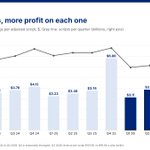
The stock looks cheap at about 4x earnings on the guided run rate of $38.15 a quarter. It isn't cheap on normal earnings. At the historical margin on next year's cost base, EPS is about $5. Give credit for the long term contracts and it's about $17, which is 34x.
Micron now has 26 long term agreements covering over 35% of revenue through 2030, and management says the floor prices in them produce margins above any prior peak quarter. Customers have also put up $12.7B in cash deposits. That's the best argument for a structurally higher margin.
The contracted minimums are smaller than the headline though. Remaining performance obligations were $150B at the end of September, spread over five years. That's about $30B a year, or around 12% of the current revenue run rate.
The margin spike also isn't mainly an AI story. Last quarter the phone and PC unit earned a 90% gross margin, while the cloud unit that sells HBM earned 83%. Management says next year's HBM price increases will narrow its margin gap with regular DRAM, which means HBM earns less today. By my estimate HBM was around 7% of FY2026 revenue. Roughly 80% of FY2026 DRAM revenue growth came from higher prices rather than more bits.
My base case keeps 87% and 85% margins through FY2028 and fades to 48% by FY2031. That's the historical margin plus credit for the contracts. EPS peaks at $187 in FY2028 and falls to $40 by FY2031. At Micron's historical median P/E of 12x plus net cash, that's a $613 stock in FY2031, about 1% a year from here. Discounted back at 10% it's worth about $384 today.
The bull case holds a 70% margin for good. FY2031 EPS comes out around $210 and the stock is worth about $1,812 today. My bear case drops back to the 30% average and is worth about $102. Weighting them 25/50/25 gets $670, an 11% margin of safety, and nearly all of that comes from the bull case.
I don't think Micron can be valued with much confidence right now. The answer depends mostly on margins after 2028, when the new Idaho and Japan fabs start adding supply. At $595 you're paying for Micron to hold a margin it reached once in sixteen years before this boom, and to hold it permanently. Next earnings are Dec 17 and I'll be watching for more detail on the contract floor prices.


And with my previous model I believe you will be able to get this around $385 to $400 on the next leg down.
135
Correction on the buyback math, thanks to @r83343642. Each case now buys back stock along its own price path. The base case is about $412 today and $659 by FY2031, up from $384 and $613. The bull case is about $2,070 by FY2031, down from $2,914. The weighted value is about $555, so there's no margin of safety at $595. The 54% implied margin doesn't change.
I'm a Micron bull, but I'm a value investor at heart and I need a margin of safety before I put money into anything. At $385 to $400 my base case still earns about 11% a year, and anything better than the base case is upside.
2
1
795
A lot of you asked about buybacks. They're in the model. My base case returns 75% of free cash flow, about $307B through FY2031, which takes the share count from 1.15B to about 756M. The $40 of FY2031 EPS is already after that, and there's still about $210 a share of net cash left on top.
1
2
1,313
CrowdStrike ($CRWD) lost about $29B of market value at one point Friday night after Bloomberg and Reuters reported it's in talks to buy Zscaler ($ZS). That's 91% of what all of Zscaler was worth at the close. By 8 PM the drop had shrunk to about $11B. Nothing is signed and nobody has reported a price.
CrowdStrike protects the device. Its Falcon agent sits on laptops and servers and watches for attacks. Zscaler protects the connection. Company traffic runs through its cloud before it reaches the internet or an internal app, which is how a lot of companies replaced their VPN.
They already work together. In September they announced CrowdStrike would send its user risk scores into Zscaler's access engine and Zscaler's logs would stream into CrowdStrike's SIEM. Some of it was still in development. Customers already get part of the combined product today, which makes a big premium harder to justify.
Owning it would give CrowdStrike control of the roadmap and let it sell and price both products as one. It would also close its biggest gap. Palo Alto already sells both sides, endpoint and network. CrowdStrike doesn't sell a full web gateway or a VPN replacement, and that's Zscaler's whole business.
Zscaler's enterprise value was about $32B before the news, or 8.5x ARR. At a 30% premium it's $42B and 11x ARR. That's above the 7.4x Cisco paid for Splunk and well below the 19x Palo Alto agreed to pay for CyberArk.
Paid in stock that's about 191M new CrowdStrike shares, an 18% bigger share count. CrowdStrike has $5B of cash and its revolver expired in January, so a big cash component means new debt. A $10B cash piece keeps debt under 3x EBITDA by my math. A mostly cash deal doesn't.
A 30% premium is about $10B. To earn that back CrowdStrike needs roughly $825M a year of extra pretax profit for good, by my math. That's a quarter of Zscaler's revenue on top of what Zscaler already makes. My base case for cross selling and cost savings gets to about $300M a year, which only supports a premium around 10%.
It would also slow growth. Zscaler guides to 17% revenue growth this year and CrowdStrike to about 25%, with similar margins.
An all stock deal would look accretive on paper. CrowdStrike trades at about 43x sales and Zscaler would cost 12.5x sales even with a 30% premium, so each new share buys more revenue and cash flow than it carries. That comes from CrowdStrike's expensive stock. It doesn't mean the deal creates value.
Jay Chaudhry and trusts for his family own about 35% of Zscaler, so nothing happens without him. CrowdStrike reports December 1 and Zscaler reports December 2.
I'd support this near Zscaler's unaffected price and mostly in stock. At a 30% premium I'd rather they keep building on the partnership.


4
907
From 2016 to 2023 $UNH paid out about 82% of its premiums in medical costs. This year it's on track for about 87%, and the $340 stock price assumes it stays around there.
I modeled EPS and free cash flow per share out to 2031 and put a 16x multiple on 2031 earnings to get a stock price. UNH guides to at least $20.50 of adjusted EPS this year and I have it at about $21. Their cash flow outlook works out to about $22 of free cash flow per share.
My bear case keeps the ratio at 87% the whole way. EPS is about $23 in 2031 and free cash flow per share is about $24. That's a $366 stock in 2031. Counting dividends and discounting at 10% a year, it's worth about $267 today, so the stock trades about 27% above that.
The base case has it back to the 2024 level of 85.5% by 2028. EPS gets to about $31 in 2028 and $37 in 2031, with free cash flow per share around $38.50. That's about a $587 stock in 2031 and about $404 a share today on the same math, which gives a 16% margin of safety at $340.
My bull case has the ratio at 84.5% and gets to about $46 of EPS in 2031. That's a $743 stock and about $501 a share today.
If I weight the bear and bull at 25% each and the base at 50%, I get about $394 a share today. That's a 14% margin of safety.
Each point of that ratio is about $3.10 a share in earnings, and medical costs are the biggest difference between these cases. I held buybacks at $5B a year and didn't put anything in for the DOJ investigation.
I'm watching the 2027 guidance in January to see if the ratio keeps coming down.


Selloffs are when your process gets tested. I'm sticking to the numbers I had before this started. When people dump good companies just to get out, that's when I want to be buying.
79
This is a deep dive on how $UNH actually makes money and why Washington keeps coming after it.
Optum did $196B of revenue in the first nine months of this year, and $118B of it was UnitedHealthcare paying its own sister company. That setup is why the business works so well. It's also why the government thinks it's unfair.
I go through each segment, the reserve releases behind this year's recovery, the new CMS audit plan that just took $70B off the stock, and what it's worth at $334.

For this to work the care ratio has to keep falling after the reserve releases run out, and Optum Health has to get back to a real margin. CRUSH also has to come in softer than the proposal.
If DOJ files charges or Congress moves on a breakup, I'd expect the multiple to stay low no matter what the earnings do.
1
1
371