

Technician by day, chart reader by night. Sharing what I notice on $QNT and crypto. Not financial advice, just my honest opinion.
Joined June 2024
- Tweets3.2K
- Following903
- Followers1.5K
- Likes22K




Pinned Tweet
If you bought $QNT because an influencer or a friend told you to, read this. It explains what you're actually holding.
Right now, when you send money, your bank moves it and hopes everything on the other side goes as planned. If something goes wrong, people spend days fixing it.
Banks are now turning normal bank money into digital tokens. They're called tokenised deposits. It's still your money in your bank, with the same protections, not some new coin. The difference is that this money can follow rules.
Example. You're buying something from a stranger online. Your money stays locked in your own account and only gets released once the item reaches you. The seller can't run with your money, and you can't take the item and refuse to pay.
This is not a future idea. It already happened in the UK in September. Real customers, real money. UK banks including Barclays, Lloyds and NatWest ran the first live payments like this, including two home loan switches where the money released itself automatically on completion day. The platform it ran on was built by Quant.
Here's why that matters. One bank doing this alone is easy. The hard part is getting different banks and their old systems to work together. That connecting part is Quant's job.
The Clearing House, a big US payments network owned by major banks, also picked Quant for the same kind of work, with it set to open to institutions in the first half of 2027.
So when you hold $QNT, you're not holding a meme. You're holding a token tied to the company building the plumbing banks are starting to use for digital money.
Price will move up and down. Pay more attention to the work being done than to the noise.
So be honest, did you buy $QNT for the tech, or because someone told you it would pump?
I hold $QNT too, but I'd never call it game over. Google just showed up with its own ledger this week, and banks like having options. What would worry you more, a rival product or a big bank going elsewhere?

Reading your replies today, the $QNT crowd splits three ways.
One group will pull out their starting money on a 2x and let the rest ride. Others are stacking everything they can under $200 before year end. A few have held seven years and won't part with a single $QNT.
Which camp are you in, and who's making the bigger mistake?

Yeah, I've read about them. A patent is legal protection that gives a company sole rights to its invention, usually for around 20 years, so nobody can copy that exact method without permission. Quant holds US patent 11,842,335, granted Dec 2023, covering how transactions from different blockchains get put in the right order, plus a second American one from April 2026. That shields how Quant links networks, not ledgers in general, so Google can still build its own. Does that protection give $QNT an edge, or do partnerships count for more?

Google just stepped into tokenised bank money, and it could split the $QNT crowd right down the middle.
On 16 Oct, Jack Henry, a US banking tech company with more than 7,200 clients, said it will be the first core provider to plug into Google Cloud Universal Ledger. Community banks and credit unions can then offer digital versions of their deposits.
No public blockchain involved. Big Tech runs the record.
One camp will say the giants just walked in and the industry lost the race. Others will say every private ledger is another separate network that has to talk to the rest, and connecting them is the work Quant was built for.
New buyers, old holders, people still on the fence: is this a threat to $QNT, or the best thing that could happen to it?
You can research $QNT for weeks, buy the dip perfectly, and still lose everything in one tap.
Picture this. Your cousin texts you: Quant just announced a surprise holder airdrop, claim by midnight, link below. You trust him, so you tap, connect your wallet, approve. Gone.
Except he never sent it. His account got hacked an hour earlier.
That's exactly the trap @kodsec32053 is warning about this Cyber Security Week. A message from a friend isn't proof it's safe.
If you're about to buy your first $QNT, learn these three things early:
Nobody legit will ever ask for your seed phrase.
Free token offers with a deadline are bait.
When a request feels odd, call the person first.
Picking the right token is half the job. Keeping it is the other half.
Would you have fallen for it, or does your gut catch these every time?


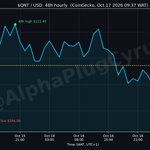
$QNT is trading near $200 this morning after a rough Sunday night.
In plain terms: around 9 PM WAT on Sunday, $QNT fell to roughly $182. As of 8:30 AM, CoinGecko has it up 3.7% on the day, with $81M traded in 24 hours. $BTC is at $82.8K and green too.
So the slide didn't drag on for days. It happened fast, then buyers stepped in overnight and lifted the price about 10% off the bottom.
For context, a week ago on Monday 12 Oct it was close to $242. There's still a gap to that, but it isn't stuck at the lows either.
After a sharp fall, I check one thing: did demand return once the selling stopped? Today, it did.
I hold $QNT and keep adding when it dips. A bounce like this guarantees nothing. It just means the weekend fear faded quickly.
Which matters more to you right now, the climb from $182 or the gap to $242?

A lot of what moves the $QNT price day to day doesn't come from anyone buying it outright.
In the last 24 hours, $QNT futures volume hit $356M on CoinGlass. Spot, where the actual token changes hands, was $38M there. Even CoinGecko's wider spot count of $75M is several times smaller.
Think of a football match. Holders are the players on the pitch. Futures traders sit in the crowd, betting on the score without touching the ball.
Many of them use borrowed money. That's leverage: put in $100, borrow the rest, and control $1,000. Small swings turn into big wins or big losses.
If the game goes far enough against them, the exchange shuts the trade automatically to protect its loan. That forced exit is called a liquidation. When someone expecting a rise gets liquidated, their position is pushed into the market at once, adding pressure.
Over the past day about $1.1M was force-closed, 89.9% of it from longs, the side hoping for gains. Open interest, the value of futures still running, sits near $103M.
So when $QNT jumps or dips quickly, part of the push can come from the stands rather than the field.
Do you keep an eye on futures data, or tune it out completely?

$QNT holders, here's the part of the bank story almost nobody talks about.
Banks around the world are building their own systems to move money faster on blockchain. Quant's Martin Hargreaves wrote this week that 10 to 15 of them are already being tested or live. The UK has one. The US has one coming in 2027.
The problem is each one is like a separate island. A UK business paying someone in America still has to jump from one system to another.
The fix he describes is easy to picture. Think of a hotel holding your deposit until you check out. One side holds the pounds, the other holds the dollars, and the payment only goes through when both are ready. Both happen, or neither does.
Why I care as a $QNT holder: Quant built the system UK banks used for their first real customer payments in September, and it's also behind the US one at The Clearing House. Same company on both islands.
Banks will keep building their own systems. The value is in whatever connects them.
Do you think these bank systems get connected, or stay separate?
$QNT holders shouldn't be cheering the bank-bashing.
Crypto loves posting bank fines and calling banks dinosaurs. But banks are the first customers Quant lists on its homepage, and its live work is with UK banks.
My $QNT bet is on banks upgrading, not banks dying.
Can you hate banks and still hold a token built for them, or is that a contradiction?
$QNT holders, the $10 trillion tokenisation story everyone is sharing is half wrong.
That money isn't coming to pump your altcoin. A tokenised Treasury is still a Treasury. A tokenised deposit is still a bank deposit. It stays with the banks.
What the banks need is software to move it safely between their networks. That's the work Quant is already doing, and that's the only reason I hold $QNT.
If your token has no part in moving that money, tokenisation doesn't save it.
Is $QNT on the right side of this, or are holders fooling themselves too?
Banks aren't funding the team, they're paying for software they use. The token side is where retail comes in. Supply is fixed at about 14.6M with no new tokens being printed, and when that usage runs through Quant, $QNT gets locked up and taken off the market. So the more real usage grows, the fewer tokens are left for everyone else. That's the bet retail holders are making.

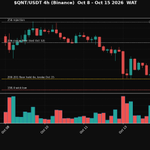
$QNT is around $193 this morning and some people think it's over. Look at the whole month before you decide.
In the middle of September, $QNT was about $61. By October 1 it was around $287. That's more than four times in two weeks.
Nothing goes up that fast and stays there. Picture a new shop that goes viral. The first week, there's a long queue and prices jump. A few weeks later the queue is shorter, but the regular customers are still coming. The shop didn't fail. The crowd just went home.
That's what this chart shows. At the peak, about $1.5 billion of $QNT was traded in a single day. Now it's about $53 million. The price drifted down while things got quiet, not because everyone rushed to sell.
Even now, it's still about three times the mid-September price, and daily trading is still about three times what it was in early September. The noise left. A lot of the new people stayed.
Nobody knows the exact bottom, and anyone who says they do is guessing. I just keep stacking $QNT slowly on dips like this, while the bank side keeps moving.
What do you see on this chart: two weeks of red, or a whole month of growth?

Fair, and that's the right question to ask. Banks and companies pay Quant to use its software. They can pay in normal money, and Quant handles the $QNT side behind the scenes, with the tokens held and locked on its end. So the bank never holds $QNT, but its usage is what creates demand for it. More real usage, more $QNT taken out of circulation. Check that on quant.network yourself before you put in a single dollar.

Unpopular take: $QNT dropping to $192 tonight changes nothing about the work being done.
The UK live payments still happened. The Clearing House is still building for 2027. Not one bank cares what the candle did tonight.
If one red day has you panic selling, you never believed in $QNT. You believed in the influencer who sold it to you.
Paper hands fund the patient ones. Which side are you on tonight?
Hard truth for $QNT holders: banks move in years, not weeks.
The Clearing House picked Quant in September, and its network isn't due to open to institutions until the first half of 2027. UK banks only just ran their first live customer payments on a Quant-built platform last month.
That's how banking works. Testing, approvals, then a slow rollout. Nobody rushes when it's other people's money.
The chart won't wait for any of that. It will chop, dip and test your patience long before the real usage shows up in full.
So if you bought $QNT expecting a quick flip, you're playing a game this project was never built for.
Are you holding $QNT for the next pump, or for when the banks actually switch on?
Before you believe any $QNT post, even mine, check it yourself.
Real Quant news comes from Quant first. If it isn't on their website or their official account, be careful.
A real partnership shows up on both sides. If a big company is working with Quant, that company says it too. A screenshot alone proves nothing.
Real news is clear. It tells you who, what and when. Hype is loud and vague, always huge and always soon.
And if anyone pushes you into a WhatsApp group or your DMs for secret updates, walk away. Real updates are public.
That's how I stack $QNT. I'd rather understand what I own than have someone tell me what I own.
Before $QNT existed, its founder was helping write the rules.
Quick breakdown for anyone new. ISO stands for the International Organization for Standardization. It's the global body that sets the rules big industries follow, from card payments to the messaging system banks use to move money. If something has to work the same way in every country, ISO usually writes the standard.
TC 307 is ISO's technical committee for blockchain. It's the group writing the official standards for how blockchain should work.
In 2015, Gilbert Verdian helped set up that committee. He went on to lead the group inside it working on how different blockchains connect with each other.
Then he built Quant to do exactly that.
That's the part new $QNT holders should know. Quant didn't start as a token looking for a use. It started with someone who helped write the standards banks follow, and then built the tool to fit them.
If you bought $QNT because your favorite influencer said it goes up, this is the part they probably skipped. Banks don't trust hype. They trust standards.
So what gives you more confidence in $QNT: the team behind it, or the deals it signs?