

RWA Growth Operator| RWA/Defi research | | @dEURO_com | prev : @shapeShift @AISUEDE | @ADIChain_
RWA
Joined May 2022
- Tweets84.1K
- Following3.7K
- Followers9.7K
- Likes116K








Pinned Tweet
Almost a year ago, I introduced “Know RWA in 4 Articles with Alpha.RWA.”
The response was more than I expected: 20K+ views, 500+ likes and 200+ comments.
It confirmed something I’ve believed for a long time. People want to understand this space. They just need someone to explain it simply.
I featured four projects and ran several giveaways of about $500 for the most insightful comments. Then the series went quiet while I focused on the technical side of the ecosystem.
That pause is over, and the series is coming back bigger.
It is now “Know RWA, DeFi and AI in 4 Articles with Alpha.RWA.”
RWA, DeFi and AI are among the most innovative and most misunderstood areas in crypto. Protocols are tokenizing real assets, rebuilding finance on-chain and putting AI to work, yet many people still can’t explain how they work or why they matter.
The first project I’ll be featuring is @NysaFinance .
Over four parts, I will cover:
- What @NysaFinance is and the problem it solves
- How the product works, in plain language
- Where the value comes from, and its use cases
- Milestones, roadmap and the bigger adoption thesis
At the close of the series, 5 readers will receive a giveaway for the most insightful comments and quotes.
If you are building in RWA, DeFi or AI and want people to genuinely understand what you’re doing, my DMs are open.
Part 1 drops soon.


Alpha.rwa | Adi retweeted

Lend on USDY. Borrow USDC against @Ondo USDY on @Solana, now available on app.nysa.finance/
Market by @Kamino, Price Feeds by @PythNetwork.
A thread on how to earn, borrow, and our path to an open standard of curation 🧵
Alpha.rwa | Adi retweeted
Know RWA, DeFi and AI in 4 Articles with Alpha.RWA | Part 2 of 4
Giveaway update: the first winner is @DannyP1333 , who receives $10. Another $40 goes to four more winners at the close of the series. Insightful quotes and comments keep counting.
QUICK UPDATE: NYSA’s(@NysaFinance) FIRST MARKET GOES lIVE TODAY
It runs on Solana, built on Kamino’s lending infrastructure, and it is the first market Nysa has launched. Part 1 covered what Nysa is. Part 2 follows one borrower through a Nysa market so you can see how it works. Every number in the example is illustrative. None of them are Nysa’s settings.
WHAT NYSA BUILDS AND WHAT IT USES
I. WHO RUNS THE LENDING ?
Nysa does not write lending code. It uses established third party lending infrastructure and decides what runs on top: which collateral to list, how much can be borrowed against it, which assets can be borrowed, and how the market behaves when prices move. For the first market, that infrastructure is @kamino on Solana.
Each asset issuer gets a market of its own. Nysa calls this counterparty isolated, which means a problem in one market stays in that market.
Control is split. The admin keys, which can change a market’s settings, sit behind multi signature approval, with at least two of three signers required. Where the lending infrastructure allows it, the power to list new collateral stays with the infrastructure provider. Nysa keeps two things: the risk parameters and the interest rate model. Any change to those parameters goes through a 7 day timelock, a mandatory delay between queuing a change and applying it, and stays visible on the front end. A change queued on Monday cannot take effect for a week.
THE FOUR NUMBERS THAT DEFINE A MARKET
II. WHAT DOES A BORROWER DO?
Meet Amara. She holds $1,000 worth of a tokenized fund share and wants stablecoins without selling it. She deposits the token as collateral. This market’s loan-to-value ratio (LTV) is 80%, so she can borrow up to $800. LTV is the borrowing ceiling, expressed as a share of the collateral’s value.
Borrowing the full $800 would leave her with little room, and Nysa built Smart Loans for this moment. Smart Loans is a machine learning model, a program that learns patterns from historical data. In Nysa’s app, Amara selects her asset, opens Manage Position, chooses Borrow and taps Smart Borrow. The app sends her loan details to Nysa’s server, which returns a recommended amount and fills it into the box.
The model studies more than 12 inputs, including recent volatility, how the asset moves relative to other assets, and simulated liquidation scenarios. It was trained on hundreds of thousands of historical position combinations and market simulations for the assets listed on Nysa. Say it returns $720. Amara reviews the number and signs. The model suggests, and she decides.
III. WHAT HAPPENS WHEN THE PRICE FALLS?
Every market has a second line above the LTV, the liquidation threshold (LT). Here it is 85%. If Amara’s debt rises above 85% of her collateral’s value, part of her collateral is sold to repay it.
With $720 borrowed, her collateral has to fall to about $847 before that happens, a drop of roughly 15%. Had she borrowed the full $800, a fall of about 6%, to $941, would do it. The distance between the LTV and the LT is her reaction window, the time to add collateral or repay before anything is sold.
How wide should that window be? Nysa measures the token’s volatility with EWMA, a method that gives recent price moves more weight than old ones, applied to the token’s price or NAV history. NAV, net asset value, is what the fund’s holdings are worth per token. Nysa then calibrates the LTV so that at least 95% of loans opened at the maximum ratio stay over-collateralized after 3 days, and at least 90% after 30. A calm asset needs less room than an erratic one.
If liquidation does arrive, it works in pieces rather than all at once. Nysa calibrates the incentive paid to liquidators, uses partial liquidations, caps position sizes and sizes a reserve fund for losses that remain. The LT itself comes from backtesting against multi year price history, with each overnight or weekend price gap charged in full.
LIQUIDATION,MONITORING AND THE FREEZE
IV. WHY DOES A MARKET LIMITS IT COLLATERAL?
A market sets a supply cap, a ceiling on how much of an asset it accepts. Suppose the fund share can only be redeemed for cash in limited amounts at any moment. A market holding too much of it could not sell the collateral fast enough in a crash. Nysa sizes the cap so that the amount redeemable instantly covers all of the collateral expected to be liquidated under stress. It does not size it for the extreme case where every position is liquidated at once.
V. What does borrowing cost, and what do lenders earn?
Amara pays interest, and lenders who supplied the stablecoins she borrowed earn it. The rate moves with utilization, the share of deposited money that has been borrowed. Nysa uses a kinked curve: rates climb slowly up to a target utilization, then steeply past it. Lenders earn the borrow rate, scaled by how much of the pool is lent out, minus a Reserve Factor that the Nysa treasury keeps.
Take an illustrative curve: a 1% base rate, a target utilization of 80%, a first slope of 4%, a second slope of 60% and a 10% Reserve Factor.
1 ) At 40% utilization, the borrow rate is 3%. Amara’s $720 loan costs about $21.60 a year. A lender with $10,000 deposited earns about 1.08%, roughly $108.
2 ) At 80%, the borrow rate is 5%. The same lender earns 3.6%, about $360 a year.
3 ) At 90%, the borrow rate jumps to 35%. Amara’s loan would cost about $252 a year, and the lender earns about 28.35%, around $2,835.
The jump past the kink keeps withdrawals possible. When almost everything is lent out, the high rate pushes borrowers to repay and pulls lenders to deposit.
4 ) What if the token’s price and its value drift apart?
Suppose thin trading pushes the fund share’s market price 5% below its NAV, even though the fund holds the same assets. Nysa calls a gap like that a depeg. A price feed based on market price alone would show Amara’s collateral worth less than it is, and could trigger liquidations the underlying value does not justify.
So where the oracle provider supports it, Nysa asks for price feeds based on NAV or redemption value. Each market also has deviation thresholds beyond which it can be suspended or frozen. A real-time system watches for on-chain anomalies and can freeze a market where the technology allows. Volatility readings feed back into the LT and LTV continuously, and the independent proof-of-reserve check on issuers runs annually.
VII . WHAT TO WATCH
With the first market live, the parameters behind it are public, and any change to them stays visible on the front end. The roadmap sets the next targets: at least 2 new markets backed by RWA collateral, and at least 3 markets live, each with 40%+ utilization against its supply cap. After that come the DAO launch, with a TGE, a public INO, a staking module and a stNYSA credit market, and a Skin-In-the-Game vault meant to protect lenders against default on a Nysa-curated market.
Part 3 looks at where the value comes from and who uses it.
Sources: Nysa Finance documentation (What is, Market-as-a-Service, Risk Management and its Market, Protocol and Credit Risk and Risk Monitoring pages, Interest Rate Models, Smart Loans, Roadmap).


Know RWA, DeFi and AI in 4 Articles with Alpha.RWA | Part 1 of 4
NYSA Finance @NysaFinance : Building the Credit Market So Issuers Don’t Have To
I. Tokenized Assets Can Already Be Used as Collateral. The Hard Part Is Setting Up Each Market.
A few protocols already let people borrow against tokenized assets.@aave Horizon lets qualified institutions post tokenized Treasury or credit funds and borrow stablecoins. @Morpho lets curators open isolated markets for specific collateral.
Think of it like a bank that already accepts a new type of property as collateral for a loan. The property exists. Someone still has to decide the maximum loan amount, what happens if the property value drops, who handles a forced sale, and where the first lenders and borrowers will come from. Each new property type needs its own set of rules before anyone can actually borrow against it.
In both Aave Horizon and Morpho, those rules are set asset by asset. Someone has to choose the price feed, the borrow limit, the liquidation point, the lending infrastructure, and the plan for attracting users. Loose rules can leave the market with unpaid debt after a sharp drop. Tight rules give borrowers little reason to use it. A market with no plan for users simply sits empty.
II. What One Market Actually Requires
Imagine an issuer of tokenized shares in a short duration credit fund. Holders of those shares want to borrow against them. Before a single loan can open, someone has to settle.
i) Which price feed values the token, and what happens if the market price drifts from the fund’s actual value.
ii) How much a holder can borrow against every $100 of shares, and at what point a position is liquidated.
iii) Who runs liquidations, and whether the token can be turned back into cash fast enough to cover them.
iv) Which assets people can borrow, and at what interest rate.
v) Which lending protocol hosts the market, and how to get listed on it.
vi) Where the first lenders and borrowers come from.
That list is the work. It is not automatic.
WHAT IS NYSA
Nysa builds and runs those credit markets for tokenized assets. Its product is called Market-as-a-Service.
Picture a property developer who has a new building. Instead of hiring architects, engineers, and a sales team themselves, they hand the building to a specialist firm. The firm designs the loan terms, sets the risk rules, connects the price data, deploys the market, and finds the first lenders and borrowers. The developer keeps a share of the fees. That is roughly the arrangement Nysa offers issuers.
According to its documentation, the work runs in four stages:
i) Due diligence and analysis — checking collateral transparency, mint and redeem rules, and which assets will actually attract borrowers.
ii) Curation — choosing the price feed, the lending infrastructure, the risk parameters, and the interest-rate model.
Development and liquidations — deploying the market, connecting the price feed, and setting up how liquidations will run.
Distribution — go-to-market, finding lenders and borrowers, front-end hosting, farming campaigns, the listing process, monitoring, and SDKs.
Nysa states that an issuer can hand over the asset and have a live market in roughly six weeks, with zero engineering work required from the issuer. All borrower fees generated by the market go to the issuer’s wallet under the agreed revenue-sharing structure.
How Nysa Approaches Risk
Nysa describes its risk process as aligned with ISO 31000 (identify, assess, mitigate, monitor) and groups risks into market and liquidity, protocol, and credit.
On the borrower side, its documentation says loan limits are set so that at least 95% of loans opened at the maximum limit remain over collateralized after three days, and at least 90% after thirty days. The intent is to give the borrower a window to add collateral or repay before liquidation. Think of it as leaving a buffer so that a sudden price move does not immediately wipe out the position. Supply caps are sized so the asset’s instant redemption capacity can cover the share of collateral expected to be liquidated under stress. For depeg and issuer risk, it publishes due diligence (including proof-of-reserve where available) and says it prefers NAV-based price feeds where possible, with thresholds that can freeze a market.
On the technical side, Nysa states that it works only with existing third party lending infrastructure that already has audits and formal verification. It does not run modified forks. It also says it uses only multi-source oracles and does not run its own price feeds.
SMART LOANS
Nysa built a feature called Smart Loans after internal testing showed users struggling to choose safe borrow amounts. A machine learning model looks at more than 12 factors (market volatility, correlations between assets, and simulated liquidation scenarios) and suggests a borrow size that tries to balance how much capital the user can access against the chance of liquidation. Users can accept the suggestion or set the amount themselves. The documentation says the feature is meant only where it measurably improves the experience. Part 2 will go into how the model arrives at its numbers.
The Roadmap and First Market
Nysa’s roadmap for 2026 2027 starts with its first market going live on Solana, built on @kamino lending infrastructure. The team has publicly said this market (borrowing USDC against @Ondo USDY) is scheduled for 19 October 2026. After that come additional RWA markets, Smart Loans, vaults run by dedicated risk curators, and later expansions into other products such as @Uniswap Hooks or Pendle markets, plus the longer-term goal of becoming an authorized custodial asset manager that can allocate and borrow from its own markets.
The Thesis
The proof that tokenized assets can serve as collateral already exists on Aave Horizon and Morpho. Each of those markets was assembled one by one. Nysa is testing whether that assembly can be turned into a repeatable service: an issuer hands over an asset and receives a finished market plus a share of its fees, without building the market itself. Whether that holds will show up in how the first Solana market performs, how it behaves in volatile conditions, and how many issuers choose to use it.
Part 2 will open the machinery:
Sources: Nysa Finance documentation (Overview, Market-as-a-Service, Risk Management pages, Smart Loans, Roadmap); Nysa public announcements on the first market (Solana / Kamino / USDY, 19 Oct 2026).


Know RWA, DeFi and AI in 4 Articles with Alpha.RWA | Part 2 of 4
Giveaway update: the first winner is @DannyP1333 , who receives $10. Another $40 goes to four more winners at the close of the series. Insightful quotes and comments keep counting.
QUICK UPDATE: NYSA’s(@NysaFinance) FIRST MARKET GOES lIVE TODAY
It runs on Solana, built on Kamino’s lending infrastructure, and it is the first market Nysa has launched. Part 1 covered what Nysa is. Part 2 follows one borrower through a Nysa market so you can see how it works. Every number in the example is illustrative. None of them are Nysa’s settings.
WHAT NYSA BUILDS AND WHAT IT USES
I. WHO RUNS THE LENDING ?
Nysa does not write lending code. It uses established third party lending infrastructure and decides what runs on top: which collateral to list, how much can be borrowed against it, which assets can be borrowed, and how the market behaves when prices move. For the first market, that infrastructure is @kamino on Solana.
Each asset issuer gets a market of its own. Nysa calls this counterparty isolated, which means a problem in one market stays in that market.
Control is split. The admin keys, which can change a market’s settings, sit behind multi signature approval, with at least two of three signers required. Where the lending infrastructure allows it, the power to list new collateral stays with the infrastructure provider. Nysa keeps two things: the risk parameters and the interest rate model. Any change to those parameters goes through a 7 day timelock, a mandatory delay between queuing a change and applying it, and stays visible on the front end. A change queued on Monday cannot take effect for a week.
THE FOUR NUMBERS THAT DEFINE A MARKET
II. WHAT DOES A BORROWER DO?
Meet Amara. She holds $1,000 worth of a tokenized fund share and wants stablecoins without selling it. She deposits the token as collateral. This market’s loan-to-value ratio (LTV) is 80%, so she can borrow up to $800. LTV is the borrowing ceiling, expressed as a share of the collateral’s value.
Borrowing the full $800 would leave her with little room, and Nysa built Smart Loans for this moment. Smart Loans is a machine learning model, a program that learns patterns from historical data. In Nysa’s app, Amara selects her asset, opens Manage Position, chooses Borrow and taps Smart Borrow. The app sends her loan details to Nysa’s server, which returns a recommended amount and fills it into the box.
The model studies more than 12 inputs, including recent volatility, how the asset moves relative to other assets, and simulated liquidation scenarios. It was trained on hundreds of thousands of historical position combinations and market simulations for the assets listed on Nysa. Say it returns $720. Amara reviews the number and signs. The model suggests, and she decides.
III. WHAT HAPPENS WHEN THE PRICE FALLS?
Every market has a second line above the LTV, the liquidation threshold (LT). Here it is 85%. If Amara’s debt rises above 85% of her collateral’s value, part of her collateral is sold to repay it.
With $720 borrowed, her collateral has to fall to about $847 before that happens, a drop of roughly 15%. Had she borrowed the full $800, a fall of about 6%, to $941, would do it. The distance between the LTV and the LT is her reaction window, the time to add collateral or repay before anything is sold.
How wide should that window be? Nysa measures the token’s volatility with EWMA, a method that gives recent price moves more weight than old ones, applied to the token’s price or NAV history. NAV, net asset value, is what the fund’s holdings are worth per token. Nysa then calibrates the LTV so that at least 95% of loans opened at the maximum ratio stay over-collateralized after 3 days, and at least 90% after 30. A calm asset needs less room than an erratic one.
If liquidation does arrive, it works in pieces rather than all at once. Nysa calibrates the incentive paid to liquidators, uses partial liquidations, caps position sizes and sizes a reserve fund for losses that remain. The LT itself comes from backtesting against multi year price history, with each overnight or weekend price gap charged in full.
LIQUIDATION,MONITORING AND THE FREEZE
IV. WHY DOES A MARKET LIMITS IT COLLATERAL?
A market sets a supply cap, a ceiling on how much of an asset it accepts. Suppose the fund share can only be redeemed for cash in limited amounts at any moment. A market holding too much of it could not sell the collateral fast enough in a crash. Nysa sizes the cap so that the amount redeemable instantly covers all of the collateral expected to be liquidated under stress. It does not size it for the extreme case where every position is liquidated at once.
V. What does borrowing cost, and what do lenders earn?
Amara pays interest, and lenders who supplied the stablecoins she borrowed earn it. The rate moves with utilization, the share of deposited money that has been borrowed. Nysa uses a kinked curve: rates climb slowly up to a target utilization, then steeply past it. Lenders earn the borrow rate, scaled by how much of the pool is lent out, minus a Reserve Factor that the Nysa treasury keeps.
Take an illustrative curve: a 1% base rate, a target utilization of 80%, a first slope of 4%, a second slope of 60% and a 10% Reserve Factor.
1 ) At 40% utilization, the borrow rate is 3%. Amara’s $720 loan costs about $21.60 a year. A lender with $10,000 deposited earns about 1.08%, roughly $108.
2 ) At 80%, the borrow rate is 5%. The same lender earns 3.6%, about $360 a year.
3 ) At 90%, the borrow rate jumps to 35%. Amara’s loan would cost about $252 a year, and the lender earns about 28.35%, around $2,835.
The jump past the kink keeps withdrawals possible. When almost everything is lent out, the high rate pushes borrowers to repay and pulls lenders to deposit.
4 ) What if the token’s price and its value drift apart?
Suppose thin trading pushes the fund share’s market price 5% below its NAV, even though the fund holds the same assets. Nysa calls a gap like that a depeg. A price feed based on market price alone would show Amara’s collateral worth less than it is, and could trigger liquidations the underlying value does not justify.
So where the oracle provider supports it, Nysa asks for price feeds based on NAV or redemption value. Each market also has deviation thresholds beyond which it can be suspended or frozen. A real-time system watches for on-chain anomalies and can freeze a market where the technology allows. Volatility readings feed back into the LT and LTV continuously, and the independent proof-of-reserve check on issuers runs annually.
VII . WHAT TO WATCH
With the first market live, the parameters behind it are public, and any change to them stays visible on the front end. The roadmap sets the next targets: at least 2 new markets backed by RWA collateral, and at least 3 markets live, each with 40%+ utilization against its supply cap. After that come the DAO launch, with a TGE, a public INO, a staking module and a stNYSA credit market, and a Skin-In-the-Game vault meant to protect lenders against default on a Nysa-curated market.
Part 3 looks at where the value comes from and who uses it.
Sources: Nysa Finance documentation (What is, Market-as-a-Service, Risk Management and its Market, Protocol and Credit Risk and Risk Monitoring pages, Interest Rate Models, Smart Loans, Roadmap).
Know RWA, DeFi and AI in 4 Articles with Alpha.RWA | Part 1 of 4
NYSA Finance @NysaFinance : Building the Credit Market So Issuers Don’t Have To
I. Tokenized Assets Can Already Be Used as Collateral. The Hard Part Is Setting Up Each Market.
A few protocols already let people borrow against tokenized assets.@aave Horizon lets qualified institutions post tokenized Treasury or credit funds and borrow stablecoins. @Morpho lets curators open isolated markets for specific collateral.
Think of it like a bank that already accepts a new type of property as collateral for a loan. The property exists. Someone still has to decide the maximum loan amount, what happens if the property value drops, who handles a forced sale, and where the first lenders and borrowers will come from. Each new property type needs its own set of rules before anyone can actually borrow against it.
In both Aave Horizon and Morpho, those rules are set asset by asset. Someone has to choose the price feed, the borrow limit, the liquidation point, the lending infrastructure, and the plan for attracting users. Loose rules can leave the market with unpaid debt after a sharp drop. Tight rules give borrowers little reason to use it. A market with no plan for users simply sits empty.
II. What One Market Actually Requires
Imagine an issuer of tokenized shares in a short duration credit fund. Holders of those shares want to borrow against them. Before a single loan can open, someone has to settle.
i) Which price feed values the token, and what happens if the market price drifts from the fund’s actual value.
ii) How much a holder can borrow against every $100 of shares, and at what point a position is liquidated.
iii) Who runs liquidations, and whether the token can be turned back into cash fast enough to cover them.
iv) Which assets people can borrow, and at what interest rate.
v) Which lending protocol hosts the market, and how to get listed on it.
vi) Where the first lenders and borrowers come from.
That list is the work. It is not automatic.
WHAT IS NYSA
Nysa builds and runs those credit markets for tokenized assets. Its product is called Market-as-a-Service.
Picture a property developer who has a new building. Instead of hiring architects, engineers, and a sales team themselves, they hand the building to a specialist firm. The firm designs the loan terms, sets the risk rules, connects the price data, deploys the market, and finds the first lenders and borrowers. The developer keeps a share of the fees. That is roughly the arrangement Nysa offers issuers.
According to its documentation, the work runs in four stages:
i) Due diligence and analysis — checking collateral transparency, mint and redeem rules, and which assets will actually attract borrowers.
ii) Curation — choosing the price feed, the lending infrastructure, the risk parameters, and the interest-rate model.
Development and liquidations — deploying the market, connecting the price feed, and setting up how liquidations will run.
Distribution — go-to-market, finding lenders and borrowers, front-end hosting, farming campaigns, the listing process, monitoring, and SDKs.
Nysa states that an issuer can hand over the asset and have a live market in roughly six weeks, with zero engineering work required from the issuer. All borrower fees generated by the market go to the issuer’s wallet under the agreed revenue-sharing structure.
How Nysa Approaches Risk
Nysa describes its risk process as aligned with ISO 31000 (identify, assess, mitigate, monitor) and groups risks into market and liquidity, protocol, and credit.
On the borrower side, its documentation says loan limits are set so that at least 95% of loans opened at the maximum limit remain over collateralized after three days, and at least 90% after thirty days. The intent is to give the borrower a window to add collateral or repay before liquidation. Think of it as leaving a buffer so that a sudden price move does not immediately wipe out the position. Supply caps are sized so the asset’s instant redemption capacity can cover the share of collateral expected to be liquidated under stress. For depeg and issuer risk, it publishes due diligence (including proof-of-reserve where available) and says it prefers NAV-based price feeds where possible, with thresholds that can freeze a market.
On the technical side, Nysa states that it works only with existing third party lending infrastructure that already has audits and formal verification. It does not run modified forks. It also says it uses only multi-source oracles and does not run its own price feeds.
SMART LOANS
Nysa built a feature called Smart Loans after internal testing showed users struggling to choose safe borrow amounts. A machine learning model looks at more than 12 factors (market volatility, correlations between assets, and simulated liquidation scenarios) and suggests a borrow size that tries to balance how much capital the user can access against the chance of liquidation. Users can accept the suggestion or set the amount themselves. The documentation says the feature is meant only where it measurably improves the experience. Part 2 will go into how the model arrives at its numbers.
The Roadmap and First Market
Nysa’s roadmap for 2026 2027 starts with its first market going live on Solana, built on @kamino lending infrastructure. The team has publicly said this market (borrowing USDC against @Ondo USDY) is scheduled for 19 October 2026. After that come additional RWA markets, Smart Loans, vaults run by dedicated risk curators, and later expansions into other products such as @Uniswap Hooks or Pendle markets, plus the longer-term goal of becoming an authorized custodial asset manager that can allocate and borrow from its own markets.
The Thesis
The proof that tokenized assets can serve as collateral already exists on Aave Horizon and Morpho. Each of those markets was assembled one by one. Nysa is testing whether that assembly can be turned into a repeatable service: an issuer hands over an asset and receives a finished market plus a share of its fees, without building the market itself. Whether that holds will show up in how the first Solana market performs, how it behaves in volatile conditions, and how many issuers choose to use it.
Part 2 will open the machinery:
Sources: Nysa Finance documentation (Overview, Market-as-a-Service, Risk Management pages, Smart Loans, Roadmap); Nysa public announcements on the first market (Solana / Kamino / USDY, 19 Oct 2026).
Alpha.rwa | Adi retweeted
Know RWA, DeFi and AI in 4 Articles with Alpha.RWA | Part 1 of 4
NYSA Finance @NysaFinance : Building the Credit Market So Issuers Don’t Have To
I. Tokenized Assets Can Already Be Used as Collateral. The Hard Part Is Setting Up Each Market.
A few protocols already let people borrow against tokenized assets.@aave Horizon lets qualified institutions post tokenized Treasury or credit funds and borrow stablecoins. @Morpho lets curators open isolated markets for specific collateral.
Think of it like a bank that already accepts a new type of property as collateral for a loan. The property exists. Someone still has to decide the maximum loan amount, what happens if the property value drops, who handles a forced sale, and where the first lenders and borrowers will come from. Each new property type needs its own set of rules before anyone can actually borrow against it.
In both Aave Horizon and Morpho, those rules are set asset by asset. Someone has to choose the price feed, the borrow limit, the liquidation point, the lending infrastructure, and the plan for attracting users. Loose rules can leave the market with unpaid debt after a sharp drop. Tight rules give borrowers little reason to use it. A market with no plan for users simply sits empty.
II. What One Market Actually Requires
Imagine an issuer of tokenized shares in a short duration credit fund. Holders of those shares want to borrow against them. Before a single loan can open, someone has to settle.
i) Which price feed values the token, and what happens if the market price drifts from the fund’s actual value.
ii) How much a holder can borrow against every $100 of shares, and at what point a position is liquidated.
iii) Who runs liquidations, and whether the token can be turned back into cash fast enough to cover them.
iv) Which assets people can borrow, and at what interest rate.
v) Which lending protocol hosts the market, and how to get listed on it.
vi) Where the first lenders and borrowers come from.
That list is the work. It is not automatic.
WHAT IS NYSA
Nysa builds and runs those credit markets for tokenized assets. Its product is called Market-as-a-Service.
Picture a property developer who has a new building. Instead of hiring architects, engineers, and a sales team themselves, they hand the building to a specialist firm. The firm designs the loan terms, sets the risk rules, connects the price data, deploys the market, and finds the first lenders and borrowers. The developer keeps a share of the fees. That is roughly the arrangement Nysa offers issuers.
According to its documentation, the work runs in four stages:
i) Due diligence and analysis — checking collateral transparency, mint and redeem rules, and which assets will actually attract borrowers.
ii) Curation — choosing the price feed, the lending infrastructure, the risk parameters, and the interest-rate model.
Development and liquidations — deploying the market, connecting the price feed, and setting up how liquidations will run.
Distribution — go-to-market, finding lenders and borrowers, front-end hosting, farming campaigns, the listing process, monitoring, and SDKs.
Nysa states that an issuer can hand over the asset and have a live market in roughly six weeks, with zero engineering work required from the issuer. All borrower fees generated by the market go to the issuer’s wallet under the agreed revenue-sharing structure.
How Nysa Approaches Risk
Nysa describes its risk process as aligned with ISO 31000 (identify, assess, mitigate, monitor) and groups risks into market and liquidity, protocol, and credit.
On the borrower side, its documentation says loan limits are set so that at least 95% of loans opened at the maximum limit remain over collateralized after three days, and at least 90% after thirty days. The intent is to give the borrower a window to add collateral or repay before liquidation. Think of it as leaving a buffer so that a sudden price move does not immediately wipe out the position. Supply caps are sized so the asset’s instant redemption capacity can cover the share of collateral expected to be liquidated under stress. For depeg and issuer risk, it publishes due diligence (including proof-of-reserve where available) and says it prefers NAV-based price feeds where possible, with thresholds that can freeze a market.
On the technical side, Nysa states that it works only with existing third party lending infrastructure that already has audits and formal verification. It does not run modified forks. It also says it uses only multi-source oracles and does not run its own price feeds.
SMART LOANS
Nysa built a feature called Smart Loans after internal testing showed users struggling to choose safe borrow amounts. A machine learning model looks at more than 12 factors (market volatility, correlations between assets, and simulated liquidation scenarios) and suggests a borrow size that tries to balance how much capital the user can access against the chance of liquidation. Users can accept the suggestion or set the amount themselves. The documentation says the feature is meant only where it measurably improves the experience. Part 2 will go into how the model arrives at its numbers.
The Roadmap and First Market
Nysa’s roadmap for 2026 2027 starts with its first market going live on Solana, built on @kamino lending infrastructure. The team has publicly said this market (borrowing USDC against @Ondo USDY) is scheduled for 19 October 2026. After that come additional RWA markets, Smart Loans, vaults run by dedicated risk curators, and later expansions into other products such as @Uniswap Hooks or Pendle markets, plus the longer-term goal of becoming an authorized custodial asset manager that can allocate and borrow from its own markets.
The Thesis
The proof that tokenized assets can serve as collateral already exists on Aave Horizon and Morpho. Each of those markets was assembled one by one. Nysa is testing whether that assembly can be turned into a repeatable service: an issuer hands over an asset and receives a finished market plus a share of its fees, without building the market itself. Whether that holds will show up in how the first Solana market performs, how it behaves in volatile conditions, and how many issuers choose to use it.
Part 2 will open the machinery:
Sources: Nysa Finance documentation (Overview, Market-as-a-Service, Risk Management pages, Smart Loans, Roadmap); Nysa public announcements on the first market (Solana / Kamino / USDY, 19 Oct 2026).
Almost a year ago, I introduced “Know RWA in 4 Articles with Alpha.RWA.”
The response was more than I expected: 20K+ views, 500+ likes and 200+ comments.
It confirmed something I’ve believed for a long time. People want to understand this space. They just need someone to explain it simply.
I featured four projects and ran several giveaways of about $500 for the most insightful comments. Then the series went quiet while I focused on the technical side of the ecosystem.
That pause is over, and the series is coming back bigger.
It is now “Know RWA, DeFi and AI in 4 Articles with Alpha.RWA.”
RWA, DeFi and AI are among the most innovative and most misunderstood areas in crypto. Protocols are tokenizing real assets, rebuilding finance on-chain and putting AI to work, yet many people still can’t explain how they work or why they matter.
The first project I’ll be featuring is @NysaFinance .
Over four parts, I will cover:
- What @NysaFinance is and the problem it solves
- How the product works, in plain language
- Where the value comes from, and its use cases
- Milestones, roadmap and the bigger adoption thesis
At the close of the series, 5 readers will receive a giveaway for the most insightful comments and quotes.
If you are building in RWA, DeFi or AI and want people to genuinely understand what you’re doing, my DMs are open.
Part 1 drops soon.
Alpha.rwa | Adi retweeted
Alpha.rwa | Adi retweeted
Almost a year ago, I introduced “Know RWA in 4 Articles with Alpha.RWA.”
The response was more than I expected: 20K+ views, 500+ likes and 200+ comments.
It confirmed something I’ve believed for a long time. People want to understand this space. They just need someone to explain it simply.
I featured four projects and ran several giveaways of about $500 for the most insightful comments. Then the series went quiet while I focused on the technical side of the ecosystem.
That pause is over, and the series is coming back bigger.
It is now “Know RWA, DeFi and AI in 4 Articles with Alpha.RWA.”
RWA, DeFi and AI are among the most innovative and most misunderstood areas in crypto. Protocols are tokenizing real assets, rebuilding finance on-chain and putting AI to work, yet many people still can’t explain how they work or why they matter.
The first project I’ll be featuring is @NysaFinance .
Over four parts, I will cover:
- What @NysaFinance is and the problem it solves
- How the product works, in plain language
- Where the value comes from, and its use cases
- Milestones, roadmap and the bigger adoption thesis
At the close of the series, 5 readers will receive a giveaway for the most insightful comments and quotes.
If you are building in RWA, DeFi or AI and want people to genuinely understand what you’re doing, my DMs are open.
Part 1 drops soon.
Alpha.rwa | Adi retweeted
Opened my @eldoraglobal this morning.
Three books on the same page. Stocks, spot, and perps. You pick the one you came for.
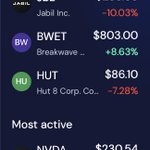
Stocks is the tokenized equity book, via @DinariGlobal. What was moving: Jabil down 10.03% at $286.86, Breakwave up 8.63% at $803, Hut 8 down 7.28% at $86.10. The names people were actually in were quieter. NVDA $230.54, up 0.94%. INTC $120.77, up 0.45%.
Spot is own the asset, no leverage. KNTQ was up 28.86%, PURR up 17.23%, TREAD down 15.68%. The active pairs were HYPE at $89.50, UBTC just under $84,000, and UZEC.
Perps is the leverage book. MON up 14.37%, ZRO down 6.73%, CRV down 4.90%. BTC and ETH were basically flat. HYPE showed up here too, same name as on spot, different instrument.
If the position is not meant to be traded, the lending side is on the platform. @aave, @maplefinance, and @Morpho. Deposit, or borrow against what you already hold.
One screen. Stocks if you want the equity. Spot if you want the coin. Perps if you want the leverage. Lending if you want the position working while you hold it.
Elplore : app.eldora.do/r/e1a55cde
🤝 Paid partnership


A full breakdown of what is live on @eldoraglobal right now.
Tokenized US Stocks & ETFs
280+ assets 1:1 backed by real shares held in regulated custody through Dinari, an SEC registered transfer agent. Not derivatives. Not synthetics. The actual underlying.
Notable names include $NVDA, $AAPL, $TSLA, $MSFT, $SPCX, $JNJ, $QQQ, $IWM and hundreds more. Available 24/7 across 5 blockchains simultaneously Ethereum, Base, Polygon, Arbitrum, and BNB Chain.
app.eldora.do/discover?type=…
Perpetuals (via Centralized Mode powered by Bitget)
300+ stock perpetual contracts USDT settled, up to 10–20x leverage depending on the asset. Covers equities, ETFs, indices, precious metals, commodities, and Pre IPO names. Same Eldora interface, Bitget’s infrastructure underneath.
app.eldora.do/perps?coin=HYP…
T-Bill Yield
5.3% APY on idle stablecoin capital. No minimum. No lock-up. Your capital earns while it sits.
DeFi Lending & Collateral Borrowing
Three integrated protocols each serving a different yield profile:
→ @aave — 127+ asset reserves. Deposit your tokenized stocks as collateral, borrow against them without selling.
→ @maplefinance — Syrup USDC at 4.45% APY. $1.4B in total assets.
→ @Morpho — Institutional-grade lending aggregation.
This is the looping layer. Post your tokenized stock as collateral → borrow stablecoins → redeploy into yield. Your equity position stays intact.
app.eldora.do/lending
Chains
Ethereum · Base · Polygon · Arbitrum · BNB Chain
Countries
85+
One KYC
Unlocks all of the above simultaneously across all five chains.
app.eldora.do/r/e1a55cde
Not financial advice. Product availability varies by jurisdiction. Futures and tokenized securities involve risk.
Opened my @eldoraglobal this morning.
Three books on the same page. Stocks, spot, and perps. You pick the one you came for.
Stocks is the tokenized equity book, via @DinariGlobal. What was moving: Jabil down 10.03% at $286.86, Breakwave up 8.63% at $803, Hut 8 down 7.28% at $86.10. The names people were actually in were quieter. NVDA $230.54, up 0.94%. INTC $120.77, up 0.45%.
Spot is own the asset, no leverage. KNTQ was up 28.86%, PURR up 17.23%, TREAD down 15.68%. The active pairs were HYPE at $89.50, UBTC just under $84,000, and UZEC.
Perps is the leverage book. MON up 14.37%, ZRO down 6.73%, CRV down 4.90%. BTC and ETH were basically flat. HYPE showed up here too, same name as on spot, different instrument.
If the position is not meant to be traded, the lending side is on the platform. @aave, @maplefinance, and @Morpho. Deposit, or borrow against what you already hold.
One screen. Stocks if you want the equity. Spot if you want the coin. Perps if you want the leverage. Lending if you want the position working while you hold it.
Elplore : app.eldora.do/r/e1a55cde
🤝 Paid partnership
A full breakdown of what is live on @eldoraglobal right now.
Tokenized US Stocks & ETFs
280+ assets 1:1 backed by real shares held in regulated custody through Dinari, an SEC registered transfer agent. Not derivatives. Not synthetics. The actual underlying.
Notable names include $NVDA, $AAPL, $TSLA, $MSFT, $SPCX, $JNJ, $QQQ, $IWM and hundreds more. Available 24/7 across 5 blockchains simultaneously Ethereum, Base, Polygon, Arbitrum, and BNB Chain.
app.eldora.do/discover?type=…
Perpetuals (via Centralized Mode powered by Bitget)
300+ stock perpetual contracts USDT settled, up to 10–20x leverage depending on the asset. Covers equities, ETFs, indices, precious metals, commodities, and Pre IPO names. Same Eldora interface, Bitget’s infrastructure underneath.
app.eldora.do/perps?coin=HYP…
T-Bill Yield
5.3% APY on idle stablecoin capital. No minimum. No lock-up. Your capital earns while it sits.
DeFi Lending & Collateral Borrowing
Three integrated protocols each serving a different yield profile:
→ @aave — 127+ asset reserves. Deposit your tokenized stocks as collateral, borrow against them without selling.
→ @maplefinance — Syrup USDC at 4.45% APY. $1.4B in total assets.
→ @Morpho — Institutional-grade lending aggregation.
This is the looping layer. Post your tokenized stock as collateral → borrow stablecoins → redeploy into yield. Your equity position stays intact.
app.eldora.do/lending
Chains
Ethereum · Base · Polygon · Arbitrum · BNB Chain
Countries
85+
One KYC
Unlocks all of the above simultaneously across all five chains.
app.eldora.do/r/e1a55cde
Not financial advice. Product availability varies by jurisdiction. Futures and tokenized securities involve risk.
🤝 Paid partnership
Two things just dropped on Eldora in the last 7 Days.
Centralized Mode is now live.
@eldoraglobal has always been a self-custody, onchain trading experience. That stays exactly as it is. What’s new is a second route Centralized Mode, powered by Bitget giving users access to stocks, spot, and futures through centralized infrastructure, all from within the same Eldora interface.
The practical implication: regardless if your capital sits in a self custody wallet or routes through centralized infrastructure, you’re operating from one platform. You choose the route based on how you want to trade. Nothing is taken away. A new option is added.
On the stock side, the assets behind Centralized Mode remain 1:1 backed by real underlying securities. The only visible change is a prefix NVDA becomes rNVDA, AAPL becomes rAAPL. Economic benefits including dividends and corporate action adjustments still apply to eligible holders. Real assets, different access route.
Fees just went down.
Across stocks, swaps, bridges, and trading free users save up to 50%. Subscribers save up to 75%. That reduction applies across the board, not on a single product or order type.
Both updates together more ways to access markets and lower costs to use them point in the same direction. The platform is expanding its reach without stripping away the onchain access it was built on.
Centralized Mode is live now at
app.eldora.do/r/e1a55cde
Product availability varies by jurisdiction. Futures and tokenized securities involve risk. Fee reductions vary by product and order type. Not financial advice

Gm
Tokenized stocks December 2024 $20M market cap. Under 1,500 holders.
Today👇👇👇
Tokenized Stocks League Table
Distributed
1. Ondo (@Ondo ) — 408 assets — $869.8M — +1.10% 30D
2. bStocks (@bstocksfinance)— 80 assets — $761.7M — +21.15% 30D
3. xStocks (@xStocksFi ) — 1,126 assets — $571.4M — −2.20%
4. Securitize (@Securitize ) — 3 assets — $513.4M — +38.24% 30D
5. Reality (@RealityFi_xyz ) — 3,190 assets — $156.9M — −12.02% 30D
6. Robinhood (@RobinhoodApp ) — 189 assets — $146.7M
7. Figure (@Figure ) — 1 asset — $77.8M
8. Superstate (@SuperstateInc ) — 3 assets — $36.6M
9. WisdomTree (@WisdomTreeFunds ) — 6 assets — $28.3M
10. Dinari (@DinariGlobal ) — 692 assets — $12.9M
Ondo still leads on value.
bStocks and Securitize took the 30D growth.
Robinhood is the outlier on pace: +246.2% in 30 days.

Two things just dropped on Eldora in the last 7 Days.
Centralized Mode is now live.
@eldoraglobal has always been a self-custody, onchain trading experience. That stays exactly as it is. What’s new is a second route Centralized Mode, powered by Bitget giving users access to stocks, spot, and futures through centralized infrastructure, all from within the same Eldora interface.
The practical implication: regardless if your capital sits in a self custody wallet or routes through centralized infrastructure, you’re operating from one platform. You choose the route based on how you want to trade. Nothing is taken away. A new option is added.
On the stock side, the assets behind Centralized Mode remain 1:1 backed by real underlying securities. The only visible change is a prefix NVDA becomes rNVDA, AAPL becomes rAAPL. Economic benefits including dividends and corporate action adjustments still apply to eligible holders. Real assets, different access route.
Fees just went down.
Across stocks, swaps, bridges, and trading free users save up to 50%. Subscribers save up to 75%. That reduction applies across the board, not on a single product or order type.
Both updates together more ways to access markets and lower costs to use them point in the same direction. The platform is expanding its reach without stripping away the onchain access it was built on.
Centralized Mode is live now at
app.eldora.do/r/e1a55cde
Product availability varies by jurisdiction. Futures and tokenized securities involve risk. Fee reductions vary by product and order type. Not financial advice
🤝 Paid partnership

More choice just landed on Eldora. ⚡
Centralized Mode, powered by @bitget, is now live.
Your market. Your route. You choose.
Gm
Yep, when I’m not talking RWAs, I’m talking ancient, medieval and modern history.
Maybe I know a little too much about the past than I should.
My gallery is gradually turning into a museum.


My Top 10 RWA Mechanisms That Went Live (Last 10 Days)
Window: Sept 13–23, 2026.
Mechanisms only. Live or production path.
1. @ecb Pontes — Sep 21
Wholesale tokenized-asset settlement in central bank money.
First cohort: Deutsche Bank, Santander, Société Générale, EIB, Clearstream.
Mechanism: DLT securities settle against CB money, not only as a stablecoins.
2. @SECGov (SEC) Innovation Exemption / TSV — Sep 17
Temporary relief so Tokenized Securities Venues can run permissioned AMMs on tokenized NMS stocks without being treated as a full exchange.
Mechanism: legal wrapper for onchain stock trading, with symbol/volume caps.
3. @Ondo Oasis Pro × @The_DTCC Fund/SERV — Sep 16
First tokenization firm on the rail that processes 85%+ of U.S. mutual fund activity.
Mechanism: tokenized funds plug into existing fund order, settlement, and reporting pipes. No first trade named yet the rail is live.
4. @RealityFi_xyz rTokens on Uniswap (@RealityFi_xyz / @Uniswap ) — Sep 15
1,700+ tokenized RWAs tradable on Uniswap day one. 1:1 backed shares.
Mechanism: tokenized stocks become DEX inventory, not only a walled ATS book.
5. @GearboxProtocol × @MidasRWA RWA leverage (@GearboxProtocol / @MidasRWA / @FasanaraDigital ) — Sep 23
One click leverage on mF-ONE and mGLOBAL, borrow frxUSD, one window redemptions. Curated by @kpk_io
Mechanism: RWA credit as collateral without manual looping.
6. @NYLIManagement × @centrifuge HY bond (@centrifuge) — Sep 17
NYLIM ($300B+ AUM) tokenizing a U.S. high-yield corporate bond strategy on Avalanche.
QIBs subscribe/redeem in USDC.
Mechanism: traditional credit fund on a public chain with stablecoin cash legs.
7. @aave RWA Hub on Avalanche (@aave / @avax ) — Sep 16–17
Isolated RWA lending market. Post tokenized assets, borrow stables (USAT named as early liquidity).
Mechanism: finance the position without selling the underlying. V4 already live on Avalanche; hub is the RWA isolation layer.
8. @BackpackOnchain × @sunrise COPX (@Backpack / Sunrise) — Sep 22
Tokenized Global X Copper Miners ETF on Solana.
Mechanism: commodity equity ETF as a native Solana RWA, not as a synthetic perp.
9.@PythNetwork Nasdaq Basic + 50 live indices (@PythNetwork) — Sep 22
Approved external distributor of Nasdaq Basic. 50 live indices: equities, ETFs, metals, FX.
Mechanism: regulated market data as the pricing layer for tokenized assets.
10. @dawninternet USD.infra Vault (@dawninternet) — Sep 22
Vault for cash flows from AI compute, connectivity, and edge infrastructure.
Mechanism: digital infra revenue as an onchain yield product, not another T-bill wrapper.
Paper on RWA Genius Mechanism/Products — Episode 4
Independent Research | @AlphaCyl
Three Mechanisms Native to Oceanpoint by @blocksquare_io
I. POINT: The First Stablecoin Backed by Real Property — With a Built In Auto Stabilizer
The stablecoin design space has produced three categories of collateral backing: fiat reserves held by a custodian (USDC, USDT), overcollateralized crypto assets (DAI’s original architecture), and algorithmic mechanisms with no hard collateral backing (the model that produced the most catastrophic failures in crypto history). Each category has a known stability property and a known failure mode.
POINT operates more like a flatcoin than a traditional stablecoin. Its value may eventually track a diversified mix of real estate and stablecoin reserves, instead of just fiat. 
blog.blocksquare.io/article/…
POINT is a fourth category that has not previously existed in production: a stablecoin whose primary collateral is a diversified basket of tokenized real-world property assets. One single POINT can always be swapped for $1 USD worth of tokenized real estate held within Oceanpoint’s asset pool. 
docs.oceanpoint.fi/oceanpoin…
The specific engineering problem this creates is the one that every other real-asset-backed instrument has failed to solve: real estate is illiquid. A stablecoin needs to be redeemable on demand. How do you build a demand redeemable instrument on top of an asset that takes months to sell in the real world?
Oceanpoint introduced a safeguard called Point Zero a smart mechanism that automatically releases stablecoins to buy back and burn POINT tokens if the market price drops below $1.00. This stabilizes the system and ensures liquidity doesn’t dry up. There’s also a revaluation mechanism. BSPT tokens are reappraised every three months. The supply of POINT tokens is dynamically adjusted based on those valuations, so you don’t end up with inflated or outdated values. 
blog.blocksquare.io/article/…
The Point Zero mechanism is the specific engineering that resolves the illiquidity paradox. Rather than attempting to make individual property tokens liquid which is impossible at short notice the protocol maintains a stablecoin reserve buffer that serves as the instant-liquidity layer whenever the POINT price falls below peg. The stablecoin reserve buys back and burns POINT, contracting supply until the price recovers. The real estate backing does not need to be sold to defend the peg. The stablecoin buffer absorbs the demand shock while the real estate backing remains intact, appreciating, and generating rental yield.
The Oceanpoint roadmap introduces four major phases: mint and burn POINT at a 1:1 ratio with USDC, DAI, or USDT and liquidity staking begins; swap BSPTs directly with POINT with a dynamic rate system; POINT Zero mechanism introduced as an auto-stabilizer that uses stablecoin reserves to buy back and burn POINT during undercollateralization events; and use BSPTs as collateral to borrow POINT. 
The four phase rollout sequence reflects a specific design philosophy: introduce the stablecoin with pure fiat backing first, then progressively substitute real estate backing as the TVL of the asset pool grows large enough to provide credible collateralization. The result, at maturity, is a stablecoin that earns rental yield on its collateral which no fiat-backed stablecoin does, and which no existing crypto-backed stablecoin does. The backing asset generates income while serving as reserve.
The broader implication of this architecture is significant. Every fiat-backed stablecoin has a fundamental tension: the issuer holds dollars in custody, but dollars earn yield only when deployed into Treasuries or money market instruments which creates the issuer’s revenue stream and the counterparty risk that comes with it. POINT’s real estate backing earns rental income continuously, directly, without requiring the issuer to place it in a separate yield generating instrument. The collateral is the yield source. That is a fundamentally different economic structure from every existing stablecoin.
The Point Zero auto stabilizer, specifically, is the mechanism with the widest applicability outside real estate. Any tokenized asset class where the backing is illiquid but income generating faces the same redemption pressure problem infrastructure assets, private credit pools, agricultural land. The Point Zero architecture a stablecoin reserve buffer that defends the peg while the illiquid backing remains intact is a template for how any illiquid real world asset can serve as stablecoin collateral without requiring the asset to be liquidated to honor redemptions.
II. The Marketplace Pool: Community Governance as a Quality Filtered Launchpad
For every 10,000 sBST tokens staked, operators of a marketplace can receive a 10% discount on Blocksquare’s tokenization services. This discount grows with additional staking, meaning operators who accumulate 100,000 sBST receive a 100% discount on Blocksquare’s technology, effectively making their operations free aside from minimal Ethereum network fees. 
blog.blocksquare.io/article/…
The Marketplace Pool mechanism is the most architecturally original feature in Oceanpoint’s stack and the one most consistently misunderstood as “just governance.” It is not governance in the standard sense of holders voting on protocol parameters. It is a specific mechanism that simultaneously performs three functions no other RWA protocol has combined into a single system: quality filtering of marketplace operators, capital formation for those operators, and aligned incentive distribution between the protocol, the operators, and the community.
Marketplace operators present proposals, detailing business plans and KPIs for community review. If the community approves, a marketplace pool campaign can be initiated, which requires the operator to deposit a minimum of 500 sBST as collateral. Community members can then explore these marketplace projects and pledge their sBST to support ventures they believe in. Proposals must reach 100,000 sBST to activate full community support and enhanced APY incentives. 
docs.oceanpoint.fi/oceanpoin…
The sequence matters precisely. The operator does not receive infrastructure access and then prove themselves later. They receive community backed infrastructure access only after successfully convincing 100,000 sBST worth of community capital to stake behind their proposal. That staked capital is not a donation it represents the community’s own locked yield. If the operator fails to deliver on their KPIs, the community suffers a real economic consequence through the lock up period on their sBST. The filtering mechanism is not reputational. It is financial.
When launching a marketplace pool, operators define a set of KPIs they intend to achieve within a maximum of 24 months. These KPIs can be anything from number of registered users, assets under tokenization, offerings completed, secondary market properties, and revenues distributed. To ensure commitment, an amount of at least 500 sBST is deposited as collateral when activating a marketplace pool. At the end, an evaluation conducted by the governance board takes place to verify if the CP has achieved the KPIs set forth at the start. 
The KPI commitment structure with governance board evaluation and collateral slashing is the mechanism that makes the Marketplace Pool a quality filter rather than an open registry. A bad operator cannot simply pay a listing fee and gain access they must convince a financially aligned community to stake behind them, commit to measurable targets, and face independent evaluation at term. That evaluation determines whether their collateral is returned or slashed.
With the previous Oceanpoint Launchpad campaign selling out in just 36 hours, the model has proven there is genuine community demand for participating in marketplace selection. 
The live validation of this mechanism a launchpad campaign filling in 36 hours without paid promotion, purely from community conviction is the empirical evidence that the design is working as intended.
The problem this solves in the tokenized real estate market is the operator quality problem that has plagued the category since its beginning. Real estate tokenization requires local expertise, legal infrastructure, property management capability, and regulatory compliance requirements that vary enormously by jurisdiction and asset type. A protocol cannot evaluate all of these centrally. The Marketplace Pool mechanism decentralizes that evaluation to a community with financial skin in the game, while maintaining a KPI accountability framework that creates consequences for failure.
The broader application is in any protocol that needs to selectively expand its ecosystem of operators or service providers without centralizing that selection in a team. Infrastructure protocols that need to qualify bridge operators, lending protocols that need to qualify credit originators, and any DAO that needs to allocate operational capacity to external parties with real accountability all face the same operator quality problem. The Marketplace Pool’s structure financial collateral from the operator, financial commitment from the community, KPI-based evaluation with slashing is a template for decentralized operator vetting that has applications far beyond real estate tokenization.
III. The Three-Token Economic Loop: BST → sBST → BSPT → POINT
Most DeFi protocols have token economies. Oceanpoint has a token loop a specific circular architecture where each token in the system feeds the next, and the output of the system’s activity flows back to its input.
Every action in Oceanpoint touches one of three tokens. BST is the governance and staking token stake BST to receive sBST, which earns protocol revenue and grants voting power. BSPT represents fractional ownership in a real property buy from any partner marketplace, hold for rental income, or stake to earn BST. POINT is the upcoming liquidity layer designed to let you swap BSPTs for stablecoins without waiting for a buyer. 
oceanpoint.fi/
The loop operates as follows. A community member stakes BST and receives sBST. Their sBST earns protocol revenue a share of the rental income, marketplace fees, and tokenization service charges that flow through the protocol. Their sBST also grants voting power in the Marketplace Pools, which they use to select the operators who tokenize the real estate properties that become BSPT tokens. Those BSPT tokens, held by investors across 19 partner marketplaces, generate rental income that flows back to the protocol. The protocol uses that rental income to purchase real estate assets, which back the POINT liquidity pool. POINT enables instant exits from BSPT positions, which reduces the holding risk of property tokens and increases investor demand for them, which increases the volume of tokenization activity on the protocol, which increases the BST staking rewards, which increases the incentive to stake BST.
The loop is closed. Each component generates the input for the next. No component requires an external yield source or an external liquidity provider the system is self-reinforcing as long as rental income from the underlying properties exceeds the cost of operating the protocol.
blog.blocksquare.io/article/…
Blocksquare has officially hit a major milestone $216.9 million in tokenized real estate assets deployed on-chain, with 187 properties tokenized across 19 partner marketplaces and 27.9 million BST staked. 
That $216.9 million represents the real estate collateral base that the entire loop operates on. The rental income from those properties currently distributing €86.2K is the exogenous yield input that makes the loop non-inflationary. The protocol earns real money from real assets, not from token emissions that dilute existing holders.
The design principle embedded in this three token loop is one that has been theorized in tokenomics research but rarely executed with real underlying assets: value created from external economic activity rental income from physical properties is captured on-chain and circulated through a token system that aligns the incentives of governance participants, marketplace operators, property token holders, and liquidity providers simultaneously.
The application of this loop architecture outside real estate is in any protocol that sits at the intersection of a real world economic activity with DeFi. A tokenized agriculture protocol where crop yield provides the exogenous income. A tokenized infrastructure protocol where toll road revenue or renewable energy output provides the external cash flow. A tokenized private credit protocol where loan interest provides the income base. In each case, the same three layer loop governance token, asset token, liquidity token can capture that external yield and distribute it through an aligned incentive system. The specific token design BST, BSPT, POINT is native to real estate. The economic loop architecture is portable to any asset class where real world income can serve as the protocol’s exogenous yield source.
Paper On RWA Genius Mechanism/Products Episode 3:
Three Mechanisms Native to Bondi Finance(@bondifinance)
Independent Research | @AlphaCyl
Not financial advice.
I. FpUSD: Coordinating Capital Without Moving It
Primary market issuance in fixed income has always had a sequencing problem. Capital cannot move until the offering closes. The offering cannot close until enough capital has committed. The investor cannot know whether their commitment will result in an allocation until the book is built. In institutional bond markets, that uncertainty is managed through the bookbuilding relationship between issuer, underwriter, and institutional allocatee a relationship built on years of counterparty trust and managed through a process that excludes retail participation by design.
On-chain, the same sequencing problem has historically been addressed through one of two unsatisfying approaches. Either capital moves to the protocol immediately and the protocol manages custody creating counterparty risk that a fixed income investor should not need to accept or capital does not move until allocation is confirmed, which requires per-investor tracking that becomes prohibitively expensive at scale.
Bondi’s FpUSD is the specific engineering response to that problem, applied for the first time to fixed income primary issuance.
docs.bondifinance.io/docs/pr…
When an investor deposits stablecoins into a Bondi funding contract, they receive FpUSD Funding Participation USD at a 1:1 ratio. FpUSD is non transferable, round specific, and carries no economic value of its own. It is a proof of participation receipt. The deposited capital stays in the non custodial funding contract. FpUSD records that the participation occurred and its size. If the funding round reaches its global target across all participating chains, FpUSD is burned and Bond Tokens are distributed at the round’s locked exchange rate. If the target is not reached, FpUSD is burned and the stablecoin is returned. The investor never lost custody of their capital they held a receipt during the window.
docs.bondifinance.io/docs/pr…
The specific property that makes this engineering rather than product packaging is the O(1) distribution complexity it achieves(docs.bondifinance.io/docs/pr…). In a conventional onchain issuance, distributing tokens to thousands of participants requires per-investor state writes gas costs scale linearly with the participant count. At 100 investors, a per-investor approach costs approximately 2,100,000 gas. At 1,000 investors, 21,000,000 gas. At 10,000 investors, the gas limit is exceeded and distribution becomes mechanically impossible. FpUSD eliminates this scaling ceiling by replacing per-investor tracking with a single exchange rate. The distribution contract stores one number the FpUSD-to-Bond-Token exchange rate locked when the round closes and each investor’s claim is calculated from their FpUSD balance against that rate. The gas cost of initializing distribution is approximately 50,000 regardless of whether 100 or 10,000 investors participated(docs.bondifinance.io/docs/pr…). The math scales; the gas does not.
The problem this solves in fixed income is the minimum ticket size that has historically made primary issuance inaccessible to retail. A $100 minimum investment is economically meaningless if the cost of distributing tokens to thousands of $100 participants exceeds the value of their participation(docs.bondifinance.io/docs/pr…). FpUSD makes the cost structure flat regardless of participant count which makes small minimum investments operationally viable in a way they were not before.
The engineering is portable to any asset class where a primary issuance round requires a minimum aggregate funding threshold before the underlying purchase can execute, and where the participant base may include thousands of small ticket investors. Tokenized private credit syndications, tokenized infrastructure bond issuances, tokenized private equity fund raises each requires capital to reach a minimum before the underlying transaction closes. The conventional approach requires either per-investor tracking that collapses at scale or a custodial structure that introduces counterparty risk. FpUSD provides a third path: non-custodial, scale-invariant, and fully refundable if the round does not close. The specific implementation is for corporate bonds. The mechanism is for any asset class with the same coordination structure.
II. The VbtVaultOracle: Continuous Collateral Pricing Through Events That Break It
Every lending market that accepts tokenized assets as collateral faces a version of the same risk: the oracle that prices the collateral can be wrong, stale, or manipulated. The response across every DeFi lending protocol has been to build better oracles more data sources, shorter update windows, more manipulation resistance. The assumption underneath all of those improvements is that better oracle data produces better collateral pricing.
Bondi’s VbtVaultOracle solves a categorically different version of the problem(docs.bondifinance.io/docs/pr…). The question it addresses is not how to make a price feed more accurate during normal operation. It is how to keep collateral pricing continuous and accurate through two specific events that are structurally guaranteed to disrupt it: issuer bond calls and oracle outages.
Both of these events are unique to tokenized corporate bonds. They do not arise in tokenized Treasuries, tokenized private credit, or crypto-native assets. docs.bondifinance.io/docs/pr… An issuer bond call when a corporation exercises its right to retire its outstanding debt before maturity by paying holders at a predetermined price is a standard feature of investment grade corporate bonds. Oracle outages are common to all onchain assets but carry a specific consequence for tokenized bonds that they do not carry for crypto assets: a bond’s price is not continuously observable from onchain markets. It depends on a price feed that queries off-chain fixed income data sources. When that feed goes temporarily stale, there is no continuous onchain price discovery to fall back on.
The VbtVaultOracle prices vbtXXX shares at every moment as btComponent plus stableComponent Bond Token backing per share plus pending stablecoin per share. This dual component design produces a specific property: every lifecycle event that changes the composition of what the vault holds is immediately reflected in the share price without creating a gap between what is removed and what replaces it.
docs.bondifinance.io/docs/pr…
The bond call mechanism is where this matters most. When a bond issuer calls a bond, the vault’s Bond Tokens are burned they cease to exist as the issuer retires the debt and stablecoin proceeds arrive in the vault in exchange. In any single component pricing model, the Bond Token burn is visible immediately while the stablecoin arrival may be recorded in a subsequent transaction. During that window, the apparent NAV of the vault drops there are fewer Bond Tokens in the vault and the stablecoin has not yet been credited. Any lending protocol that uses the vault shares as collateral would see a NAV drop and might trigger liquidations of positions that are, economically, perfectly healthy. For lending protocols using vbtXXX as collateral, any unaccounted gap in NAV during that window could trigger unnecessary liquidations of otherwise healthy positions. The Reinvestment Vault eliminates this gap entirely.
docs.bondifinance.io/docs/pr…
Bondi’s implementation makes the Bond docs.bondifinance.io/docs/pr… Token burn and stablecoin receipt happen atomically in a single transaction, in the same block. The vault calls the distribution contract, which burns the Bond Tokens and transfers the stablecoin proceeds to the vault, triggering the vault’s registerCall callback in the same transaction. btComponent drops and stableComponent rises simultaneously. The share price reflects the bond call price rather than experiencing an artificial NAV collapse. The lending market sees continuous, accurate collateral valuation through an event that, in any other implementation, would create a liquidation-triggering gap.
The oracle staleness handling is the second mechanism that addresses what every other tokenized bond protocol has ignored. When the price feed that supplies the real world bond price is temporarily unavailable a common occurrence in systems that depend on off-chain data sources a naive oracle implementation drops the BT component to zero or to a stale value. For a lending market using vbtXXX as collateral, dropping the BT component to zero makes the share appear almost worthless for the duration of the outage. Positions that are economically healthy the bond still exists, is still paying coupons, and still has an approximately known market value would be flagged for liquidation because the oracle cannot currently confirm the price. The VbtVaultOracle holds the last valid bond price rather than falling back to a zero or stale-data valuation. The last valid price is a better estimate of current collateral value than zero is because the bond has not ceased to exist simply because the price feed had a momentary outage. Holding the last good price keeps collateral valuation continuous through temporary feed downtime.
docs.bondifinance.io/docs/pr…
The full implication of this oracle design becomes clear when you consider what makes tokenized corporate bonds different from every other collateral type that DeFi lending protocols currently accept. A crypto asset has continuous onchain price discovery. Its oracle can be wrong but it can also be immediately checked against live market trades. A tokenized Treasury has a NAV that changes slowly, is updated regularly by the fund administrator, and rarely moves sharply enough to create liquidation risk from a brief outage. A tokenized corporate bond has a market price that is determined by the fixed-income market’s trading activity, updated by a price feed that depends on data from that off-chain market, and subject to specific issuer actions bond calls that create instantaneous, structurally guaranteed changes to the token’s backing. The VbtVaultOracle is the specific engineering that makes corporate bonds usable as lending collateral despite each of those characteristics.
The architecture is applicable to any tokenized yield bearing instrument where the underlying asset is subject to issuer-initiated early termination or redemption events preferred equity with call provisions, callable infrastructure bonds, any instrument where the issuer retains the right to retire the obligation before maturity. In each case, the same gap between Bond Token burn and stablecoin receipt would, without atomic settlement and dual component pricing, create the same artificial NAV drop that would trigger unnecessary liquidations. The VbtVaultOracle’s design provides a template for how that gap is closed at the contract level rather than managed operationally after the fact.
III. The Funding Round Series: Successive Issuance on a Single Bond Token Line
The standard model for primary bond issuance is one offering, one allocation, one settlement. An issuer goes to market, a book is built, the offering is allocated and settled, and the instrument then trades in the secondary market. Reopening a bond issuing additional supply of the same instrument after the initial offering is possible in traditional markets but requires a separate process: a new registration or a tap of an existing registration, a new pricing, a new settlement. The additional supply is fungible with the original issuance because it carries the same ISIN, but the operational process for each issuance is independent.
Bondi’s funding round series architecture implements that same economic structure multiple rounds of issuance that are fungible with each other at the Bond Token level through a specific contract design that has not been applied to tokenized fixed income before.
docs.bondifinance.io/docs/pr…
A single Bond Token line in Bondi’s architecture for example, btINTC-28 (docs.bondifinance.io/docs/pr… )representing Intel’s 4.875% senior notes due 2028 can support multiple successive funding rounds. Each round deploys its own Funding contract and its own Handler contract, with its own FpUSD token and its own exchange rate. Each round has its own funding target and its own deadline. But all rounds share the same Distribution contract and the same Bond Token.(docs.bondifinance.io/docs/pr…) When a subsequent round closes, the Handler calls emitBonds against the same Bond Token contract that the first round used, increasing the total supply of btINTC-28 by the amount of the new issuance. The Bond Tokens from the second round are fungible with those from the first a holder of btINTC-28 from round one and a holder from round two hold economically identical instruments.
The exchange rate (docs.bondifinance.io/docs/pr…) for each round is calculated independently based on the dirty price of the bond at the time that round’s contracts are deployed. If Intel’s bond is trading at a different price in the secondary market when the second round launches than when the first round launched, the second round’s exchange rate reflects that difference. Investors in each round receive Bond Tokens at the price that corresponds to the round they participated in. The Bond Tokens themselves are identical; the price paid for them differs by round.
The specific problem this solves is the gap between the demand for a tokenized bond instrument and the capital that any single primary issuance can aggregate within a single funding window. A first round with a $200,000( docs.bondifinance.io/docs/pr… ) target serves one segment of the market participants who are aware of the offering and ready to commit within the first window. A second round, launched after the first closes, can capture participants who learned of the protocol from secondary market activity, who needed more time to complete KYC, or who wanted to observe the first round’s execution before committing capital. Each round stands independently in terms of its funding mechanics but contributes to a growing supply of a single, fungible, liquid bond token.
For secondary market liquidity, the accumulation of supply across multiple rounds matters. A single $200,000 round produces a relatively small float enough tokens exist to demonstrate the instrument works, not enough to support meaningful secondary market depth. Multiple successive rounds, each adding to the total supply of the same Bond Token, build the float that secondary market liquidity requires. The instrument’s trading volume in secondary markets creates the price discovery that informs the exchange rate for subsequent primary rounds. A feedback loop forms between primary issuance and secondary market activity that deepens both over time.
The broader application of this architecture is in any tokenized fixed income instrument where the issuer wants to grow the on-chain float of a specific instrument progressively rather than committing to a single large primary issuance at the outset. Tokenized emerging market sovereign bonds where the initial addressable investor base may be smaller and the pool of KYC-verified participants grows over time benefit from the same successive round design. Tokenized structured credit instruments, where additional tranches may be issued as the underlying collateral pool grows, follow the same pattern. The funding round series is a mechanism for progressive float development on a single instrument, implemented at the contract level through independent Handler contracts sharing a single Distribution and a single Bond Token.
1st Image is RWA Dashboard From March 2026
2nd Image is RWA Dashboard From today.
Spot any difference 👀👀
Credit: @RWA_xyz


Current Founding Members of the Tokenized Asset Foundation so far (@stofdn)
Four organizations. Four different layers of the stack.
@DigiSharesDK
White label software for the full tokenized asset lifecycle: issuance, investor onboarding, cap table, corporate actions, and secondary transfer inside a project. Used by real estate, funds, and asset owners who need the operating system after the token is created. Not a broker dealer.
@StoboxCompany
Intelligence and tokenization infrastructure for real world assets. Works issuers from readiness and structuring through issuance. Track record since 2018 across 100+ clients and multiple jurisdictions. The record first, the token second.
@PolymathNetwork
Issuance technology for regulated digital securities, including the ST-20 standard and the white label Polymath Capital Platform. Built @PolymeshNetwork , an L1 designed for identity, compliance, and settlement of regulated assets. Infrastructure layer, not an issuer.
@dickinsonwright — Jason M. Powell
Securities and corporate counsel. Capital formation, fund and offering structure, M&A, and the legal work that sits under a tokenized raise. This is the structure layer: who owns what, what the investor actually holds, and what happens in a default.
🤝 Paid partnership
Busy week at Tokenized Asset Foundation(@stofdn).
Weekly Recap
The Rebrand
STO Foundation is now the Tokenized Asset Foundation(@stofdn) . Same organization, same mission advancing tokenized assets and digital securities globally.
IssuerDirectory.com Launched
The Foundation launched IssuerDirectory.com a global directory connecting investors, institutions, advisors, and professionals with issuers bringing real world assets on-chain. 47 issuers listed at launch across real estate, private credit, debt, commodities, government securities, trade finance, luxury assets, agriculture, carbon credits, and infrastructure. 108 active offerings browsable by asset class, jurisdiction, minimum investment, and technology provider. Went through @Reental_co profile this week full company snapshot, active offerings, key partners, direct contact options all in one place. That is what the space has been missing.
@tZERO Joins as Founding Member
tZERO Group has joined the Tokenized Asset Foundation as a Founding Member. Founded in 2014, tZERO has spent over a decade building regulated infrastructure across the full digital securities lifecycle capital formation, token issuance, investor onboarding, custody, transfer agency, secondary trading, clearing, settlement, and institutional connectivity. Their ATS is SEC-regulated. Their next-generation platform connects primary offerings, secondary trading, custody, and payments into a single experience with API connectivity for financial institutions and broker-dealers wanting to integrate tokenization capabilities.
Alan Konevsky, CEO of tZERO, put it clearly tokenized financial markets reach their full potential when issuers, investors, and institutions can operate within a connected, regulated ecosystem. That is the same thesis the Foundation is organizing around.
On the Forum
The RWA Forum continued its conversations across regulatory fragmentation, what credible tokenized offerings look like, STO liquidity, institutional adoption requirements, and regional discussions across North America, Europe, and the Middle East. Full forum at stofdn.com.
A strong week. The Foundation is building a decent infrastructure around this space not. xitter.cf/stofdn/status/20980542… xitter.cf/stofdn/status/20976716…
New Week
New Boring Contents
The Yield Compression Cycle: Where RWA Capital Goes When the Arbitrage Closes
Independent Research | @AlphaCyl
Not financial advice.
I. The Numbers as They Stand Today
Tokenized US Treasuries paid a 3.37% seven day category yield in August 2026 across 87 products and $16.21 billion in value. The category average sits at 3.28%. 
Those two numbers — 3.28% category average and $16.21 billion in total value are the most important data points in the current RWA yield landscape, and not for the reason most coverage emphasizes. The significance is not the size. It is the spread.
The yield gap between RWA and DeFi has all but disappeared. Tokenized Treasuries average 3.28%. @aave v3’s USDC supply rate sits at 3.29%. @Morpho Blue offers 3.76%. @maplefinance syrupUSDC pays 4.33%. 
A market that spent two years building on the premise that tokenized Treasuries offered superior risk adjusted yield to DeFi alternatives now sits in a position where DeFi protocols are paying more than the flagship product category. That convergence is not a crisis it is a structural milestone. It marks the moment when the first phase of the RWA yield narrative closes and the second phase begins.
Understanding what the second phase looks like requires tracing where capital actually moves when the first arbitrage closes.
II. How the Treasury Yield Arbitrage Was Built and Why It Is Closing
The tokenized Treasury category was built on a specific arbitrage: in 2022 and 2023, DeFi yields collapsed as crypto deleveraged. USDC supply rates on Aave peaked above 10% in the 2021 bull market. By mid-2022, they had fallen below 2%. Total DeFi TVL shed more than $140 billion, over 75% of its peak value, as deleveraging swept through the ecosystem. 
coinmarketcap.com/academy/ar…
Into that compressed DeFi yield environment, tokenized Treasuries arrived offering 4–5% backed by US government securities. The arbitrage was obvious: why hold USDC earning 1.5% in DeFi when you could hold a tokenized Treasury earning 4.5% with sovereign backing? Capital flooded in. Tokenized US Treasury products crossed $15.9 billion in on-chain assets under management as of September 2026, up from $6.5 billion a year ago and less than $1 billion in early 2024. The category now spans 76 distinct products, approximately 58,600 on-chain holders, and six major blockchains. 
github.com/Ricosworks1/block…
The arbitrage is closing for two simultaneous reasons. First, DeFi rates have recovered as the broader market has stabilized and lending utilization has risen. Second, the Federal Reserve’s rate trajectory has compressed the underlying Treasury yield that tokenized products pass through. As of June 2026, the 3-month Treasury bill yields approximately 4.30% and the 1-year bill yields roughly 4.10%. After the platform’s management fee, typically 0.15–0.50%, net yield on a tokenized Treasury tracks a few tenths of a point below those benchmarks. 
switchwize.com/learn/tokeniz…
When the net yield on the safest RWA product and the yield on DeFi stablecoin lending converge to within basis points of each other, the yield differential that drove capital into tokenized Treasuries is no longer a sufficient reason to hold one over the other. Capital begins looking for the next rung up the yield ladder.
III. The Rotation Already Underway: Private Credit at $19 Billion
The capital rotation from Treasuries toward higher-yielding RWA categories is not a prediction it is a current, observable pattern with real numbers behind it.
Tokenized private credit has emerged as the largest category within the broader RWA sector, accounting for roughly $19 billion and nearly half of all non-stablecoin tokenized assets on public blockchains. According to the RedStone Tokenization and RWA Standards Report 2026, the total RWA market has grown from $5 billion in late 2023 to over $35 billion today, with private credit driving the majority of that expansion. 
bex.co/blog/2026/03/28/rwa-p…
The yield differential explains the rotation. On-chain private credit delivers 9% to 18% APY with real credit risk and lock-up windows.  Against a Treasury category averaging 3.28%, private credit offers a spread of 600 to 1,500 basis points. That spread is not free money it is compensation for credit risk, duration risk, and illiquidity. But for institutional capital that has properly underwritten those risks, the spread is substantial enough to justify the rotation.
stablecoininsider.org/how-mu…
As this trade becomes crowded, institutional capital will rotate into higher yielding tokenized private credit at 8–12%. The ability to use tokenized credit positions as collateral across DeFi protocols creates a capital efficiency advantage that traditional private credit cannot replicate. 
The composability layer is what makes the private credit rotation structurally different from simply moving from one fixed-income product to another. A tokenized private credit position that earns 12% and can simultaneously be posted as collateral in a DeFi lending protocol to borrow at 5% deploying the borrowed capital into another yield position produces a blended return profile that the underlying 12% headline figure does not capture. The loop is real, operational, and being actively used by institutional capital that has moved out of Treasuries in search of yield.
IV. The Three Asset Classes Capturing the Next Layer of Rotation
Beyond private credit, three specific categories are absorbing capital that has passed through the Treasury arbitrage and is now moving through the private credit wave in search of the next yield source with differentiated risk characteristics.
Tokenized Gold: The Yield-on-Store of Value Trade
Tokenized gold did $90.7 billion of spot volume in Q1 2026, more than all of 2025.  That volume spike is not explained by gold’s price appreciation alone it reflects a structural change in how tokenized gold is being used.
Bybit unveiled a yield bearing tokenized gold product built on Tether Gold, enabling users to earn interest on their XAUT holdings while staying exposed to gold’s price movements. Separately, tokenization platform Theo disclosed a $100 million structured investment facility backing its gold-linked yield stablecoin thUSD. 
The trade being constructed across these products is not simply “buy gold on-chain.” It is “earn yield on gold exposure without selling gold.” Industry observers see tokenized gold becoming the collateral layer for on-chain finance, just as stablecoins became the settlement layer.  Gold currently offers no native yield in traditional markets a tokenized gold position that generates 3–5% through lending or structured product mechanisms converts a zero yield store of value into an income generating asset. For capital rotating out of Treasuries specifically, the risk profile is different enough to be genuinely diversifying: gold’s price is driven by geopolitical factors, inflation expectations, and dollar weakness rather than by the Fed funds rate that determines Treasury yields.
Tokenized Reinsurance: Uncorrelated Yield at the Infrastructure Level
@onrefinance is a reinsurance protocol that uses @kamino as its primary liquidity layer, with ONyc a tokenized insurance asset serving as collateral. OnRe deposits on Kamino grew 80% in 30 days. 
The reinsurance category represents the most structurally uncorrelated yield source in the entire RWA stack. Reinsurance premiums are priced by actuarial models of catastrophic natural event probability hurricane frequency, earthquake severity, wildfire loss projections. None of those variables have any structural relationship to the Federal Reserve’s rate decisions, credit cycle conditions, or crypto market sentiment. When Treasury yields compress because the Fed is cutting rates, reinsurance premiums do not compress they continue to be priced by the probability of weather events.
For capital that has rotated out of Treasuries specifically because rate compression has closed the yield arbitrage, reinsurance yield offers a source of return with no correlation to the rate environment that drove the original rotation. That uncorrelated characteristic is the precise property that sophisticated portfolio construction requires and it is now accessible on-chain for the first time through protocols like OnRe.
Tokenized Equities and Perpetuals: The Volume-Driven Yield Layer
RWA perpetuals traded $524.8 billion in Q1 2026 alone against approximately $33 billion of spot value.  The derivatives layer built on top of tokenized equities is generating fee income and funding rate yield that has no equivalent in the Treasury or private credit categories.
The funding rate on a tokenized equity perpetual is determined by the demand imbalance between longs and shorts not by the underlying Treasury rate, not by the credit cycle. In periods when retail demand for leveraged equity exposure is strong, funding rates generate double digit annualized yield for delta neutral strategies holding the opposite side. That yield source is entirely orthogonal to the rate environment driving Treasury compression.
V. The Structural Question: Is This Rotation Sustainable or Self-Defeating?
The history of capital rotation in yield markets produces a consistent pattern: as capital rotates into a higher yielding category, the yield in that category compresses, which drives the next rotation. The Treasury arbitrage is closing precisely because capital flooded in and tightened spreads. Private credit at $19 billion is the current beneficiary. The question worth asking honestly is whether private credit’s 9–18% yield range is durable as $19 billion becomes $40 billion.
Global private credit AUM reached approximately $3 trillion by early 2025 and is projected to reach $4.5 to $5 trillion by 2030. The broader global bond market totals roughly $133 trillion.  The addressable market for private credit is large enough that $19 billion in on-chain loans represents approximately 0.6% of the traditional private credit AUM. At that penetration rate, the on-chain category can grow substantially before yield compression from supply excess becomes the binding constraint. The constraint is more likely to be credit quality as the category grows, the marginal borrower admitted to on-chain credit pools carries higher default risk, which puts upward pressure on loss rates and downward pressure on realized net yield even as headline yield remains nominally high.
The reinsurance and gold yield categories face different sustainability questions. Reinsurance capacity is constrained by the supply of capital willing to absorb catastrophic risk as more on-chain capital enters the category, premiums may compress gradually. Gold yield is constrained by the demand for gold-denominated lending as more gold is tokenized and posted as collateral, lending rates on gold-denominated positions will normalize over time.
VI. Where the Research Points
The market is voting with its capital, and it’s voting for assets that actually exist in the real world. 
The yield compression in tokenized Treasuries is not a failure of the category. It is confirmation that the category has successfully become part of institutional capital markets infrastructure a position achieved by every financial instrument that graduates from arbitrage opportunity to baseline utility. When a product’s yield converges to the risk-free rate, that is the signal that the market has properly priced it, not that the market is abandoning it.
What the data from September 2026 shows is a market in active rotation. DeFi TVL has fallen 24% while RWAs have grown by 38%.  Capital is not leaving the on-chain ecosystem when Treasury yields compress it is moving up the risk curve within the RWA stack, from Treasuries to private credit, from private credit to gold yield and reinsurance carry, from passive holding to active derivatives strategies that generate funding rate income. Each rotation is capturing a yield source with different risk drivers, building what will eventually become a genuinely diversified on-chain fixed income portfolio with exposure to sovereign credit, corporate credit, commodity price dynamics, catastrophe probability, and equity market sentiment simultaneously.
The arbitrage that built the first $16 billion of tokenized Treasuries is closing. The infrastructure that arbitrage built is what makes the next $100 billion possible.
Regulatory Fragmentation Is Not a Bug, Nope Its Not. It Is the Architecture.
Independent Research | @AlphaCyl
Not financial advice.
I. The Assumption That Is Costing Protocols Millions
The default position in most tokenization projects is that regulatory fragmentation is a transitional problem. The thinking goes: jurisdictions are moving at different speeds, frameworks are emerging unevenly, but eventually the world will converge on compatible standards, passporting arrangements will develop, and a tokenized asset built compliantly in one major jurisdiction will effectively be accessible globally.
That assumption is wrong. And the cost of building on it is becoming visible.
The passage of the US GENIUS Act in July 2025, the full rollout of the EU’s Markets in Crypto Assets framework, and new stablecoin ordinances in Hong Kong and the UAE have collectively produced more regulatory architecture around tokenized assets than at any previous point in financial history. But more rules have not meant more alignment. Across the world’s major financial centers, the definition of what a tokenized asset is, who can issue one, and how it must be backed differs materially.
The primary challenge for 2026 is cross border regulatory fragmentation. While tokenized assets operate globally, regulations remain strictly national. Minor inconsistencies in reserve rules, disclosure requirements, and local exchange restrictions create friction, fragment market liquidity, and significantly increase compliance costs for crypto businesses trying to scale internationally.
This paper argues that regulatory fragmentation in tokenized finance is not a temporary coordination failure waiting to be resolved. It is the permanent consequence of sovereign governments treating financial regulation as a tool of economic and geopolitical policy and it will persist regardless of how many international working groups are convened or how many bilateral task forces are established. Protocols that treat it as temporary are building infrastructure that will need to be fundamentally restructured the moment they try to cross a border with real capital at stake.
II. The Map: Six Frameworks, Six Different Realities
To understand the fragmentation problem, you have to look at what each major jurisdiction has actually built not the marketing summary, but the specific legal structure that determines what a tokenized asset is, who can hold it, who can issue it, and what happens when something goes wrong.
The European Union: Comprehensive But Internally Complex
The Markets in Crypto Assets Regulation became fully applicable on December 30, 2024, and now governs how tokenized real world assets are issued, marketed, and serviced across the 27 EU member states. Tokenized RWAs do not sit in a single MICA bucket: a tokenized money market fund share is typically a financial instrument under MiFID II, while a stablecoin style claim on a basket of assets is an Asset-Referenced Token under MiCA. The distinction drives every downstream obligation, from prospectus to custody to cross border passporting.
The EU’s DLT Pilot Regime adds a second layer. The DLT Pilot allows market infrastructures to test DLT based trading and settlement under temporary exemptions from CSDR and MiFIR, with a market cap ceiling of EUR 6 billion per market infrastructure. Several EU venues, including BX Swiss affiliated structures and 21X in Germany, operate under the Pilot for tokenized equities and bonds.
What looks like a unified European framework is, on closer examination, a classification problem embedded in law: the same asset can be subject to entirely different regulatory obligations depending on how it is structured. A Luxembourg-based platform tokenizing French real estate must navigate the AMF in Paris, the CSSF in Luxembourg, and MiCA’s whitepaper requirements and those three conversations do not always produce the same answer.
The United States: Agency by Agency, Still
The US continues to operate through a fragmented, agency by agency approach, creating complexity for both businesses and investors. That fragmentation produces uneven token listings, varying compliance standards across platforms, and uncertainty around asset classification.
The SEC asserts jurisdiction over tokenized securities through the application of the Howey test, which determines whether a digital asset constitutes an investment contract under federal securities law. Under Chair Paul Atkins, appointed in 2025, the SEC has shifted toward a guidance based approach, issuing staff statements and no action letters rather than relying exclusively on enforcement actions. However, the fundamental framework remains: if a token is a security, it must be registered or qualify for an exemption.
In 2025, the SEC dropped nearly all of the enforcement actions commenced under the Biden administration against fintechs based on allegations of unregistered broker dealer, issuance, exchange, or clearing agency activities, without accompanying fraud allegations. The regulatory tone shifted dramatically. But the underlying legal framework the Securities Act of 1933, the Exchange Act of 1934, the Investment Company Act of 1940 did not change. A tokenized security in the US is still a security. The treatment of it has become friendlier. The compliance requirements have not disappeared.
China: The Controlled Opening That Isn’t Open
China’s approach in 2026 is the most consequential and the least understood outside of specialist circles.
On February 6, 2026, eight Chinese authorities including the People’s Bank of China, National Development and Reform Commission, and China Securities Regulatory Commission jointly issued Notice No. 42. The Notice provides China’s first official definition of RWA: activities that use cryptographic and distributed ledger technologies to convert asset ownership rights, income rights, or other interests into tokens or token-like claims, and issue and trade such instruments. It further clarifies that conducting RWA and related intermediary or IT services domestically is, in principle, classified as illegal financial activity except where such activities are approved by competent authorities and conducted on designated financial infrastructure.
The market’s favourite slogan “RWA is not crypto” was precisely the argument that Notice No. 42 targeted. By formally defining RWA tokenization and bringing it explicitly within the same risk disposal framework as virtual currencies, the Notice eliminated the regulatory gray zone that many projects had been operating in.
The nuance matters: the framing is no longer “all on-chain equals illegal.” It identifies where supervised activity can exist. Mainland enterprises may use cross-border structures, including Hong Kong special purpose vehicles, to place assets into issuance environments that global investors recognize. But the constraints approvals, filings, cross border procedures, foreign exchange controls, data governance, and AML requirements are explicit and comprehensive.
The Bahamas: Regulated, But With FTX’s Shadow
The Securities Commission of The Bahamas announced that DARE 2024 has been passed into law, introducing comprehensive reforms designed to address the evolving landscape of digital assets. The implementation is expected to maintain a competitive, robust, and pragmatic regulatory framework for fintech entrepreneurs and established digital asset businesses.
The Bahamas framework is genuine regulation not a flag of convenience. But the Bahamas will carry the FTX association for years. FTX was regulated there. The Securities Commission moved faster than the SEC when FTX collapsed, freezing assets before US regulators had filed their first motion. That response demonstrated the framework’s capability. It also demonstrated that even a functional regulatory framework cannot prevent collapse only respond to it.
The UAE: VARA and the Emerging Markets Bet
The UAE’s Virtual Assets Regulatory Authority has become one of the fastest-moving licensing environments in the space. VARA has licensed 23 entities, with 8 new additions in 2025. Abu Dhabi’s ADGM and Dubai’s DIFC operate as separate financial free zones with their own regulatory regimes meaning a protocol operating across both zones in the UAE is already navigating three frameworks within a single country’s borders.
theindustryspread.com/?p=428…
Singapore: Project Guardian and the Institutional Template
Singapore’s MAS has been running Project Guardian a collaborative initiative with institutional participants including JPMorgan, DBS, and Standard Chartered as its primary mechanism for developing tokenization policy through live pilots rather than theoretical frameworks. Singapore advanced its approach to cross-border digital token activities, with MAS clarifying the scope of its Digital Token Service Providers regime. The Singapore approach prioritizes institutional credibility and cross border connectivity over retail accessibility a deliberate policy choice that shapes which protocols find the Singapore framework useful.
III. When Fragmentation Produces Real Damage: Three Live Cases
Regulatory fragmentation is not an abstract compliance problem. It has produced specific, verifiable failures that carry lessons for every protocol building cross border tokenized asset infrastructure.
Case One: The Robinhood EU Regulatory Probe
When Robinhood launched tokenized OpenAI and SpaceX exposure products for European users in 2025, it structured them as bilateral derivative contracts with Robinhood Europe not as direct equity transfers. OpenAI publicly objected, stating that no equity transfer had been approved and that the structures violated its transfer restrictions.
The Bank of Lithuania Robinhood’s lead EU supervisor under the MiFID passport intervened, asking Robinhood to clarify whether the disclosure and classification of these products aligned with EU rules. The probe turned specifically on whether Robinhood’s consumer-facing marketing accurately communicated that these were derivative contracts rather than equity ownership a disclosure obligation that exists under EU law but that the US product architecture was not designed around.
This is regulatory fragmentation operating at the product level: a structure that might be acceptable under US securities law disclosure standards triggered regulatory intervention under EU consumer protection and marketing rules that apply to the same product in a different jurisdiction.
cnbc.com/2025/07/07/robinhoo…
theblock.co/news/business/20…
Case Two: China’s Notice No. 42 Stranding Existing Projects
Before February 6, 2026, numerous protocols were operating in what they described as a regulatory gray zone tokenizing Chinese real world assets, issuing the tokens offshore, and distributing them to global investors. The framing “RWA is not crypto” was the specific argument used to distinguish these activities from the virtual currency prohibition that had been in place since 2021.
Notice No. 42 eliminated that distinction explicitly. Projects that had built their entire legal architecture on the separation between RWA tokenization and crypto were suddenly operating structures that Chinese regulators had formally classified alongside prohibited activity. The restructuring required moving to Hong Kong SPVs, obtaining mainland approvals, navigating foreign exchange controls, and implementing data governance requirements was not a simple compliance update. It was a fundamental redesign of the legal architecture underlying the product.
coindesk.com/policy/2026/02/…
cryptoslate.com/crypto-laws/…
Case Three: The GENIUS Act’s Stablecoin Fragmentation Effect
The GENIUS Act, signed into law on July 18, 2025, established a regulatory framework for payment stablecoins and was the first piece of comprehensive US federal stablecoin legislation. It sounded like harmonization. In practice, it produced fragmentation at a new level.
Across the world’s major financial centres, the definition of what a stablecoin is, who can issue one, and how it must be backed differs materially. Tokenized deposits sit in an even more ambiguous space, treated as bank liabilities in some jurisdictions and as novel digital instruments requiring fresh oversight in others. The result is a patchwork that institutions operating across borders must navigate daily.
A stablecoin that is compliant under the GENIUS Act’s reserve and redemption requirements may not meet MiCA’s Article 48 requirements for Asset-Referenced Tokens, which mandate 100% reserve backing under a different definition of qualifying reserve assets. A product that passes one framework may fail the other not because of bad intent, but because the frameworks were designed independently by sovereigns with different policy priorities.
congress.gov/bill/119th-cong…
crypto.news/the-genius-act-t…
IV. Why Harmonization Will Not Arrive on the Schedule the Market Expects
The standard response to the fragmentation problem is to point toward international coordination bodies the Financial Stability Board, IOSCO, the FATF, the G20 digital finance working groups and argue that convergence is coming.
Cross border inconsistencies in rules can create significant friction. Small but material differences in reserve, redemption, and disclosure requirements across jurisdictions can be challenging for global arrangements. Crypto asset exchange regulation that prevents local users from tapping into global order books can fragment liquidity and price discovery, to the detriment of investors. The industry will be closely observing in 2026 whether regulators make progress on reducing cross-border inconsistencies, building cross-border information sharing and supervisory structures, and considering passporting or mutual recognition frameworks.
The observation is correct. The prognosis is optimistic beyond what the evidence supports. Regulatory frameworks for tokenized assets reflect three distinct and often irreconcilable policy priorities.
Financial stability: Central banks and prudential regulators want tokenized assets to not destabilize the financial system. This produces conservative reserve requirements, asset segregation mandates, and leverage restrictions.
Consumer protection: Securities regulators want retail investors to be protected from losses they don’t understand. This produces disclosure requirements, marketing restrictions, and investor qualification thresholds.
Geopolitical control: Governments want to maintain sovereign oversight of capital flows, data, and financial infrastructure within their borders. This produces data localization requirements, foreign ownership restrictions, and preferential treatment for domestically regulated infrastructure.
These three priorities exist in tension with each other and with the goal of global interoperability. A framework optimized for financial stability and geopolitical control will restrict capital flows in ways that fragment the global market. A framework optimized for consumer protection will impose disclosure requirements that vary by jurisdiction in ways that make a single global token practically impossible to distribute uniformly.
The industry remains early in answering some of the hardest questions. These include how digital assets fit within existing securities and custody frameworks, what good looks like for operational resilience, and how cross-border compliance should work in practice. These questions have been on the agenda of every major international regulatory body for three years. Progress has been real and measurable. Convergence has not arrived.
V. How Protocols Should Actually Build for a Fragmented World
If regulatory fragmentation is a permanent feature rather than a temporary condition, the infrastructure response changes significantly. Three design principles follow from accepting this reality.
Compliance as a modular layer, not a fixed architecture. By 2026, projects must define target investor types and countries and then tailor issuer location, licenses, and offering terms to those specific regulatory frameworks. A protocol that hardcodes its legal structure for one jurisdiction and treats cross-border access as a future problem to solve is not building scalable infrastructure. It is building a product that will need to be redesigned at the protocol level the moment it tries to operate in a second major market. Modular compliance architecture where the transfer restriction logic, the investor qualification layer, and the disclosure framework are composable components that can be configured per jurisdiction is the engineering response to permanent fragmentation.
Jurisdictional selection as a strategic decision, not a cost-minimization exercise. The instinct to register in the cheapest, most permissive jurisdiction available is understandable and increasingly dangerous. Enforcement trends in the EU, US, and Singapore in 2024-2025 have pushed trading, custody and issuance of RWA tokens onto licensed CASPs, investment firms, banks, and ATS/MTFs. By 2026, a smart contract plus marketing approach without these layers is no longer acceptable for serious RWA products. The question for a protocol choosing its regulatory home is not which jurisdiction requires the least it is which jurisdiction’s framework provides the most credible foundation for the specific investor base the protocol is targeting.
Bilateral and regional rather than global. The US UK Transatlantic Taskforce for Markets of the Future, established in September 2025, is a more realistic model for regulatory coordination than global harmonization. The UK is focusing on plumbing and governance questions that institutions care about: control of the register, operational resilience, identity and KYC controls, and how to integrate tokenized fund rails into existing investor protection frameworks. Protocols that build for bilateral recognition establishing that their product is compliant in two jurisdictions that have agreed to recognize each other’s standards can access meaningful cross border capital without waiting for global consensus that may never arrive.
VI. The Strategic Implication
One unrestricted RWA token for everyone everywhere conflicts across regimes. That sentence, from a legal analysis of the 2026 regulatory landscape, is the clearest available summary of where the fragmentation problem ends up in practice.
The largest tokenized asset markets the EU’s $17.2 billion in regulated tokenized RWA AUM, the US institutional pipeline, the Gulf’s sovereign capital are each operating under frameworks that are incompatible at the margin with the others. The incompatibilities are not in the fundamental goals. Every regulator wants investor protection, financial stability, and market integrity. The incompatibilities are in the specific rules that implement those goals reserve ratios, disclosure timing, custodian qualification, investor classification thresholds. Small differences, large consequences.
A protocol that treats the current moment as the last chapter before harmonization arrives is assuming that sovereign governments will voluntarily reduce their regulatory control over domestic capital markets to achieve international interoperability. That assumption has not been validated by thirty years of international financial regulation history. There is no reason to expect it to be validated by the next three.
The protocols that will define the next phase of tokenized finance are the ones that have accepted this reality and designed accordingly building compliance infrastructure that is as modular and configurable as the financial products it supports, treating jurisdictional selection as a core strategic decision rather than a legal afterthought, and building for the bilateral and regional recognition frameworks that are actually achievable rather than the global harmonization that remains theoretical.
Regulatory fragmentation is not a problem to wait out. It is the environment to build for
Busy week at Tokenized Asset Foundation(@stofdn).
Weekly Recap
The Rebrand
STO Foundation is now the Tokenized Asset Foundation(@stofdn) . Same organization, same mission advancing tokenized assets and digital securities globally.
IssuerDirectory.com Launched
The Foundation launched IssuerDirectory.com a global directory connecting investors, institutions, advisors, and professionals with issuers bringing real world assets on-chain. 47 issuers listed at launch across real estate, private credit, debt, commodities, government securities, trade finance, luxury assets, agriculture, carbon credits, and infrastructure. 108 active offerings browsable by asset class, jurisdiction, minimum investment, and technology provider. Went through @Reental_co profile this week full company snapshot, active offerings, key partners, direct contact options all in one place. That is what the space has been missing.
@tZERO Joins as Founding Member
tZERO Group has joined the Tokenized Asset Foundation as a Founding Member. Founded in 2014, tZERO has spent over a decade building regulated infrastructure across the full digital securities lifecycle capital formation, token issuance, investor onboarding, custody, transfer agency, secondary trading, clearing, settlement, and institutional connectivity. Their ATS is SEC-regulated. Their next-generation platform connects primary offerings, secondary trading, custody, and payments into a single experience with API connectivity for financial institutions and broker-dealers wanting to integrate tokenization capabilities.
Alan Konevsky, CEO of tZERO, put it clearly tokenized financial markets reach their full potential when issuers, investors, and institutions can operate within a connected, regulated ecosystem. That is the same thesis the Foundation is organizing around.
On the Forum
The RWA Forum continued its conversations across regulatory fragmentation, what credible tokenized offerings look like, STO liquidity, institutional adoption requirements, and regional discussions across North America, Europe, and the Middle East. Full forum at stofdn.com.
A strong week. The Foundation is building a decent infrastructure around this space not. xitter.cf/stofdn/status/20980542… xitter.cf/stofdn/status/20976716…
Exploring IssuerDirectory.com after the launch.
Clicked into @Reental_co one of the featured premium issuers and a @stofdn Foundation member. Spain based tokenization platform, founded 2020, operating across Spain and the United States. 4 active offerings live right now including Rentas 3, Miami 5, and Valencia 14 all real estate, direct asset ownership, low minimum investment, open to verified investors. Running on Ethereum and Polygon.
The profile gives you the full picture in one place. Asset class. Active offerings with terms. Leadership team background. Key partners covering tokenization infrastructure, qualified custody, KYC/AML compliance, and securities legal counsel. Contact options directly from the page.
That is what a properly structured issuer profile looks like.
47 issuers listed at launch across real estate, private credit, debt, commodities, government securities, trade finance, luxury assets, agriculture, carbon credits, and infrastructure. 108 active offerings browsable by asset class, jurisdiction, minimum investment, and technology provider.
This is the infrastructure the space has been missing. One place where you can actually compare issuers and offerings across asset classes and geographies without spending two hours crawling individual websites.
issuerdirectory.com


