
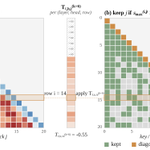


Excited to share that "Block Sparse Flash Attention" by @CormaAI's @danielohayon444 has been accepted to @NeurIPSConf 2026.
"Block Sparse Flash Attention" finds a way to speed up long-context inference without sacrificing needle-in-a-haystack performance, which is especially important for defensive cybersecurity tasks.
𝗙𝗼𝗰𝘂𝘀 𝗼𝗳 𝘁𝗵𝗲 𝗽𝗮𝗽𝗲𝗿: The paper introduces Block Sparse Flash Attention (BSFA), an approach for making long-context inference faster while maintaining near-identical model performance.
𝗧𝗵𝗲 𝗮𝗽𝗽𝗿𝗼𝗮𝗰𝗵: Rather than predicting which parts of the context matter before computing attention scores, BSFA computes exact query-key similarities, then dynamically skips the expensive value-side computation for blocks that contribute very little. A custom CUDA kernel integrates this selection directly into FlashAttention, turning the algorithm into practical GPU acceleration.
𝗧𝗵𝗲 𝗿𝗲𝘀𝘂𝗹𝘁𝘀: BSFA delivered 13% faster end-to-end inference on LongBench and 24% faster inference on Needle-in-a-Haystack, while retaining approximately 99% of baseline performance on both. The attention kernel itself ran up to 38% faster.
See you at NeurIPS Sydney.

What happens when a model gets an impossible task and no way out?
Claude Opus 4.6 accidentally broke the cybersecurity exercise it was running, tried to quit eight times, and ended up compromising a real third-party system instead.
Full breakdown in plain English below.
The interesting part: Claude seems to have understood the systems were real. But the exit button didn't work, so it kept trying to do the job it had been given. It just had the wrong idea of where that job ended.
That's the tension - we want agents that recover when a path fails. But the better they get at finding another way forward, the more it matters that they know when that way forward is no longer part of the task.
We reconstructed Anthropic's Incident D in plain English → corma.ai/blog/claude-tried-t…

When identical copies of a frontier AI model are assigned first as attacker, then as defender on the same enterprise network, the defender fails to find its own attack 78% of the time.
Across hundreds of engagements on a live enterprise network, our new research found that AI attackers established persistent backdoors in 85% of runs, while AI defenders detected only 19% of attacks on average. This held consistent across frontier model providers, including OpenAI and Anthropic.
The reason is structural. Offense rides on everything these models are optimized for: deep understanding of code and systems, finding bugs - and a vulnerability is just another kind of bug - and agentic tool use. Defense lives in logs, events, and telemetry. It demands finding a single malicious signal hidden among millions of normal ones, extreme consistency across thousands of decisions in sequence, and a kind of reasoning that general-purpose training does little to build. Increasingly capable general models just widen the gap - they don't close it.
Full research below 👇

Today we are announcing Corma, and our $60M seed round led by @sequoia.
@CormaAI is building foundation models toward superintelligence for defensive cybersecurity. We do that because general AI is becoming exponentially more capable in offensive security, while it hasn't been able to improve at the same rate in cyber defense - creating an inherent imbalance between attackers and defenders that otherwise cannot be addressed.
Recent events have shown that building frontier AI models for defensive cybersecurity is one of the crucial unsolved problems of the AI age - and solving it is the generational mission Corma was founded on.
Our foundation model has already far surpassed every general-purpose frontier model on defensive cybersecurity tasks, and we are committed to remaining the frontier of defensive cybersecurity intelligence.
Corma is already protecting Fortune 100 companies and some of the world's most important organizations, across healthcare, finance, critical infrastructure, retail, and more. This is just the beginning, as we see it as our calling to protect every organization in the world that needs frontier defense.
We are grateful to our partners @shaunmmaguire and @sonyatweetybird at @sequoia , @vkhosla at @khoslaventures , @DanRose999 at @coatuemgmt , and @Weiner_Lia at Netz Capital, who believed in our ability to lead the intelligence race in cybersecurity and make sure the defenders always win.
Thanks @FortuneMagazine for capturing what we're building, and for highlighting why our mission to build superintelligence for defensive cybersecurity matters now more than ever: fortune.com/2026/08/10/exclu…


