Applying ecological theory to help solve conservation problems in coastal ecosystems @UMichEEB
Ann Arbor, Michigan
Joined October 2019
- Tweets197
- Following224
- Followers3K
- Likes113
Coastal Ecology and Conservation Lab retweeted
🍽 COURSE ALERT 🍽
Dr. Allgeier's (@AllgeierLab) undergraduate course will explore how changing environmental and biological factors interact to influence their sustainability. Offered Fall semester 2023. Full food systems course listings on our website:
sites.lsa.umich.edu/sustaina…
Coastal Ecology and Conservation Lab retweeted
1/2 🌿🐟=💥New paper alert! Just published my latest (royalsocietypublishing.org/d…) w/ the amazing @AllgeierLab! 🎉 Turns out, seagrass love fish pee. It's a goldmine of nutrients that boost their growth, even under fishing pressure & human nutrient influence.
Coastal Ecology and Conservation Lab retweeted
Michigan News: Caribbean seagrasses provide services worth $255B annually, including vast carbon storage. The findings show that seagrass ecosystems deserve to be at the forefront of the global conservation agenda. @AllgeierLab #EEB #conservation #seagrass myumi.ch/JpGW2
Coastal Ecology and Conservation Lab retweeted
Nate Sanders, @UMichEEB professor, co-authored a study examining how coral bleaching leaves some species of reef fish struggling to identify and respond appropriately to competitors. myumi.ch/NkWkr
Coastal Ecology and Conservation Lab retweeted
Replying to @AllgeierLab @ProfTerryHughes
Coral do colonize them, and because of all the fish pee - grow fast. 3/3
science.org/doi/10.1126/scie…
onlinelibrary.wiley.com/doi/…
Coastal Ecology and Conservation Lab retweeted
Replying to @AllgeierLab @ProfTerryHughes
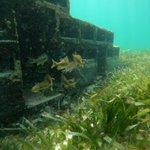
They are intentionally built in seagrass beds and synergistically increase seagrass production which can increase carbon sequestration and augment the energy base for secondary production. 2/n
esajournals.onlinelibrary.wi…
Coastal Ecology and Conservation Lab retweeted
Replying to @ProfTerryHughes
@ProfTerryHughes makes a good point. Our goal is not to recreate coral reefs. Our research primarily focuses on how they can be used for fisheries restoration. In this context all the juveniles are great. 1/n
Coastal Ecology and Conservation Lab retweeted
#EEB invites nominations for the Early Career Scientists Symposium, “Global Change and its Consequences for Green Life." Register and for more info: myumi.ch/gN4kW #Biology #ecology #research #GoBlue #gobluescientists
Coastal Ecology and Conservation Lab retweeted
What a crazy cool past couple of weeks!
First conference as a PhD student and won the best poster prize with my work with @AllgeierLab.
Then I presented my PhD plan with @biogeochemSCU and confirmed as a candidate.
And covid to spice things up😅
Now, ready for the field season!
This Post is from an account that no longer exists. Learn more
Coastal Ecology and Conservation Lab retweeted
Fish clear space for corals to grow in small scale experiments. But does grazing cause reefs to recover faster? A new paper by @timothyjcline & @AllgeierLab in @NatureEcoEvo says no—other factors take precedence at the ecosystem scale.
Read more: lternet.edu/stories/do-fish-…
Coastal Ecology and Conservation Lab retweeted
🚨Recruiting a PhD student🚨Fall 2023 at @UNCW_BaMB to study how fish-mediated ecosystem functions are responding to global change! Amazing team including @ReeFishNews @AllgeierLab @Matt_D_Ramirez. Field work on European bottom trawl surveys! Details: mclean-lab-uncw.com/join-us
Coastal Ecology and Conservation Lab retweeted
New paper on #coral reef resilience from our friends @NatureEcoEvo @timothyjcline @AllgeierLab 🪸🐟
nature.com/articles/s41559-0…
Coastal Ecology and Conservation Lab retweeted
Not enough: Protecting algae-eating fish insufficient to save imperiled coral reefs, study concludes news.umich.edu/not-enough-pr… Check out this new @NatureEcoEvo paper by @AllgeierLab @UMichEEB.
Coastal Ecology and Conservation Lab retweeted
Adventurous & resilient EEB grad John David Curlis featured in SC Voyager article "Although I love nature, it does not always love me back. I am extremely allergic to most insect bites ... I sometimes react so poorly that I cannot walk" #UMMZ myumi.ch/29JJz
Coastal Ecology and Conservation Lab retweeted
The end of our first Whale Camp for 2022 .. lots of dolphins seen, by a great team! Thanks to Ms Major and Mackey for being fun camp leaders and to our campers for asking questions, and leaning in to the experience. #FOCUS #dreamplansucceed
Coastal Ecology and Conservation Lab retweeted
Check out my friend @ks_munsterman and the incredible work she is doing in partnership with local Bahamian fishers 🐠💙 vimeo.com/461528934?embedded…
Coastal Ecology and Conservation Lab retweeted
We are searching for a postdoc in Fish Ecology and Climate Change to start fall 2022 @UMSEAS. Come work with historical data, museum specimens, and models to understand why warming may influence growth of some fishes more than others. sites.google.com/umich.edu/a…
Coastal Ecology and Conservation Lab retweeted
Marine algae expert Dr. Isabella Aiona Abbott broke barriers during her long career as a #biologist, #botanist, #author, and #professor. She is thought to be the 1st Native Hawaiian person to earn a PhD in science.
Read more here:
ow.ly/ohE450J70he
#AAPIHeritageMonth
Coastal Ecology and Conservation Lab retweeted
Exciting new @AllgeierLab paper: simulation shows artificial reefs in seagrass ecosystems are an effective means to promote #fisheries restoration–increased primary production can increase energy input into the food web, and carbon sequestration @KenzoEsquivel @MHKHesselbarth
Now online in @ESAApplications:
Mechanistic support for increased primary production around artificial reefs
doi.org/10.1002/eap.2617
With #OpenData in @ZENODO_ORG
@AllgeierLab @UMichEEB @KenzoEsquivel @NSF
#Seagrass
#EcosystemProductivity
#NSFFunded

ALT Model overview. Seagrass primary production is based on water column nutrients; seagrass biomass is sloughed to detrital biomass which is remineralized to water column nutrients. Mobile fish consume detrital biomass at a rate determined by their respiration (based on body mass and movement activity). If consumption requirements cannot be met, individuals die, adding their body nutrients to fish detrital biomass