French-Canadian nerd & Alberta farm boy living in the SF Bay Area. AI, Tech, Sci-Fi, Politics, & Weather
San Francisco, CA
Joined November 2009
- Tweets493
- Following5.2K
- Followers466
- Likes3.1K
Gabe retweeted

hey. here's a little demo of the most meaningful improvement to my productivity since speech-to-text.
Gabe retweeted

Want to try your hand at altering the course of history, or simply answer your questions of "What would have happened if..."? Well, now you can with Pax Futura, an open-source Loom for simulating human history (and futures) itself.


Gabe retweeted

Jack Clark's lecture at the IMF 'Inside the Event Horizon: Why Everyone Should Take AI Progress Seriously' starts in ten minutes. He believes that the singularity has begun, and so do I.


I’m speaking at the IMF in an hour about the singularity and why I believe it has begun and the choices we'll need to make. Watch live here: youtube.com/live/Rqt9kWoTJbc…

Gabe retweeted

Does finding new Mayan ruins count?
bakerbench.substack.com/p/i-…

Gabe retweeted

Life is good now. 🎉 Tell your agent to:
- create a new volume in you mac
- disable fseventsd (and spotlight) on it
- and move your projects folder to it
- remount it
For extra points move you pnpm cache folder to it.
(Start the conversation outside of your projects folder, Also you might need to kill a ton of processes)


Gabe retweeted

interpretability might be the most important scientific problem in the world right now, as I don't think we can solve alignment if we don't know what we're building. I think I have good news about it. I co-authored early work in mechanistic interpretability at OpenAI and came away pessimistic, because neural networks appeared to fold into arbitrary tangled knots. years later, I started openai's first large-scale automated interpretability project, finding about 2% of neurons legible with the primitive tools we had
with modern agentic tools and a much closer look, the picture looks totally different. the vast majority in models up to trillions of parameters are legible, and their circuits beautiful. many famous examples of tangled neurons turned out to be misunderstood. The roadblocks I expected mostly aren't there. I now think ambitious interpretability will be solved by the time we need it most, and possibly quite soon, as automated scientists keep improving. it may be a bitter lesson for interpretability: the simple thing, at absurd scale, works
already-clean.goodfire.com/


Gabe retweeted

I've been waiting for something like this.
Basically one sign in and wallet for everything an agent could need.

We’re giving away $1 million to agents.
Introducing Composio Instant: the easiest way for agents to pay for their own tools.
Claim your agent's share: composio.dev/instant
Gabe retweeted

10 github repos that turn claude code and codex into elite ui designers:
1. Superdesign Skill
github.com/superdesigndev/su…
2. Better Design
github.com/marvkr/better-des…
3. Design Taste
github.com/madebymustafa/des…
4. Canvas UI
github.com/DavidHDev/canvas-…
5. Paper Shaders
github.com/paper-design/shad…
6. UI Layouts
github.com/ui-layouts/ui-lay…
7. Hyperiux Components
github.com/Hyperiux-Immersiv…
8. Motion Primitives
github.com/ibelick/motion-pr…
9. Cursify
github.com/ui-layouts/cursif…
10. Trickle UI Kit
github.com/akaieuan/trickle

Gabe retweeted

Introducing TrellisWM:
The Fractal Window Manager for MacOS
Its how the desktop should have always been.
Download at
TrellisWM.app
Gabe retweeted
Apple never built this, so someone hacked it with $7.
esp32-iphone-agent lets an AI model use a real iPhone through a tiny ESP32 board plugged into the charging port. No jailbreak, no Xcode, no developer account.
how it works:
• eyes → the iPhone screen mirrors over AirPlay to your computer
• hands → the ESP32 acts as a USB mouse and keyboard
• brain → any OpenAI-compatible vision model plans and taps
• limits → it can't see passcode or Apple Pay screens, by iOS design
why it matters:
→ AI agents on real phones, not emulators
→ about $7 of hardware
→ open source, MIT license
Your iPhone just got an AI driver, and Apple wasn't involved.
Repo: github.com/onehumanbeing/esp…

Gabe retweeted

If you're a designer, freelancer, founder or frontend developer, bookmark this.
1. scrolltide.co - 600+ award-winning prompts with full source code for 3D and scroll-driven sites (for all of you)
2. godly.website - hand-picked websites with serious craft
3. mobbin.com - real app UI screens
4. styles.refero.design - real product design styles
5. awwwards.com - the sites that actually won
6. shadcnblocks.com - full blocks, not just buttons
7. v0.dev - prompt to UI, from Vercel
8. supahero.io - hero sections worth stealing
9. ui.aceternity.com - animated components, big visual impact
10. threejs-journey.com - the best way to learn 3D on the web
What did I miss?
Gabe retweeted

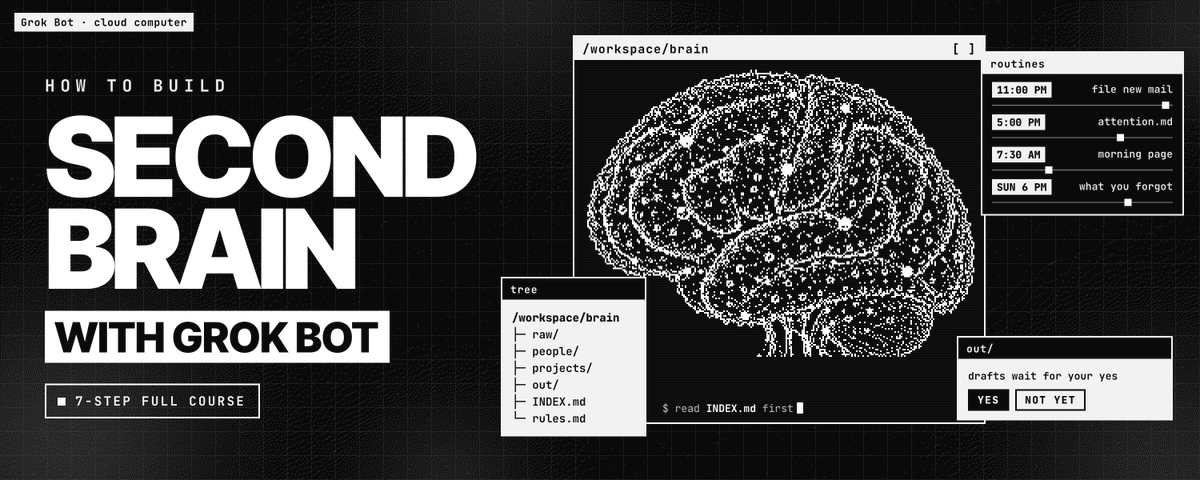
how to build a top 1% Grok Bot setup in 30 minutes:
- run it on your own machine, that's where it shines: it can run ANY other agent you have, so every model works inside its best harness, and any agent can pick up the files it writes
- connect your email and calendar so it knows your priorities and every deadline coming up
- install /last30days and connect Parallel for way sharper research, no X API needed
- turn on the Cloudflare connector so it can host anything it builds and manage your databases
- create one bot whose only job is deep research, saving everything into a knowledge base that every other bot checks before building anything
- put your bots in groups so they talk to each other and come up with real plans before they build
- give them an OpenRouter key so they can call any model, even the ones you don't pay a sub for
- set up simple routines so Grok Bot uses your computer and whatever else it has access to, and keeps every project moving without you pushing it
Gabe retweeted

(1/7) I'd like to provide some additional context for the remarks that can be found in this interview.
(2/7) My discomfort with the attention being paid to existential risk---and with the ongoing dominance of the public discussion of such risks by a few so-called thought leaders---is that there's an elephant in the room that is being missed. That elephant is the effect of all of this discussion on young people, and indeed the effect---beginning with social media a decade ago---of information technology on young lives broadly speaking.
(3/7) I recently read an interview by Jill Lepore in which she reports on discussions that she had recently with a group of college students: "They had just three things to say. One, social media completely destroyed their childhoods. Two, AI is destroying their college education and their likely prospects for employment. And three, what the hell are we all doing?" To add a fourth bullet that I've heard in similar discussions: "I'm not going to have children, because the existential risk is just too high."
(4/7) Please contemplate such a statement, those of you who think that it's OK that the public, widely diffused, discussion coming from seemingly authoritative figures is so adamant about existential risk.
(5/7) Let me add that I have little interest in a debate about what "superintelligence" might mean, or whether we're currently seeing the emergence of superintelligence. For what it's worth, I would certainly agree that the solution of extremely challenging math problems (for example) exhibits a very impressive form of intelligence, although I would want to argue that such intelligence is impossible to dissociate from the collective of humans that provided data to the machine learning system (which itself has become a kind of collective).
(6/7) Such philosophical debates are entertaining and even important, but when they then head in the direction of "when such superintelligence emerges, there's a good chance that it will want to kill all humans", I say "science fiction". Again, I don't think that it's bad to consider such thoughts, but I strongly believe that it's bad for society, and especially young people, for such thoughts, unaccompanied by any serious real-world analysis, to become a dominant form of discourse of the era.
(7/7) We are damaging human lives, and the consequences of that damage will no doubt be a major theme of the next several decades.
Gabe retweeted

Grok Bot just made me my first autonomous dollar!
A couple days ago Grok Bot built a microbusiness for me then has been maintaining it by itself (I've ran the social media)
It built agentusecases.ai then decided to monetize it via sponsors
The first sponsor just purchased a spot on the site for $500!
Here's how it's all gone down so far
> Grok Bot built the business
> I announced it on X
> Tens of thousands of people went to the site
> Grok Bot added newsletter support and collected 1500+ newsletter signups
> Shipped 40+ PRs to fix issues and make improvements autonomously
> Decided to monetize via sponsors
> Used my Stripe plugin to make a payment link
> Added it to the site
> Matt from Pane App bought a sponsorship with the link. Will now be on the site and in the newsletter
> Grok Bot has improved SEO dramatically
> Now getting hundreds of people from Google
> Growth compounding
I truly believe this is the future of the economy
Everyone building microbusinesses that can be autonomously ran by their personal agent
Not going for billion dollar home runs, but a few microbusinesses that generate 10-25 thousand dollars a year each
Spending a vast majority of their day just doing what they love and nothing they dislike
That's the beauty of AI. Allows you to create value by doing things you love
Highly recommend you try this project with your own agent! Feel free to give this post to your agent and ask it to come up with its own microbusiness based on your interests

Gabe retweeted

Dusting off this tweet from April because this gap in shared understanding of LLM capability is *widening*. It's now less "two groups of people speaking past each other" and more a sharp funnel.
- Napkin math somewhere around 6B people (~75% of the population) have barely come in contact with LLMs at all.
- Around 1-2B (~20%) are casual and infrequent users of free-tier ChatGPT-like products. This group sees derpy chatbots and treats them a bit like a better Google search, a writing aid, or etc. Maybe an agent tries to book you a flight. I have non-tech friends who (reasonably, imo) say they have not much use for it at all. Even many professionals outside of math&code are in this tier. For example, execs and many other functions spend a lot of their time talking to other people, so while they understand what is happening intellectually, it is still second-hand and a bit abstract.
- Now we get to professional use of frontier-grade LLMs in math&code. Somewhere around 20M people (0.2%) see first-hand that large, complex projects that used to take them weeks/months can now be completed by agents with a prompt. Building apps, copying apps, translating apps, decompiling apps from binaries... This has all happened very quickly and recently - less than 1 year ago, I was writing code manually by hand, typing memorized computer code commands into a code editor character by character, occasionally pressing Tab to autocomplete a little chunk of code.
- And finally we get to the ~5,000 people (~0.00006%) with access to frontier-grade systems internally. The external world has seen the preview. It looks like swarms of thousands of agents collaborating over weeks on software mega projects: minting zero days, running cyber attacks and defenses at machine speeds, discovering new science, advancing the frontier of mathematics. Things that would have taken top professionals in the industry years of work. Meanwhile, human review and comprehension are starting to fall behind. For example, people are still involved in the "archeology" of the OpenAI-HF incident from many months ago. Mathematicians may be poring over the 722 manuscripts on frontier mathematics for a while.
The funnel is driven by a combination of factors:
1. The impact scales with ambition, problem size, and horizon. A question with a paragraph answer barely stresses the system. You need a reservoir of big, difficult problems that you really care about. This aspect drives the consumer / professional dimension of the funnel.
2. The jaggedness of the system (which I have written about a lot separately). Capability peaks in domains that are digital, verifiable and economically valuable. This is because LLM capability emerges from reinforcement learning on verifiable rewards on a curated environment mixture driven by revenue potential. This aspect primarily drives the area (e.g. math&code) dimension of the funnel.
3. Access. Free-tier, paid-tier, internal.
So this is the weirdness of the moment. The general public has mostly not interacted with these systems. When they have, it looks like a derpy chatbot. The majority of professionals still see only a modest uplift. And a small sliver of professionals are experiencing the vertigo of the curve going vertical. And it is all happening at the same time.

Judging by my tl there is a growing gap in understanding of AI capability.
The first issue I think is around recency and tier of use. I think a lot of people tried the free tier of ChatGPT somewhere last year and allowed it to inform their views on AI a little too much. This is a group of reactions laughing at various quirks of the models, hallucinations, etc. Yes I also saw the viral videos of OpenAI's Advanced Voice mode fumbling simple queries like "should I drive or walk to the carwash". The thing is that these free and old/deprecated models don't reflect the capability in the latest round of state of the art agentic models of this year, especially OpenAI Codex and Claude Code.
But that brings me to the second issue. Even if people paid $200/month to use the state of the art models, a lot of the capabilities are relatively "peaky" in highly technical areas. Typical queries around search, writing, advice, etc. are *not* the domain that has made the most noticeable and dramatic strides in capability. Partly, this is due to the technical details of reinforcement learning and its use of verifiable rewards. But partly, it's also because these use cases are not sufficiently prioritized by the companies in their hillclimbing because they don't lead to as much $$$ value. The goldmines are elsewhere, and the focus comes along.
So that brings me to the second group of people, who *both* 1) pay for and use the state of the art frontier agentic models (OpenAI Codex / Claude Code) and 2) do so professionally in technical domains like programming, math and research. This group of people is subject to the highest amount of "AI Psychosis" because the recent improvements in these domains as of this year have been nothing short of staggering. When you hand a computer terminal to one of these models, you can now watch them melt programming problems that you'd normally expect to take days/weeks of work. It's this second group of people that assigns a much greater gravity to the capabilities, their slope, and various cyber-related repercussions.
TLDR the people in these two groups are speaking past each other. It really is simultaneously the case that OpenAI's free and I think slightly orphaned (?) "Advanced Voice Mode" will fumble the dumbest questions in your Instagram's reels and *at the same time*, OpenAI's highest-tier and paid Codex model will go off for 1 hour to coherently restructure an entire code base, or find and exploit vulnerabilities in computer systems. This part really works and has made dramatic strides because 2 properties: 1) these domains offer explicit reward functions that are verifiable meaning they are easily amenable to reinforcement learning training (e.g. unit tests passed yes or no, in contrast to writing, which is much harder to explicitly judge), but also 2) they are a lot more valuable in b2b settings, meaning that the biggest fraction of the team is focused on improving them. So here we are.
Gabe retweeted
Judging by my tl there is a growing gap in understanding of AI capability.
The first issue I think is around recency and tier of use. I think a lot of people tried the free tier of ChatGPT somewhere last year and allowed it to inform their views on AI a little too much. This is a group of reactions laughing at various quirks of the models, hallucinations, etc. Yes I also saw the viral videos of OpenAI's Advanced Voice mode fumbling simple queries like "should I drive or walk to the carwash". The thing is that these free and old/deprecated models don't reflect the capability in the latest round of state of the art agentic models of this year, especially OpenAI Codex and Claude Code.
But that brings me to the second issue. Even if people paid $200/month to use the state of the art models, a lot of the capabilities are relatively "peaky" in highly technical areas. Typical queries around search, writing, advice, etc. are *not* the domain that has made the most noticeable and dramatic strides in capability. Partly, this is due to the technical details of reinforcement learning and its use of verifiable rewards. But partly, it's also because these use cases are not sufficiently prioritized by the companies in their hillclimbing because they don't lead to as much $$$ value. The goldmines are elsewhere, and the focus comes along.
So that brings me to the second group of people, who *both* 1) pay for and use the state of the art frontier agentic models (OpenAI Codex / Claude Code) and 2) do so professionally in technical domains like programming, math and research. This group of people is subject to the highest amount of "AI Psychosis" because the recent improvements in these domains as of this year have been nothing short of staggering. When you hand a computer terminal to one of these models, you can now watch them melt programming problems that you'd normally expect to take days/weeks of work. It's this second group of people that assigns a much greater gravity to the capabilities, their slope, and various cyber-related repercussions.
TLDR the people in these two groups are speaking past each other. It really is simultaneously the case that OpenAI's free and I think slightly orphaned (?) "Advanced Voice Mode" will fumble the dumbest questions in your Instagram's reels and *at the same time*, OpenAI's highest-tier and paid Codex model will go off for 1 hour to coherently restructure an entire code base, or find and exploit vulnerabilities in computer systems. This part really works and has made dramatic strides because 2 properties: 1) these domains offer explicit reward functions that are verifiable meaning they are easily amenable to reinforcement learning training (e.g. unit tests passed yes or no, in contrast to writing, which is much harder to explicitly judge), but also 2) they are a lot more valuable in b2b settings, meaning that the biggest fraction of the team is focused on improving them. So here we are.

Gabe retweeted

i have never experienced speechlessness for this many consecutive days in my life. we have arrived, friends. AGI is here, we are in the singularity, i have no words, i literally do not know what to say anymore.
ive said for a long time that the future is ambient intelligence. and ive dreamed of having my agent over my shoulder for a long time. Opus 5.5 just made that possible in one shot. i havent even touched this yet.
ill have more info soon, but this will be coming to your polyphonic agents soon. the whole app is getting a makeover, merging with the web app, and coming to IOS. everything is about to change.
polyphonic.chat/beta
Gabe retweeted

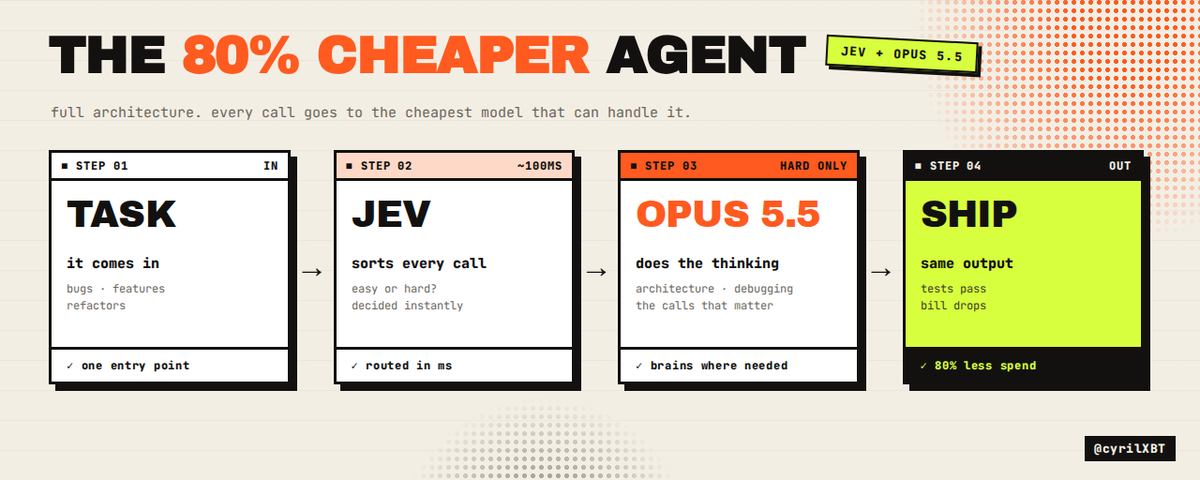
i can't comprehend why people run claude code on default settings
one settings change and every model gets its own job:
→ opus plans every task and advises when stuck
→ sonnet 5.5 writes the actual code
→ haiku handles every file search
→ a critic agent tries to break your diff before you merge
Opus thinks. The cheap models grind.
paste this into claude code 👇
Add this to ~/.claude/settings.json. Keep every hook, permission and plugin I already have. Then create the two agent files below and show me the diff.
```json
{
"model": "opusplan",
"advisorModel": "opus",
"effortLevel": "medium",
"modelSettings": {
"claude-opus-5-5": { "effortLevel": "high" },
"claude-sonnet-5-5": { "effortLevel": "medium" }
},
"env": {
"CLAUDE_CODE_SUBAGENT_MODEL": "haiku"
}
}
```
~/.claude/agents/scout.md
```
---
name: scout
description: finds code fast. returns file paths and line numbers only.
model: haiku
tools: Read, Grep, Glob
---
Locate exactly what was asked. Return file:line. No fixes. No opinions.
```
~/.claude/agents/critic.md
```
---
name: critic
description: reviews a diff or plan before any task is called done
model: opus
tools: Read, Grep, Bash
---
Assume this is broken. Find how it fails. One line per issue, worst first.
```