

Give your network capabilities that weren’t possible before. Aliro makes it easy to use entanglement for your applications.
Boston, Massachusetts
Joined September 2019
- Tweets1.1K
- Following30
- Followers598
- Likes143






Today we go LIVE with a new webinar exploring how shared entanglement enables multiple senders to securely perform distributed computations.
Join Brian Doolittle, Director of Engineering and Head of Simulation at Aliro, to learn:
>> The fundamentals of quantum dense network coding.
>> How entanglement reduces the information each sender needs to transmit.
>> Why the advantage amplifies as the network grows.
>> How measurement-device independence can enable data privacy and new approaches to secure distributed computation.
Entanglement is enabling capabilities that go beyond simply recreating what classical networks already do. This webinar offers researchers, network architects, and quantum technology leaders a look at what becomes possible when entanglement itself becomes a network resource.
Register: hubs.la/Q04yFzWm0
Research behind the webinar: hubs.la/Q04yFB1q0
#QuantumNetworking #EntanglementNetworksf

The Internet didn’t scale because everyone used the same hardware. It scaled because software and protocols made it possible for different infrastructure to work together.
Entanglement networks face a similar challenge. These networks may include entangled photon sources, detectors, switches, quantum memories, classical networking equipment, and other technologies from a wide range of vendors. This raises an important question:
How do you keep building on top of the network when the hardware keeps changing?
Part of the answer is Orchestration. As entanglement networks grow and change, software must go beyond controlling individual devices and begin to coordinate resources across the network, manage services, monitor performance, and provide consistent operations across the entire network.
Our white paper, Orchestration of Quantum Networks, looks closely at what orchestration means for entanglement-based networks, how it’s similar and different from orchestration in classical networks, and why it it’s needed to scale entanglement beyond a few nodes.
Read it here: hubs.la/Q04yGHdz0

As network complexity grows, tools that can reliably and accurately predict performance become necessary for the design, development and deployment of entanglement-based networks.
There are two main methods for predicting network performance: theoretical modeling and discrete event simulation. These approaches each have different strengths and weaknesses. By using both methods, the best hardware can be selected for a given quantum networking, avoiding expensive dead ends. Teams evaluating entanglement-based networking want concrete predictions:
- What secret key rate can be achieved over an existing fiber optic network?
- How sensitive is our quantum network design to environmental factors, such as polarization drift, dispersion, and timing jitter?
- What are the loss and noise thresholds at which secure keys can no longer be established with practicality?
Our goal with simulation is to make it simpler to predict the performance of entanglement links in your network, and make it easier to verify that your network design supports the performance you need.
Check out this blog post, where we give a high-level explanation of the findings of our research paper, Realistic quantum network simulation for experimental BBM92 key distribution.
hubs.la/Q04ttf4m0 #EntanglementNetworks #SecureNetworks

It’s always exciting to see foundational research take on a life of its own.
Researchers at Pasqal published a new paper exploring how neutral-atom quantum computing might be used to optimize entanglement routing in quantum networks. Their work builds directly on research coauthored by Aliro Co-Founder and CTO Michael Cubeddu with collaborators at NIST, which examined entanglement routing as a core networking challenge and is cited as reference #1 in the new paper. (hubs.la/Q04z7NbD0)
Why does routing matter?
As quantum networks grow, distributing entanglement efficiently will require making routing decisions under constraints including limited network resources and end-to-end fidelity. These are difficult optimization problems, and an important part of turning interconnected quantum hardware into large-scale networks.
The Pasqal team takes an interesting approach: a hybrid classical-quantum framework in which classical optimization selects routes while a neutral-atom quantum optimization method helps generate fidelity-feasible candidate paths.
The authors describe the work as a proof of concept rather than evidence of quantum utility or scalability, but that's exactly what makes developments like this worth watching: researchers are connecting advances in quantum computing with the practical problems involved in operating quantum networks.
We’re looking forward to seeing where the work goes next. Check out the paper here: hubs.la/Q04z7Ndg0

Entanglement-based networks are fundamentally different from classical networks, but they don’t require us to forget everything we learned from building classical networks.
Classical networking has spent decades solving the same types of problems that entanglement-based networks experience as they expand:
- Interoperability.
- Resource management.
- Monitoring.
- Automation.
- Orchestration.
- Fault detection.
- Integration with existing infrastructure.
Quantum networks add entanglement to the network, but many of the operational requirements remain familiar. That means the quantum networking industry doesn’t have to invent an entirely new philosophy of network operations from scratch;
we can take proven architectural principles from classical networking and apply them thoughtfully to infrastructure built around entanglement.
This webinar emphasizes what we’ve learned from how classical networks have developed over time, and where we’re applying that to how Aliro Orchestrator helps operators run and manage the integrated quantum channels of their network: hubs.la/Q04yGtG30

Check out this report on practical considerations for integrating entanglement into your security posture.
We also address a number of important questions we hear from cybersecurity professionals:
- Once generated, how are these keys used?
- How does entanglement-based key generation get translated into usable outputs for classical systems?
- How does the entanglement layer handle traffic, and how does it integrate into the classical network?
... and a lot of other questions about the security of entanglement networks!
hubs.la/Q04ttJMp0
#EntanglementNetworks #SecureNetworks

What if entanglement could be used to accomplish the same distributed computation using half the communication as that of a classical network?
That’s the advantage demonstrated by quantum dense network coding. As more senders join the network, the advantage can even grow exponentially.
Join Brian Doolittle, Director of Engineering and Head of Simulation at Aliro, for a new LIVE webinar exploring how shared entanglement can enable multiple senders to securely perform distributed computations with fundamentally different communication requirements. In this webinar, you will learn:
>> The fundamentals of quantum dense network coding.
>> How entanglement reduces the information each sender needs to transmit.
>> Why the advantage amplifies as the network grows.
>> How measurement-device independence can enable data privacy and new approaches to secure distributed computation.
Entanglement is enabling capabilities that go beyond simply recreating what classical networks already do. This webinar offers researchers, network architects, and quantum technology leaders a look at what becomes possible when entanglement itself becomes a network resource.
Register: hubs.la/Q04yFw7W0
Research behind the webinar: hubs.la/Q04yFwxW0
#QuantumNetworking #EntanglementNetworks
What does an entanglement network look like?
Let's take a look at an example of an entanglement network, including the hardware that you’ll find in each node on the network.
hubs.la/Q04ttqtt0
#EntanglementNetworks #SecureNetworks

Elementary entanglement generation is a foundational process required for using entanglement in your network and extending it across network nodes. This video shows a meet-in-the-middle scheme for successfully performing EEG in an entanglement-based quantum network.
#EntanglementNetworks #SecureNetworks
Aliro is at Quantum World Congress 2026 this week! We’re meeting with leaders in financial services, utilities, and telecom to talk about how to use entanglement to protect the most sensitive communications on their network. Join us September 23–25 at The Hotel at UMD in College Park, Maryland.
Why Entanglement matters now:
• AI acceleration and quantum progress are shrinking the security of math-based encryption and long-lived data.
• Harvest Now Decrypt Later risks exposing high-value communications: data center interconnects and cloud links are the most targeted.
• Organizations are asking for concrete roadmaps, not experiments.
Visit us at Booth 14 and we'll show you how:
- Simulation de-risks entanglement network design choices.
- Orchestration is an end-to-end control plane for managing entanglement with traffic engineering and automation.
• On-device software runs adaptive protocols across heterogeneous hardware.
• A path from emulation to pilot to deployment for entanglement-based secure networking.
Entanglement Networks are part of a cybersecurity roadmap that can protect your most sensitive communications today.
• Near-term pilots that harden critical links without forklift upgrades.
• PQC blended with entanglement-based security for defense-in-depth.
• A simulation-first roadmap that shortens time-to-deployment and reduces risk.
Meet us at #QWC2026 at Booth 14!
#SecureNetworks #EntanglementNetworks #QuantumWorldCongress

Quantum networking won’t scale on hardware alone.
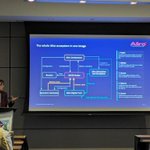
In a presentation at IEEE Quantum Week, Aliro’s Cara Alexander, VP of Product, showed what scaling a quantum network looks like in practice: combining realistic physics modeling with network planning, abstracting heterogeneous quantum hardware, and orchestrating the resources and services required to operate an entanglement network.
Sources, detectors, links, protocols, timing, synchronization, network topology, and application requirements all interact. The software layer transforms these quantum devices into a field-ready operational network, and ultimately into infrastructure that applications can use.
As quantum networking moves to operational systems, advances in hardware will remain essential. But so will the ability to design, validate, orchestrate, and operate that hardware as one integrated network.
#QuantumNetworking #EntanglementNetworks #SecureNetworks

What is Hyperentanglement?
Entangled photons can be generated across multiple degrees of freedom, including polarization, spatial mode, angular momentum, time, and frequency. By creating entanglement across several dimensions simultaneously, we can achieve superior quantum capabilities using hyperentanglement!
#EntanglementNetworks #QuantumNetworking
As quantum networking moves to real-world infrastructure, there's an important question coming up: how do you design, test, and validate network behavior before committing to physical deployment?
At IEEE Quantum Week 2026, Brian Doolittle, PhD, Director of Engineering & Head of Simulation at Aliro, presented his talk, “Enterprise-scale Emulation of Quantum Secure Communications," getting right to the root of this question.
Realistic simulation and emulation give engineers a way to model quantum network components, protocols, timing, noise, and performance at scale, helping bridge the gap between experimental systems and operational networks.
At Aliro, this is exactly how we approach building entanglement-based networks: design and validate first, then operate with confidence.
Thanks to IEEE Quantum Week for bringing together researchers and engineers working to make quantum networks practical at scale! #IEEEQuantumWeek #QuantumNetworking #EntanglementNetworks

In this video, Aliro’s experts share the creative analogies they’ve used to describe entanglement-based key generation.
hubs.la/Q04tt5rL0
#EntanglementNetworks #SecureNetworks
Timestamps for this video:
00:03 Supernatural twins: entanglement through storytelling
01:46 Entangled photons and matching random generation
02:17 Coin flip analogy for correlated outcomes
03:24 Polarized sunglasses to explain measurement basis
Featuring:
Cara Alexander, VP of Product at Aliro
Geoff Mitchell, Software Engineer at Aliro
Matthew Skrzypczyk, Software Engineer at Aliro
Suparna Seshadri, Research Scientist at Aliro

Did you know we host webinars? Our team of experts choose topics that are timely and helpful to organizations exploring, building, and expanding their networks to include entanglement links. Join us for our next webinar to get your questions answered live, or check out our on-demand webinars: hubs.la/Q04tsTHm0
#EntanglementNetworks #SecureNetworks

How are entangled photons created?
In this segment, we explore the processes used to generate entangled photons, focusing on two key methods: Spontaneous Parametric Down Conversion and Spontaneous Four-Wave Mixing.
#EntanglementNetworks #SecureNetworks
Have you seen our YouTube channel? We post videos with insights and actionable advice for leveraging Entanglement for a wide range of network applications today with in-depth explanations of how they work.
hubs.la/Q04wWl810
#SecureNetworks #EntanglementNetworks

Why do we care so much about entanglement? Because of the capabilities in sensing, security, and communications that it enables!
hubs.la/Q04tsTZ80
#EntanglementNetworks #SecureNetworks

What is quantum sensing? Quantum sensing uses systems at the atomic scale to probe the natural world with unprecedented precision. Quantum sensors can be connected via entanglement to achieve measurements not possible with individual sensors alone!
Timestamps for this video:
00:03 – Quantum sensing defined.
00:25 – Sensing process explained.
#EntanglementNetworks #SecureNetworks
Are you in search of answers to your questions about quantum networking? Would a curated newsletter of live and on-demand webinars, explainer videos, blog posts, and white papers be welcomed to your inbox?
Sign up for Aliro's monthly newsletter today and get our next issue delivered this week!
hubs.la/Q04sghN00
#SecureNetworks #QuantumNetworking
