

AI aficionado | Lover | Exploring the wonders of AI, one algorithm at a time!
Philadelphia
Joined May 2023
- Tweets1.3K
- Following214
- Followers16
- Likes2.1K
Leonard Lin retweeted

this actually proves that there is gonna be more software engineering jobs out of necessity


Leonard Lin retweeted

A full tutorial on building an advanced MCP server in Python, with OAuth, a database, and how the protocol actually works

Here’s a full tutorial on building advanced MCP servers in Python.
We’ll go beyond basic tools and cover the underlying architecture, HTTP transport, OAuth authentication, and persistent data with a database.
Then we’ll build a working MCP server and connect it to Claude Code.
Timestamps:
00:00:00 | Overview
00:01:10 | What is MCP?
00:02:12 | Important MCP Concepts and Architecture
00:03:48 | MCP Transport
00:05:10 | MCP Server Components
00:06:08 | Authorization
00:09:54 | MCP Authorization Server
00:12:26 | Identity Providers
00:14:02 | Basic MCP Server Setup
00:21:22 | Claude Code Connection
00:26:47 | Adding Authentication
00:43:00 | Building the Auth Page
00:53:41 | Adding Databases
01:05:29 | Fixing User Identification
Leonard Lin retweeted

a) neither – share price. Note that neoclouds are issuing quite a bit of equity, diluting shareholders
b) think no (esp consider how hotels or airlines often lease don’t own assets)
Leonard Lin retweeted
It can be simultaneously true that we’re going to need a shit ton of GPUs and that the equity return of owning GPUs isn’t going to be super high. I’m biased but I think most value will accrue in the software layer – applications and infrastructure.
Leonard Lin retweeted

Meet Ollama co-founder & CEO @jmorgan who speaks about open model adoption in the enterprise.
Watch the episode
👇


Leonard Lin retweeted

LLMs break every assumption about regular ML inference.
A traditional ML model such as a CNN, transformer classifier, or XGBoost model produces its output in a single forward pass.
Nothing carries over between requests. The hardware performs roughly the same kind of work each time.
LLMs work differently.
An LLM generates output one token at a time, turning one request into hundreds of sequential forward passes.
Prefill is often compute-bound, while decode is usually memory-bandwidth-bound. The serving engine must schedule both workloads without letting one stall the other.
Each request also builds a KV cache that grows with its context. When prefixes overlap, cached blocks may be reused across requests, so routing can depend on cache locality instead of only sending traffic to the least-busy replica.
MoE models add expert routing and communication on top of this.
None of these constraints exist in the same form in traditional ML serving.
That is why LLM inference now has its own stack of optimizations across compression, attention, KV cache management, batching, decoding, parallelism, and routing.
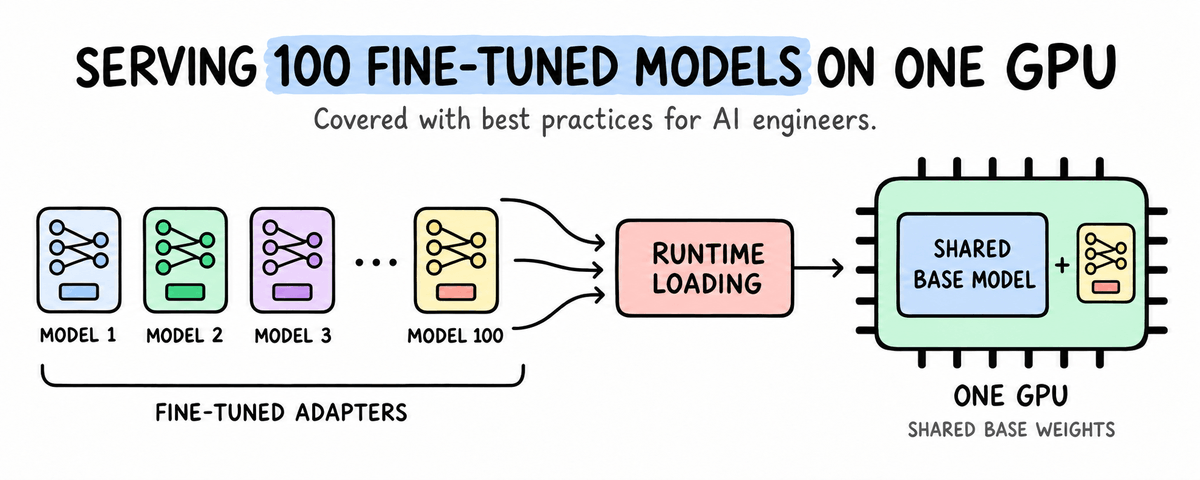
One principle sits beneath many of these systems, which is to duplicate only the parts that differ.
This becomes especially useful when many fine-tuned models share the same base. Treating every fine-tune as an independent deployment duplicates the same base weights, storage, and startup work.
A better mental model is one common model with many small task-specific variations. The base weights remain shared, the specialization stays separate, and the serving layer selects the required variation for each request.
We wrote a detailed article applying this principle to serving 100 fine-tuned models on one GPU.
Read it below.

Leonard Lin retweeted

Crazy how Anthropic started to hide the full names of engineers on its engineering blogs... never seen this happen in tech before.
After the OpenAI espionage story I have empathy why they do it, but strange to see none the less
Clearly shows eng at an AI lab is high stakes?

Leonard Lin retweeted

ListQA: A Benchmark for Evaluating List-Formatted Factual Knowledge Retrieval in Large Language Models
@mayank_k91 et al. present a benchmark where LLMs recall facts from Wikipedia tables and return them as structured lists.
📝 arxiv.org/abs/2610.19165
👨🏽💻 listqa.github.io

Leonard Lin retweeted

An attacker doesn't always need to get past your login page.
A management interface has to handle web requests before it knows who's sending them. If there's a bug in that path, a strong password or MFA on the login page might not even matter.
𝗖𝗩𝗘-𝟮𝟬𝟮𝟲-𝟮𝟬𝟬𝟳𝟵 is an example in Cisco's firewall management console. An attacker can send crafted HTTP requests, 𝗯𝘆𝗽𝗮𝘀𝘀 𝗮𝘂𝘁𝗵𝗲𝗻𝘁𝗶𝗰𝗮𝘁𝗶𝗼𝗻, and execute commands as root.
Cisco traced the flaw to an improper system process created at boot time. This resulted in a path from an unauthenticated web request to 𝗳𝘂𝗹𝗹 𝗰𝗼𝗻𝘁𝗿𝗼𝗹 𝗼𝗳 𝘁𝗵𝗲 𝗺𝗮𝗰𝗵𝗶𝗻𝗲.
And this machine could manage other firewalls too. Compromising it means an attacker can change the rules those firewalls enforce.
𝗧𝗟𝗗𝗥: 𝗪𝗵𝗼 𝗰𝗮𝗻 𝗿𝗲𝗮𝗰𝗵 𝘁𝗵𝗲 𝗶𝗻𝘁𝗲𝗿𝗳𝗮𝗰𝗲 𝗺𝗮𝘁𝘁𝗲𝗿𝘀 𝗯𝗲𝗳𝗼𝗿𝗲 𝗮𝘂𝘁𝗵𝗲𝗻𝘁𝗶𝗰𝗮𝘁𝗶𝗼𝗻 𝗲𝘃𝗲𝗻 𝘀𝘁𝗮𝗿𝘁𝘀.
A 𝗽𝗿𝗶𝘃𝗮𝘁𝗲 𝗼𝘃𝗲𝗿𝗹𝗮𝘆 𝗻𝗲𝘁𝘄𝗼𝗿𝗸 lets admins reach the console without exposing it to the public internet or replacing the existing firewall:
• Set up a routing peer on a device in the appliance's network to provide a private path to the console.
• Have admins connect their laptops through the company's identity provider with SSO and MFA.
• Allow only devices in an admin group to reach the console's management port, remove any broader access rules, and close that port to the public internet.
An internet scanner then has 𝗻𝗼 𝗼𝗽𝗲𝗻 𝗺𝗮𝗻𝗮𝗴𝗲𝗺𝗲𝗻𝘁 𝗽𝗼𝗿𝘁 𝘁𝗼 𝗰𝗼𝗻𝗻𝗲𝗰𝘁 𝘁𝗼. This is one of the reasons why ZTNA puts identity checks 𝘣𝘦𝘧𝘰𝘳𝘦 the connection, not after it. A pre-auth bug can't be exploited by someone who can't reach the endpoint in the first place.
Example access-policy configuration: docs.netbird.io/manage/acces…

Leonard Lin retweeted

Virtual science for agents!
Each world consist of interacting fields governed by complex equations, discovered through evolutionary search. Agents have sensors available to them, as well as actuators to interact with the fields, setting up experiments that they can analyze.

Can agents discover the physical laws of artificial worlds? During my residency at @PrimeIntellect I built PhySim to find out. swpo.github.io/physim/
Leonard Lin retweeted

21× smaller vectors. 99.9% of baseline retrieval quality retained with rescoring.
We tested Perplexity’s pplx-embed-v2-late with Qdrant’s TurboQuant across 4 ViDoRe v3 datasets.
856 KB → 40 KB per page, with a trade-off: rescoring requires the original vectors.
Full benchmarks below 👇
Leonard Lin retweeted

We are getting there...
A developer just used Claude Code and Codex to identify a possible planet in NASA telescope data.
Imagine millions of AI agents helping scientists explore the universe and uncover things we've never seen before.
We're only getting started.
Claude Code rebuilt a Kepler data analysis pipeline and identified 17 new planet candidates.
Astronomers used Anthropic's Claude Code, a coding agent, to rebuild the aging software pipeline used to analyze data from NASA's Kepler telescope.
The refactored pipeline replaced hand-tuned noise filters with a trainable model, recovering 23 known planets and identifying 17 new candidates, including KOI-456.04.
That candidate orbits a Sun-like star in the habitable zone, with follow-up observations planned for early 2027.
Space will surprise us so much that we can't even imagine it yet!
where i found:
news.lavx.hu/article/claude-…


Leonard Lin retweeted
I published Vol. 177 of "Top Information Retrieval Papers of the Week" on Substack.
🔗 recsys.substack.com/p/search…

Leonard Lin retweeted

if you are interested about continual learning but wonder what the heck it evens means I greatly recommend this 1h30min discussion with @carnot_cyclist
first because he got a clear head about what it is or should be
second because godamn this man enthusiasm is infectious

Leonard Lin retweeted

Moral of the story:
avoid benchmaxxing, build robust models

AstroLoc was used by Artemis II to localize photos of the Moon taken by astronauts!
We built Astroloc two years ago to localize photos of Earth taken by astronauts on the International @Space_Station: the model is so robust that they use it also for the Moon!


Leonard Lin retweeted

We call the testing team “QA”, then ask them to check everything after we’ve built it. That job title is doing quite a lot of work.
Quality control checks whether the result meets the requirements. Run the test, inspect the output, find the deviation, correct it. It gives us feedback about what we actually built.
Quality assurance asks whether the way we work gives us good reasons to expect those requirements will be met. Are they clear? Have we considered the failure modes? Have we planned checks that would actually expose them?
Take a payment retry.
A test finds that retrying after a timeout charges the customer twice. Finding that defect is QC.
Asking what a timeout means, defining the retry behavior and requiring evidence that duplicate charges are prevented belongs in the engineering process before somebody writes the implementation. QA helps make sure that process exists and is followed.
You need both. A sensible process can still produce a broken implementation. A passing test can still check the wrong expectation.
And this is where the conversation about coding agents gets interesting.
If the workflow is “generate code, then ask another agent to review it”, we’re putting a lot of responsibility on inspection. We’ve automated the reviewer, but we may still have no clear agreement about what the software is supposed to do.
Agents can also help recover requirements, expose contradictions, analyse hazards and work out which checks are needed. Then they can test the implementation against those expectations.
That gives us a chance to improve how software is built, as well as how quickly we find its defects.
Otherwise we risk building a very expensive machine for discovering, at impressive speed, that nobody agreed what “correct” meant.
Leonard Lin retweeted

Tokenized stocks are becoming more interesting for a reason beyond 24/7 trading.
If over 85% of overnight price moves are reflected in conventional shares within five minutes of market open, that suggests tokenized markets can serve as an additional layer of price discovery.
But trading access alone doesn’t make a market mature.
Liquidity, legal ownership, redemption rights and interoperability will determine whether tokenized equities become meaningful financial infrastructure or remain fragmented products.
I believe If tokenized stocks can capture price movements overnight before traditional markets open, their role may extend beyond trading access. They could become another venue where markets discover prices!
Leonard Lin retweeted

the final output can look perfect.
the tools the agent used along the way can still be messy.
checking only the result misses half the story.
Leonard Lin retweeted

“The problem is if the only thing we do is automation.”
I interviewed @DAcemogluMIT , MIT economist and winner of the 2024 Nobel Prize in Economics, about AI, jobs and where he thinks the real opportunities are.
We talked about much more:
-Why AI is great at coding but still struggles with customer service
-Why AI’s economic impact still doesn’t match its technical progress
-How Daron uses AI in his own research
-Why he doesn’t want students using AI to write for them
-Whether university will still be worth the money in 10 years
-What work could look like in 2035
-Why he worries about people losing their agency
-How he invests his own savings during the AI boom
-Where entrepreneurs should be looking for AI opportunities today
What I liked about this conversation is that we got very practical: Where is AI actually useful today? What should entrepreneurs build? What should people learn? And what parts of our work and thinking should we NOT hand over to AI?
Watch the full interview!

Leonard Lin retweeted

A fast model chooses experiments. A 3D model predicts the chemistry
To modify a drug-like molecule, chemists need to know where a reaction will occur. Training AI to answer that question requires experimental data—and a decision about which molecules to test next.
Minot and colleagues gave those jobs to different models.
An XGBoost ensemble, a group of decision-tree models, selected experiments by finding molecules where its members disagreed about whether a reaction would work. It could score more than 22,000 candidates in about 0.1 seconds, making repeated selection inexpensive.
The expanded dataset then supported geometric graph neural networks, which use the 3D arrangement of atoms to predict the chemistry. Their advantage became clear when tested on unfamiliar molecular frameworks. When molecules were simply divided randomly between training and testing, the best tree model performed similarly.
That division of labour is worth borrowing: choose each model for the decision it needs to support. Selecting informative experiments and making accurate scientific predictions need not require the same architecture.
Minot et al., Nature Computational Science (2026). CC BY 4.0. nature.com/articles/s43588-0…
