

MS Nutrition | Researcher 10+ Years | Scientific Communicator
Arizona, USA
Joined December 2018
- Tweets14.2K
- Following283
- Followers4.8K
- Likes12K





Sounds like we agree on pretty much everything then. Food companies just want to make money, so of course they make food as appealing to our neurobiology as possible.
The people eating their products are the ones who fundamentally need to change their beliefs and habits, because the food companies would follow suit. But that will never happen and instead people will just make excuses about how food is addictive or something.
Yeah, so the entire presentation basically made the case that ultraprocessed foods are tasty and people like eating them, and then twisted that into the conventional brain disease model whereby the foods compel people to eat them and make people lose control, which is all bogus.
I think we need to stop calling foods, substances, and behaviors "addictive" because it carries some really erroneous conotations.
Like, what does addiction even mean in these situations?
1) It's rewarding and people want to keep using. Okay, that's a meaningless definition that accompanies all pleasurable activities.
2) People want to use despite negative consequences. Okay, this can again apply to virtually anything and is also completely subjective in terms of what constitutes a consequence.
3) It changes the brain in ways that compel people to continue regardless of conscious intent. This is basically the brain disease model of addiction, which has been largely discredited in addiction research.
Food companies try to engineer foods that taste good and provide pleasure to those eating them. That's it, and that pleasure contributes to motivation for many to continue eating them.
There is no circumstance where one's brain becomes "hijacked," and I actually find such wording to be quite defeating for those struggling to change their behaviors. It essentially tells people that they have no control and are victims to their food, drug, or behavior or choice.

@doctortro is right, the food environment we live in today is literally engineered to be as addictive as possible.
Turns out there's big money in hijacking our neurology.
All that said, can anyone explain how Berry's response is relevant... at all?


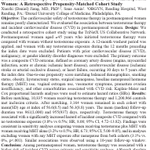
I'm highly skeptical of this finding. Need to see the full-text when published, but a few issues pop out to me based on the conference abstract (screenshots included for convenience).
First, how is reverse causality accounted for? One of the primary indications for TRT in women is sexual dysfunction, and a 2024 meta-analysis of nearly 150,000 participants found that cardiovascular diseases are themselves associated with sexual dysfunction in women (PMID: 38297501).
Second, what was the testosterone exposure? There's no info about formulations, doses, duration of treatment, serum levels, etc.
Third, composite cardiovascular events increases statistical power to detect differences between groups, but they aren't interchangeable. This isn't necessarily a bad thing, but I'd want to see the individual outcome rates and whether any association was driven by less severe diagnoses.
Fourth, how is surveillance bias accounted for? Women on hormone therapy are more likely to be part of the medical system than those not receiving it, so the likelihood of documenting something is higher by this alone.
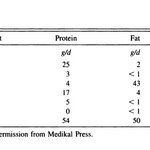
Fifth, what is going on with their data table? There were supposedly 3164 women in each group (testosterone vs control), but in the second row, 305 events at 3.2% would be over 9,000 participants in the group. Maybe they meant to put 105. Could just be a simple error.
Anyway, these are just some things off the top of my head. Might be more. Sucks that such findings can make the rounds and strike unnecessary fear before any meaningful review of their study is even possible.


No, because his ceiling would rise whereby he could sustain higher-intensity speeds without relying on glycolysis.
My baseline assumption would be that he was working above his first ventilatory threshold, but since it is him, I assume he's tested his lactate throughout training to find his personal threshold and just has a strong aerobic base.
Seems like you missed my qualifier where I explicitly said "part of resilience". There are many components to it 🙂
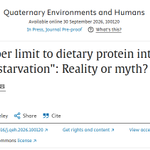
Thanks man. For what it is worth, I do think that there are some limitations in this study that greatly limit its use for addressing the MPS question.
The difference in MPS between the 25 and 100 grams of protein in the first four hours was just 20%, with most of the difference being in the next 8 hours (+40% greater with 100 g).
Issue here is that there is no intermediate group to see if early MPS rates saturate, nor is there a group that consumes 100 grams of protein spread across meals within the 12 hour testing window.
I'd speculate that early MPS probably maxes out around 40-50 grams of protein, and that consuming 2-3 meals that add up to 100 g of protein would lead to more MPS than the single 100 g bolus.
Regardless, this study supports others in showing that total-body protein synthesis rates appear to have no upper limit with amounts of protein tested.
I'm happy for you, truly. You set a goal for something you've always wanted to accomplish and then set out to make it a reality. That's admirable.
And obviously injury prevention is important. That was never disputed.
My point is much broader. I don't think that we should become so risk-averse or dependent on optimizing every little metric that we end up using ordinary and minor setbacks as reasons to avoid challenging ourselves.
That said, you have the unique luxury of just changing your life around at a whim so that you can get away with such things. But still, a poor night of sleep doesn't automatically make a training session reckless.
Building resilience requires developing the physical and mental capacities to challenge yourself and keep moving forward when conditions aren't ideal. Managing risk is important, but this isn't recklessness.