Economist @resfoundation, working on social security, poverty and living standards.
Joined June 2017
- Tweets452
- Following921
- Followers550
- Likes399
Alex Clegg retweeted
Our Research of the Week goes to @resfoundation for their research looking at the role of in- work progression in tackling child poverty. resolutionfoundation.org/pub… (1/6)
Alex Clegg retweeted
Our latest Housing Outlook finds that more than 1 million children are pushed into poverty by high housing costs. Tackling this should be a central element of the Government’s upcoming Child Poverty Strategy. 🧵/
Alex Clegg retweeted
🚨 New report published today 🚨
Our final Housing Outlook of the year looks at the 1.1 million children who live in families whose housing costs push them below the poverty line.
Read the report ➡️ buff.ly/3VnzDq8

ALT Alex Clegg quote: “Over a million children living in poverty today would not be below the poverty line were it not for sky-high housing costs, especially in the private rented sector. “The Government could lift 75,000 children out of poverty by the end of the decade if they spent £1.8 billion to repeg Local Housing Allowance to the 30th percentile of rents. “But in the longer term, investment in house building – especially social housing – is essential to both reduce the rents that low-income families are paying and ease the pressure on the housing benefit bill.”
The new stats are here (and now on StatXplore!) gov.uk/government/statistics…
But it is not the case that all Tax Credit claimants forgoing claiming UC are those with very low levels of award. An FOI request from @Z2K_trust showed an average annual Tax Credit award of £4,300 among those who have had their claims closed z2k.org/wp-content/uploads/2…
It is certainly interesting that the lowest claim rates in the chart above are for claimants of the legacy benefits that do not feature any form of work-search conditionality rules
Some Tax Credit claimants may have fallen out of eligibility for UC by the time they received a migration notice, while others will have decided they do not want to engage with UC's conditionality rules
The DWP point to very low numbers of complaints from Tax Credit claimants who don't claim UC, which suggests the majority choose not to claim rather than struggle with the process and fall off 'by accident'. gov.uk/government/publicatio…
But the big caveat here is that still only a relatively small number of combinations of different legacy benefit claimants have come to the end of their migration windows, so this is a developing story as more data comes in
Claim rates of above 90% for other legacy benefit combinations are reassuring, and less surprising given these benefits typically make up a larger portion of claimants' income.
Before April, almost all migration notices had been sent to claimants of Tax Credits only, and rates of claiming UC for this group have been worryingly low: 71% of CTC & WTC claimants and just 47% of WTC only claimants went on to claim UC, with the rest having their claims closed
New statistics out today on managed migration to Universal Credit show more promising rates of claiming as more combinations of legacy benefits claims have been issued notices and completed their migration windows.
However, it should also be noted that some of the losses at the bottom will hit a small number of households sharply, as those who lose health-related benefits as a result of the Work Capability Assessment changes will be worse off by £5,000 per year
These measures are more progressive, meaning that richer households will face the largest cash impact overall.
But this analysis does not include rises in Capital Gains Tax and Inheritance Tax as they are taxes on wealth transfers rather than regular incomes, and because of difficulties in determining precisely where in the income distribution they fall
The Budget's distributional impact: combined effect of the pass-through to earnings of employer NI rises, benefit cuts + consumption tax changes will hit richer and poorer households relatively evenly: a 0.8% income hit for the bottom half of the distribution vs 0.6% for the top
Alex Clegg retweeted
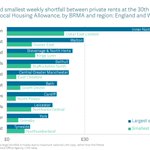
Freezing the Local Housing Allowance from April 2025 would have very different effects geographically. Weekly shortfalls between LHA rates and 30th percentile rents are currently over £60/week in parts of London, compared to highs of less than £10/week in the North East.
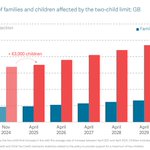
And the frozen benefit cap means more than 120,000 families won’t have their benefits uprated next year, and more will be brought under the cap
…but with significant differences across the country and even within regions. The highest shortfalls in London are now more than £60 per week, for instance, compared with £24 in the North West, £18 in the East Midlands, and just £9 in the North East.
And a frozen Local Housing Allowance has drastically different impacts across the country due to uneven rent growth. We estimate that the average shortfall between the 30th percentile of rents and the LHA in each area is currently £14 per week…