

Ex. KKR and RBC GAM. Now building an institutional-quality credit analyst training program.
Joined December 2025
- Tweets421
- Following716
- Followers1.6K
- Likes1.8K




Pinned Tweet
Excited for the second cohort!

Our second Credit Academy cohort is officially open for enrollment, kicking off December 10th! And this time, another experienced credit investor is scheduled to join us as an upcoming guest speaker in the program, along with a special offer for our first 50 enrollments.
Michael Gatto, Partner at Silver Point Capital, former member of Goldman Sachs’ Special Situations Group, and Adjunct Professor at Columbia Business School, is scheduled to join our guest speaker lineup to share his experience and perspective with Credit Academy students.
To celebrate, the first 50 students to enroll will receive a free copy of his book, The Credit Investor’s Handbook. It’s a must-read for all aspiring credit investors.
Learning from experienced credit investors is a big part of what makes Credit Academy valuable. Alongside guest sessions with industry practitioners like Michael, students receive structured, hands-on training led by Alex Goston, who brings credit investing experience from KKR and RBC Global Asset Management.
The program is designed to help investors build a repeatable credit investment process while incorporating modern AI tools and workflows into their research and analysis.
What’s included in Credit Academy:
- 40+ hours of practitioner-led training across 8 modules covering credit fundamentals, capital structures, credit document analysis, public credit, direct lending, distressed investing, and more.
- Learn to incorporate AI into your investment process through custom-built AI skills and live AI workflow labs designed to support credit research and analysis.
- Learn from experienced credit investors through guest speaker sessions covering public, private, and distressed credit.
- Live office hours beginning in December to ask questions, work through concepts, and continue learning alongside the cohort.
- 12 months of access to all pre-recorded course content, with live sessions recorded so you can learn on your schedule.
Whether you’re looking to strengthen your credit fundamentals or develop a more efficient, AI-supported investment process, Credit Academy gives you the frameworks and practical tools to apply to your work.
Enrollment for the December cohort is now open.
Explore the program and enroll: fundamentedge.com/credit-aca…

The QT below re: SpaceX GPU financing is funny...what is not funny is not being aware of incoming supply/relative value as a holder of existing SpaceX corporate debt and taking a mark-to-market loss in the existings.
This GPU financing is backed by a hell-or-high-water lease from SpaceX (so effectively SpaceX corporate risk), where the A3 tranche (largest tranche at $25.2B) priced at 8.259%, fully amortizing through the term of the 5 year lease w/ a weighted average life of 3.6 years, vs. SpaceX existing notes maturing in 2031 trading at ~7.2%. This has put pressure on the existings in the secondary market.

Lenders participating in SpaceX's $32B GPU financing reportedly seriously discussed including provisions prohibiting Elon from sending their collateral into space according to the FT (as per below, unclear whether such provision was included in the finalized docs)...
Interstellar LME risk is a first for me... "yeah we didn't move assets away from the borrower/guarantors or out of the restricted group...we just launched your collateral into space" 😂😂😂

Lenders participating in SpaceX's $32B GPU financing reportedly seriously discussed including provisions prohibiting Elon from sending their collateral into space according to the FT (as per below, unclear whether such provision was included in the finalized docs)...
Interstellar LME risk is a first for me... "yeah we didn't move assets away from the borrower/guarantors or out of the restricted group...we just launched your collateral into space" 😂😂😂
My $ANT allocation feels like punishment from the fill gods for flipping all of those new issue bonds back in the day...
2
13
1,426
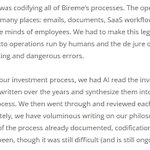
Great excerpt from Bireme Capital on importance and difficulty of codifying research process in deploying AI. As I go through my own Skill creation process, I always find it to be a bit of a paradox that understanding the old-school way of how a credit analyst does the work becomes the productivity unlock via AI.

1
15
1,200

biremecapital.com/blog/3q26-…
We've spent the last few months rebuilding Bireme around AI agents.
In our Q3 letter: what going AI-native looks like at a two-person firm, why AI favors the generalist, and why we're still short AI's picks and shovels. Plus Moderna, Disney and three new positions.
2
192
Alex Goston retweeted

@Fundament_Edge is rethinking how fundamental investing — and now credit investing — is taught.
great opportunity to learn from some of the best (@Alex_Goston + mike gatto as a guest speaker). also, an awesome ecosystem to be a part of in ai/investing.
idk how i’m a guest speaker too but honored to be a part of this and sharing some of my learnings from equities sell-side, credit buy-side, and building in ai.
…alongside @HajarnisMohit, @prashantrad, and other amazing folks in credit.
Our second Credit Academy cohort is officially open for enrollment, kicking off December 10th! And this time, another experienced credit investor is scheduled to join us as an upcoming guest speaker in the program, along with a special offer for our first 50 enrollments.
Michael Gatto, Partner at Silver Point Capital, former member of Goldman Sachs’ Special Situations Group, and Adjunct Professor at Columbia Business School, is scheduled to join our guest speaker lineup to share his experience and perspective with Credit Academy students.
To celebrate, the first 50 students to enroll will receive a free copy of his book, The Credit Investor’s Handbook. It’s a must-read for all aspiring credit investors.
Learning from experienced credit investors is a big part of what makes Credit Academy valuable. Alongside guest sessions with industry practitioners like Michael, students receive structured, hands-on training led by Alex Goston, who brings credit investing experience from KKR and RBC Global Asset Management.
The program is designed to help investors build a repeatable credit investment process while incorporating modern AI tools and workflows into their research and analysis.
What’s included in Credit Academy:
- 40+ hours of practitioner-led training across 8 modules covering credit fundamentals, capital structures, credit document analysis, public credit, direct lending, distressed investing, and more.
- Learn to incorporate AI into your investment process through custom-built AI skills and live AI workflow labs designed to support credit research and analysis.
- Learn from experienced credit investors through guest speaker sessions covering public, private, and distressed credit.
- Live office hours beginning in December to ask questions, work through concepts, and continue learning alongside the cohort.
- 12 months of access to all pre-recorded course content, with live sessions recorded so you can learn on your schedule.
Whether you’re looking to strengthen your credit fundamentals or develop a more efficient, AI-supported investment process, Credit Academy gives you the frameworks and practical tools to apply to your work.
Enrollment for the December cohort is now open.
Explore the program and enroll: fundamentedge.com/credit-aca…
Toss up between CCC Intelligent Solutions TLB at S+425 and $ANT IPO for new issue of the week...
First broadly syndicated loan financing for a software LBO since the spring is pricing this week...issuer is CCC Intelligent Solutions (what a name for a software credit!!!).
$6.1B take-private by GTCR and Elliott, financed with a $2.85B of 1L debt (47% LTV, closing net leverage marketed at 5.75x). B-/B2 ratings. Price talk for 7Y loan is S+425. 0% floor, OID of 98-99. 25bp margin step-down under 5x leverage and another 25bp upon an IPO.
Company provides software connecting workflows of auto insurers, repair shops, and parts suppliers: pitch to lenders is network effects + mission criticality.
As of last week there was $4B of demand across both loan and bond tranches so this will likely get done. Very interesting to see the business attributes of levered software borrowers that can get deals done in the public credit markets currently...good examples of haves vs. have nots...
1
20
2,864
First broadly syndicated loan financing for a software LBO since the spring is pricing this week...issuer is CCC Intelligent Solutions (what a name for a software credit!!!).
$6.1B take-private by GTCR and Elliott, financed with a $2.85B of 1L debt (47% LTV, closing net leverage marketed at 5.75x). B-/B2 ratings. Price talk for 7Y loan is S+425. 0% floor, OID of 98-99. 25bp margin step-down under 5x leverage and another 25bp upon an IPO.
Company provides software connecting workflows of auto insurers, repair shops, and parts suppliers: pitch to lenders is network effects + mission criticality.
As of last week there was $4B of demand across both loan and bond tranches so this will likely get done. Very interesting to see the business attributes of levered software borrowers that can get deals done in the public credit markets currently...good examples of haves vs. have nots...
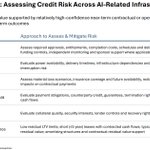
A good example of the below discussion around GPU financing and duration. In Q3, Blue Owl and PIMCO led a $2.4B GPU financing for $IREN. Was a fixed 9% rate with ~2pts of OID implying a “low double digit” all in return, fully amortizing during the term, with a 2.5 year maturity. This instrument has a modified duration of just ~1.2 years.
Blue Owl commentary last week on the spread environment for GPU financing: “What we know is that the need for capital is enormous, and we'll continue to be involved in financing these businesses. I think the spreads are going to continue to widen out for some period of time. We can talk specifically about how we think the right structures to build around those risks, to actually lend against the GPUs will continue to work, but we think the spread environment is going to get better from our perspective, and the opportunity set is extremely large, I think that [9% fixed rate] might be on the tight side over time. I just want to underscore low double digits and very short duration. This is a very short-duration piece of paper, we think it's extremely defensive.”
No view on the underlying credit risk here – this paper has non-IG tenants and no residual value guarantee, so credit underwrite would hinge on tenant solvency, but you only have to make this bet for 2.5 years here. Just trying to point out advantages of short-duration GPU financing as a way to play the AI infrastructure financing theme in a way that's more insulated from general supply/market spread risks.
AI infrastructure finance: duration and GPU financing
One of the things that we discuss at length in our buyside credit analyst training programs is using duration as a way to play offence and defense in credit. In other words, thinking critically about when and how to extend duration to express a positive view on spreads and vice versa. Managing duration is relevant to both mark-to-market risk as well as capital recycling dynamics within a credit portfolio.
One of the factors driving a cautious stance on AI infrastructure financing among some credit investors today on both the public and private side is uncertainty around the supply picture. How much more is coming down the pipe? Even if a credit is "money good", supply/concentration issues may push spreads wider.
As a credit investor, to the extent you want to generate income from carry (absolute levels are attractive today) but are still cautious about the supply picture potentially driving spreads higher, you may want to shorten duration. The beauty of GPU financing deals within the broader AI infrastructure credit theme, is that GPU financings are generally structured to fully amortize over ~5 years, making them very short duration credit instruments.
A 5-year GPU financing at 10%, fully amortizing over 5 years has a modified duration of just ~2.3 years. This is significantly shorter than datacenter financing bond deals (duration of ~3.5 years for HY 5nc2 deals with no amort during development period and partial amort thereafter, ~7 years for fully amortizing 15-year IG deals) or IG hyperscaler paper on the long end of the curve (duration of 10++ years).
In a GPU financing you are still underwriting the terms of the lease (MSA), credit quality of the tenant, and the quality of the guarantee (if any). But to the extent you are comfortable with the credit risk, these can be excellent short-duration instruments to generate attractive carry returns in an environment where you are cautious around supply/market spread levels.
A credit investor's equivalent of "invert, always invert": when facing a tight diligence timeline, reverse-engineer the "low case" from both asset coverage and levered FCF profile that would make you comfortable with the risk and focus your research on the variables that would validate such low case.
Credit Office Hours Q&A: Identifying the Credit Questions That Matter Within a Tight Diligence Timeline
Q: When you have limited time to diligence a credit, how do you identify and prioritize the questions most likely to affect your investment decision? Is there a framework you use to distinguish critical issues from lower-priority questions and focus management discussions on the areas that matter most or provide the greatest value?
A: When time is scarce in a rushed credit diligence process, I recommend reverse-engineering a low-case, in terms of both asset coverage and run-rate levered free cash flow profile, that would give you adequate downside protection and then asking "what do I need to believe about the key variables here to become confident in this low case?". These key variables are going to be situation-dependent across businesses and industries, but this is a good approach for identifying what matters from a credit perspective during a rushed diligence timeline. As succinctly stated by King Street in describing their investment philosophy when it comes to credit - "Focus on the downside and the upside will take care of itself".
Flashback to my analyst days: covering The Fresh Market distressed 1L bonds pre-pandemic not only gave me the opportunity to worry about weak SSS and Apollo as the sponsor, but also the chance to spend several days walking around grocery stores in New Jersey to gather primary research... (real ones will remember TFM 9.75% 2023s - ended up working out well...)
Importance of Primary Diligence in the Age of AI
As AI continues to automate more analyst workflows and informational edge compresses, the value of investment research will increasingly shift towards gathering and analyzing information that the models don’t have. The importance of boots-on-the ground (off-the-desk) primary diligence in the age of AI will become increasingly more important.
Young credit investors often ask for concrete examples of how primary diligence can shape a credit investor’s understanding of an industry or business.
A good example that comes to mind is the field research I did when analyzing distressed grocer credits prior to the pandemic. At the time, grocers were under pressure from Amazon’s entry into the space via the acquisition of Whole Foods and the expansion of European discount grocers Aldi and Lidl into the US market.
Primary diligence was key to developing my understanding of competitive dynamics in the grocery industry at the time.
AI can comb through a bunch of materials and tell you that Aldi's competitive advantage is efficiency. But it's hard to truly understand what drives this, and whether efficiency is, in fact, a durable competitive advantage. There are some things that you can only learn if you tour a bunch of Aldi stores in New Jersey and talk to some of the people that work there. Walking through an Aldi store with a diligence hat on, you learn that they have a ruthless focus on saving every last penny, and it shows up everywhere if you look closely. Shelf design, shelf stocking process, warehouse/store layout, and even shopping cart design. Examples of this approach:
1.) Nearly all packaged product comes into the store in boxes that are designed to fit directly on the shelf and open in the front (so no unpacking boxes and manual stocking of shelves is necessary).
2.) Each store's warehouse is connected to the back of refrigerated shelves - so refrigerated items come off the truck and are stocked right away from the back (never wheeled into the actual store and stocked from the front).
3.) Coin operated shopping carts that need to be returned by the customer to get their quarter back (so less labor needed to gather carts), etc., etc.
All of this adds up, and in the uber to the city back from New Jersey you better understand that Aldi builds out its stores and in-store workflows with an approach that is hard for large existing grocers to copy. For peers, it’s difficult to shift to this intense efficiency-first approach when you already have established processes and store designs across a giant footprint.
Primary diligence can give analysts a level of understanding that goes far beyond what is possible with desk research.
From the Desk of @Alex_Goston
Fundamental Edge Instructor
Take away of this diligence for TFM by the way was that they would never be able to compete on efficiency/value, but good store locations w/ limited overlap to premium competitors, overweight on fresh vs. packaged/frozen (inverse of value grocers), local/organic brands, high quality private label, store feel/decor, etc. were what they needed to lean into
3
227
AI infrastructure finance: duration and GPU financing
One of the things that we discuss at length in our buyside credit analyst training programs is using duration as a way to play offence and defense in credit. In other words, thinking critically about when and how to extend duration to express a positive view on spreads and vice versa. Managing duration is relevant to both mark-to-market risk as well as capital recycling dynamics within a credit portfolio.
One of the factors driving a cautious stance on AI infrastructure financing among some credit investors today on both the public and private side is uncertainty around the supply picture. How much more is coming down the pipe? Even if a credit is "money good", supply/concentration issues may push spreads wider.
As a credit investor, to the extent you want to generate income from carry (absolute levels are attractive today) but are still cautious about the supply picture potentially driving spreads higher, you may want to shorten duration. The beauty of GPU financing deals within the broader AI infrastructure credit theme, is that GPU financings are generally structured to fully amortize over ~5 years, making them very short duration credit instruments.
A 5-year GPU financing at 10%, fully amortizing over 5 years has a modified duration of just ~2.3 years. This is significantly shorter than datacenter financing bond deals (duration of ~3.5 years for HY 5nc2 deals with no amort during development period and partial amort thereafter, ~7 years for fully amortizing 15-year IG deals) or IG hyperscaler paper on the long end of the curve (duration of 10++ years).
In a GPU financing you are still underwriting the terms of the lease (MSA), credit quality of the tenant, and the quality of the guarantee (if any). But to the extent you are comfortable with the credit risk, these can be excellent short-duration instruments to generate attractive carry returns in an environment where you are cautious around supply/market spread levels.
