

The Maverick Gambler Crypto / AI / Finance / Current Affairs / Poker
Sham Shui Po District
Joined September 2024
- Tweets868
- Following1.6K
- Followers1.8K
- Likes1.2K

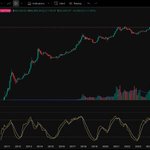




In the past bear market cycle, the performance of STH was usually the most panicked in the early stage, and a large number of short-term chips were cut off; instead, in the later stage, it became relatively calm.
Part of the reason is that the overall cost of STH in the later stage is decreasing, and it is increasingly insensitive to price fluctuations. On the other hand, it is also because of the loss, and no matter how much it falls, I don’t want to move.
And the behavior of LTH is just the opposite.
They are more reluctant to sell their chips at a loss in the early stage of the bear market, so the peak loss of LTH often does not appear in the first half of the bear market.
Only in the end, under the expectation that a major event or a big background led to extreme pessimism, did they finally stop. For example, the last round was FTX thunderstorm, and the loss value of LTH exploded.
This round is the macro background. Inflation, interest rate hike, liquidity tightening, AI bubble, financing risk, credit pressure and other comprehensive factors are under pressure.
However, we can also understand that ”the surrender of LTH“ seems to have become a standard for testing the purity of the ”real bear bottom“.
Without such a large-scale panic, it seems that I always feel that something is missing, or that ”this winter is not too cold“.
Well, it‘s cold enough now...
Hey hey, Ruixue is a prosperous year! It indicates that there will be a good harvest in the coming year.

1
12

zcash:native has been hit by a fifth infinite-minting exploit.
Under the crushing weight of AI, it is spiraling toward zero.
Of course, "whales" and institutional players might still shill it, giving ZEC a few more kicks before the end.
It’s a real shame; I was actually quite bullish on the "Privacy Bitcoin" narrative. At one point, I even considered buying the dip and holding it just like Bitcoin.
But times change, and circumstances shift. It’s time to return to value investing.


How to Boost Your Exposure on X
1. Comment on and like every post in your timeline.
2. Do not use hashtags.
3. Make good use of the Retweet/Repost feature; aim for a few per day.
4. If you don't know what to do, focus on gaining followers.
5. Post a tweet every 20–30 minutes, and leave 20 comments.
6. A pinned tweet helps boost exposure; ideally, update it daily.
7. A Premium+ subscription ($30) can increase your account's weight/authority.
8. Utilize voice-to-text input—it makes hitting 1,000+ (interactions/posts) easy.
9. Do not spread rumors!
10. Stay on top of trending topics.
5
13
306
Current ranking of "god-tier" models:
1. Opus 5.5 – ranks first overall for development tasks.
2. Gemini Carbon/Neon.
3. GPT 6.2 Astra.
However, when it comes to text-based capabilities, Gemini Carbon/Neon is the undisputed, "true god"—leading the pack by a massive margin.
Take the word of someone who has spent years writing for a living: it is absolutely, incredibly powerful.
5
143

BTC has entered the bottom-formation phase of the current cycle, though the definitive bottom has yet to be confirmed. The bottom is projected to fall within the $50,000–$60,000 range—with a specific focus on the $52,000–$56,000 zone—occurring between late November 2026 and January 2027.
Rationale:
1. Historical Cycles: In the previous three bear markets, the transition from peak to bottom took approximately 364–406 days, with drawdowns ranging from 76% to 84%. Given the peak of ~$124,800 in October 2025, historical patterns suggest a bottoming window around October–November 2026—a period we have now entered. However, the maximum drawdown in the current cycle is only about 53% (reaching the vicinity of $58,500)—significantly shallower than in the past. This is primarily due to the influence of ETFs and institutional capital, which have altered the market structure.
2. Technicals: The $58,500 level serves as a critical watershed (representing a previous low in this cycle and a high-volume trading zone from 2021). Holding this level could establish it as the definitive bottom; a breakdown, however, would shift the focus to the $52,000–$56,000 range, with a potential extreme downside scenario reaching $48,000–$50,000.
3. Capital Flows & Macro Factors: Spot ETFs continue to see net outflows, and institutional capital has yet to make a stable return. Meanwhile, US tech and AI valuations are under pressure, and the Nasdaq is exhibiting high volatility. Compounded by monetary policy, inflation, and geopolitical risks, there is insufficient spot buying demand. A rebound driven solely by derivatives (contracts) is unlikely to signal a reliable trend reversal.
Trading Strategy: It is not advisable to take heavy positions or use high leverage to "buy the dip" at this stage. Consider observing and deploying capital in stages; significant position building should await confirmation of a re-test of the lows, a return of spot capital inflows, and a recovery in the weekly trend. It is better to miss out on the initial rebound than to commit heavy capital too early.
The primary focus has shifted from "how much lower can it go?" to "when will a genuine, actionable long signal appear?"

6
61


My 2027 Bull Market Prediction:
December: Bull Trap
January: Bitcoin Breakout
February: Altcoin Season
March: New All-Time High (~$215,000)
April: Bear Trap
May: Chain-Reaction Liquidations
June: Bear Market Begins
Remember: Bitcoin bottomed out at $55,130 on November 21—exactly four years to the day after its previous bottom of $15,476 on November 21, 2022.
Following that 2022 bottom, it rallied +715% to reach a peak of $126,200.
Now, at $59,000, it stands at the starting point of that same trajectory.
3
80

Year-to-date, top-tier luxury companies like LVMH have seen their share prices plummet by 40%.
Even Hermès—previously the strongest performer—saw its third-quarter revenue grow by only 4.3% year-on-year, while LVMH fared even worse, with revenue up just 1%.
In the past, when people came into money, they liked to buy designer cardholders to show off in an "understated" way. Today, however, people prefer wearing items without visible logos, or simply prioritizing comfort.
1
26