

Financial Researcher, Investor, Trader. Bitcoin Class of 2013, CFA, MFE. Christ Follower.
Newport Beach, CA
Joined March 2009
- Tweets1K
- Following1.4K
- Followers1.9K
- Likes28.8K




Alex Pickard retweeted

I do not understand, in 2026, why anyone is shorting anything, and I have, over the last several years, watched a generation of intelligent, well-credentialed, technically sophisticated investors set fire to their capital on the short side of a market that has been telegraphing its direction with the subtlety of a marching band, and the only explanation I have ever been able to construct is that none of these people have read a single page of monetary history written before 1990.
The setup is not subtle. The federal government is running a 7% structural deficit with no political coalition in either party willing to address it. The Treasury is issuing debt at a pace that will push publicly held debt-to-GDP past 130% within five years, which is the level at which, historically, every government in recorded history has either inflated its way out, defaulted, or both. The Fed is, regardless of what it says in public, the marginal buyer of that debt, and the only mechanism it has to fund the purchases is the creation of new dollars. The money is being printed. The debt is being monetized. The currency is being debased. And asset prices, which are denominated in the currency being debased, are doing the only thing they have ever done in any country that has ever tried this, which is going up.
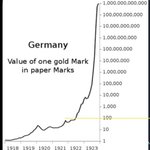
Every country that has run this experiment has produced the same chart. Weimar Germany in 1922 and 1923 produced one of the most violent equity bull markets in recorded history in nominal terms, as the mark collapsed and the Berlin exchange repriced upward by orders of magnitude. Argentina, across four separate inflationary cycles since 1975, produced in each cycle a nominal rally that outran every short thesis published, while the peso lost 99.9% of its purchasing power. Zimbabwe in 2007 and 2008 produced an equity market that rose so violently the exchange had to be closed because the calculations could not keep up. Turkey, right now, in front of the entire world, has produced a Borsa Istanbul up 1,400% in lira terms while the lira has lost 85% against the dollar, and every short of Turkish equities has been carried out in nominal terms even when they were right in real terms.
The lesson is not that asset prices are going up because the businesses are getting better. The lesson is that asset prices are going up because the unit they are measured in is getting smaller, and any investor who positions short against this dynamic is betting against the will and capacity of a government to debase its own currency, which is the single most reliable bet you can lose in 4,000 years of recorded monetary history. The government always wins. The government always debases. The currency always loses purchasing power. The assets always reprice upward in nominal terms, on a path the shorts always insist is unsustainable and that always, somehow, sustains.
You can short individual frauds. You cannot short the market. You cannot short the currency itself without being on the wrong side of the largest force in modern capital markets, which is the slow, politically inevitable destruction of the dollar’s purchasing power against everything that cannot be printed. The shorts have been wrong for five years. They will be wrong for the next five. The only investors who will, in real terms, preserve and grow their wealth are the ones who understood, early, that the game is not about being right on valuation, it is about being on the right side of monetary debasement, and the right side has always been owning real assets, productive businesses, scarce commodities, and the one monetary metal that has functioned as money continuously for 5,000 years, while the people on the other side continue to insist this time is different. This time has never been different. The math is the math. The shorts will continue to lose. The owners will continue to win.
Alex Pickard retweeted

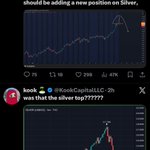
🔥MASSIVE MOVE IN SILVER LOOKS IMMINENT🔥
💥Silver Will Give Us the Answer Within 7 Days‼️
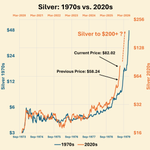
Silver's HUGE wedge formation is nearing completion. ⚡️A breakout likely sends us back to all-time highs & beyond ($150-$170 likely)
📉A breakdown likely sends us back to retest the entire breakout from the 50 year cup-and-handle formation.
Silver's consolidation is nearing completion.
A MASSIVE MOVE looks to be imminent:


Alex Pickard retweeted

Silver backing futures keeps falling and is now 87.2M oz.
Key takeaway from Tuesday’s close:
71 million ounces were rolled yesterday, and everyone who called force majeure now has to admit it will not happen in March.
What stands out is the complete absence of new metal coming in, and the longer that continues, the better silver will perform.
Silver just touched $91.14, which is above the 50-day moving average ($83.52). Since May 30, the 50 MA has not declined, which shows how strong the uptrend is.
The reason I started building this table is that I think silver will trade above $120 later in 2026. The driver will be that silver demand proves to be larger than supply. You can track that by watching how much silver is backing the futures market.
I expect that number to keep falling. Then we will see the March-May spread, or later the May-July spread, flip from contango to backwardation. After that, I expect the outflow from COMEX to accelerate.
Then retail investors will realize that the spike to $120 was not a one-off move. They will start buying ETFs, which removes more physical silver from the market. After that, the market will realize that if you pay enough, there is always silver from mining, and that is when silver mining stocks can go vertical.
This is obviously not a guarantee, and that is exactly why this simple daily table is so useful: it shows whether my path is still unfolding or not.
Date: Trading day of the snapshot.
Registered Silver (oz): Silver in COMEX vaults that is warrant-issued and available for delivery against futures.
March Open Interest (oz): Open interest in the March contract converted to ounces (contracts × 5,000 oz).
Implied Deficit (oz): March open interest (oz) minus registered silver (oz).
Daily OI Reduction (oz): The day-over-day decline in March open interest (in ounces).
Days to Clear Deficit: Implied deficit divided by Daily OI Reduction. A rough estimate of how many trading days it would take for the deficit to disappear if the current roll pace continues.
Deficit Clears By: The calendar date implied by “Days to Clear Deficit” (projected forward from the current date).
March Future: Settlement/close price of the March silver futures contract.
May Future: Settlement/close price of the May silver futures contract.
March–May Spread: March price minus May price.
SOFR carry %: The annualized financing rate (SOFR) used to estimate the interest component of carry between March and May.
Storage & Insurance: Estimated storage + insurance cost for holding silver from March to May, expressed in $ per oz.
Carry Adjusted Basis May Future ($): Total estimated carry cost between March and May (financing + storage/insurance), expressed in $ per oz.
Backwardation / Contango: A carry-adjusted signal. It compares the March–May spread to total carry. If this flips from contango to backwardation, the market is effectively saying: “I don’t care what the paper price is. I need physical silver. And I need it now.”


Alex Pickard retweeted

Thought I’d re-post for all that haven’t seen. If you’re new to stacking gold and silver, I’d suggest you give this a read and pick up the pace.

Alex Pickard retweeted

There is a lot of talk that silver will be slammed when the Shanghai Exchange is offline for the Chinese New Year. So, I have collect the loss/gain data for the last 10 years. History is not indicative of future results, but the average over the last 10 years is a +0.876% increase in the silver price during CNY.
Here's the breakdown:
2016: 6.99%
2017: 2.55%
2018: -0.43%
2019: -0.32%
2020: 1.15%
2021: -3.36%
2022: 1.48%
2023: 0.30%
2024: -1.29%
2025: 1.69%
Alex Pickard retweeted

Trump's Federal Reserve chairman-designate will not be able to stop the bull market in gold:
Myrmikan Research note argues that currencies do not typically decline gradually but instead collapse abruptly once excessive debt undermines confidence, a process that has repeated across history in countries ranging from Weimar Germany to Argentina, Turkey, Russia, and Mexico.
It explains that over-indebted governments, corporations, and households borrow more not out of optimism but out of necessity or anticipation of devaluation, creating a fragile equilibrium in which central banks attempt to print just enough money to service interest obligations without triggering a loss of confidence.
This equilibrium eventually fails when a shock such as war, financial crisis, or systemic stress disrupts debt servicing, forcing sudden currency devaluation, often over a very short time frame.
Gold priced in local currency, as shown through multiple historical charts, consistently acts as an early warning signal of this collapse, becoming increasingly volatile as the pace and acceleration of monetary debasement intensify.
It emphasizes that the current gold bull market differs fundamentally from past inflation-driven episodes because it began not with domestic U.S. economic distress but with an external geopolitical rupture in February 2022, when the United States froze Russia’s dollar reserves and thereby exposed the political risk embedded in holding dollar-denominated assets.
This action triggered a quiet but persistent shift by central banks, sovereign wealth funds, insurance companies, and other large balance-sheet holders away from U.S. Treasuries and dollar assets and toward gold, the only non-dollar asset liquid enough to absorb such flows.
From late 2022 through early 2026, gold’s steady parabolic rise reflects this growing institutional demand rather than retail enthusiasm or inflation panic.
Myrmikan argues that the U.S. dollar’s reserve status is increasingly sustained by inertia rather than genuine global acceptance, noting that neither geopolitical rivals nor even U.S. policymakers fully support the burdens associated with reserve currency dominance.
The international dollar system has allowed the United States to run persistent trade and fiscal deficits while attracting foreign capital to finance excessive leverage across the financial system.
As foreign demand for dollar assets weakens, the paper warns that this external stress will translate into an internal financial crisis marked by rising funding costs, with private equity & private credit markets identified as the most vulnerable points due to their dependence on cheap and abundant liquidity.
The Federal Reserve, the authors argue, lacks effective tools to resolve such a crisis without further destabilizing the currency.
It casts serious doubt on feasibility of any attempt to simultaneously lower interest rates, shrink Fed’s balance sheet, and finance large-scale U.S. reindustrialization, concluding that political & market pressures will ultimately force renewed and accelerating monetary expansion.
The Three Phases of the Gold Endgame
Myrmikan outlines a three-phase monetary unwind:
Phase 1 (Current)
•External de-dollarization
•Gold rises steadily, institutions remain underinvested
•No visible domestic crisis yet
Phase 2 (Next)
•Fed forced to monetize more aggressively
•Inflation resurfaces domestically
•Bond market loses credibility
•Gold reflects Fed impotence
Phase 3 (Terminal)
•Sovereign debt death spiral
•Rising yields → rising deficits → forced monetization
•Choice between default or currency destruction
•Historically, this always ends in collapse
Myrmikan avoids near-term calls but provides balance-sheet logic:
•Historical gold backing: 33%–50% of central bank assets
•That implies gold between $8,400–$12,600/oz
•Panic scenarios can briefly push gold toward 100% backing
myrmikan.com/pub/Myrmikan_Re…

Alex Pickard retweeted

Gold prices needed to wipe out all federal debt:
- Russia: $4.8K
- Eurozone: $44.7K
- United States: $147K
Rising gold prices can solve global debt problems,
as a rise in prices doesn’t hurt any industry.
- No factories shut down because gold goes up.
- No inflation
- No crisis
Just gold prices rising significantly

Alex Pickard retweeted

For the first time in recorded history, global data show zero gold discoveries in two consecutive years.
This has never occurred before.
And this is not unique to gold.
Major discoveries across most metals have fallen into the single digits, with no meaningful projects in the pipeline capable of materially altering the global supply curve.
This is the real barometer of where we are in the mining cycle.
Still early.

Very interesting that the last time PSLV traded at a discount was in March 2020. And we know what happened after that.
I’m surprised that $PSLV can be picked up at a discount. Right now it’s about 2.7%, whereas in 2011 and 2012 you had to pay a huge premium to the silver price.


Silver bottom most likely in.
Thursday appears to have been the "second shoe to drop", a final shakeout to clear sentiment before the bull market continues in precious metals.
This similar fractal occurred in BTC in Jan 2017, as can be seen below. BTC recovered in 1.5 months and went on to much greater highs that year.
If we see similar price action in silver, it would imply new all time highs by mid-March.

Alex Pickard retweeted

In my 32 years of trading I have never seen a crazier move than what just happened to silver past few weeks

Alex Pickard retweeted

🔒PROJECT VAULT: America’s economy depends on critical minerals—the building blocks revitalizing American industry and strengthening our supply chains.
That’s why EXIM has launched Project Vault: the U.S. Strategic Critical Minerals Reserve. 🇺🇸
Alex Pickard retweeted

‘The CME COMEX has ‘circuit breakers’ in the silver market that halt trading for a period if extreme price movements occur to allow for a more orderly market. What the CME COMEX calls dynamic circuit breakers automatically kick-in when the price of silver drops or rises by 10% on a rolling 1 hour basis. We can see in Figure 1. below that from ~ 12:30 to ~ 13:30 Eastern Time, the price of silver - both cash/spot and futures - ranged between $91 /oz. and $75 /oz., representing an 18% range, and yet the CME COMEX automatic circuit breakers were not activated nor announced by the CME. Yesterday, I wrote a letter to the CME asking why this exception to CME COMEX rules occurred and will report their response when received’ #DavidJensen
open.substack.com/pub/jensen…
Alex Pickard retweeted

SLV ETF ALERT
The largest one day drop in Silver's history and the next day saw 36.3 million shares created or 32.9 million ounces deposited into the fund. The largest amount of silver held by SLV so far in 2026 and 2025.

I find the timing very interesting.
General Motors, Stellantis, Boeing and Google mentioned as participating in the project.
nytimes.com/2026/02/02/busin…


Alex Pickard retweeted

Nonsense.
As if Trump and Bessent chose Warsh, only to have him betray their plan.
The three of them will work together to "run it hot" with rate cuts and, if necessary, Yield Curve Control.

WARSH FED LIKELY TO CHANGE BALANCE SHEET, NOT RATES
Morgan Stanley says meaningful policy shifts under a Warsh-led Fed would come gradually through balance sheet adjustments, not interest rates. Shrinking the Fed’s footprint and reserve demand would take time and regulatory changes, likely steepening the yield curve in the process.