
Day job: Golf Data Science & Biomechanics. Sports science/performance consultant and researcher on the side.
Raleigh, NC
Joined February 2016
- Tweets5.6K
- Following1.7K
- Followers3.3K
- Likes9.7K




Pinned Tweet
To⬆️clubhead speed (CHS) with training
- ⬆️force potential (rate & magnitude) of the muscles
- ⬆️time available to apply force and/or distance through which the force is applied (e.g., longer hand path via better rotation).
- Develop skill of using this within the golf swing

Alex Ehlert, PhD retweeted
Running a golfer’s Trackman data through some models to identify what launch conditions may be beneficial, then simulating the effects across many golf shots.
This helps identify promising areas to target. But the next step is actually making the change and retesting to confirm

Alex Ehlert, PhD retweeted
Top 25 golfers on the PGA Tour over time, categorized by distance and accuracy vs the field
You can get it done in a variety of ways, but being good at one and at least solid at the other is a good combo. We're seeing less short golfers in the Top 25 golfers now than previously


Running a golfer’s Trackman data through some models to identify what launch conditions may be beneficial, then simulating the effects across many golf shots.
This helps identify promising areas to target. But the next step is actually making the change and retesting to confirm
Playing around with some methods for modeling a golf ball’s trajectory based on launch and environmental conditions.
A few simple examples attached here, but definitely a lot of ways this type of modeling can be useful.


I've been trying to model characteristics that predict longevity on the PGA Tour. Some initial results:
1. Good ball striking is protective against losing status
2. Performance decay across ~3 years is useful for predicting who will lose status vs current performance alone

Top 25 golfers on the PGA Tour over time, categorized by distance and accuracy vs the field
You can get it done in a variety of ways, but being good at one and at least solid at the other is a good combo. We're seeing less short golfers in the Top 25 golfers now than previously
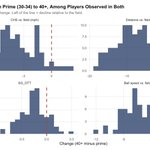
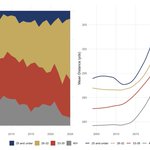
Some trends from top 100 PGA Tour players by year.
All age categories are hitting it further and faster over time. But there are progressively less older players in the top 100.
It's a change in who makes up the PGA Tour, not just changes at the individual player level.

2. However, many of these golfers are now more accurate than previously, offsetting some of the speed/distance loss.
3. 40+ golfers that still gain strokes on the field have generally lost less speed/distance and gained more accuracy than those who are dropping shots on average


It’s easy to fall into the trap of collecting data because it’s there.
There’s many ways to collect data. But without a plan it can add noise or take attention away from what matters
A useful question to ask:
Is this useful and actionable or just interesting and accessible?
A simple, but useful process
1. Identify the problem or question
2. Understand the problem/question (know your craft/domain expertise)
3. What data could be useful? Do I have the ability to get/use it?
4. What are strengths & limitations of the data/tech?
5. What’s the plan?
Alex Ehlert, PhD retweeted
In an industry full of tech and data, transparency can be a powerful differentiator for golf tech companies/products.
Many coaches and golfers are naturally skeptical. So the gain in trust can often outweigh any fear of “being exposed” for not being 100% perfect at everything.
In an industry full of tech and data, transparency can be a powerful differentiator for golf tech companies/products.
Many coaches and golfers are naturally skeptical. So the gain in trust can often outweigh any fear of “being exposed” for not being 100% perfect at everything.
Alex Ehlert, PhD retweeted

HE IS A MACHINE 🏆🦿
75-year-old+ Michael Kish runs a 13.27 100m (+3.2 m/s) to win the 75+ Master Men's 100m. Last year, Kish ran 13.47 - so he's only getting faster!
#PennRelays coverage presented by @On
🎥 Watch the Penn Relays LIVE on FloTrack
Alex Ehlert, PhD retweeted
I like to make some data collection an embedded part of training vs just formal structured test sessions
In this case, athletes did a few max effort jumps at the end of warm-ups. Main goal was feedback to drive some intent & competition
On the backend: we track trends over time

