

Conservation biologist, Ornithologist (specialising in Asia) • Science Team, BirdLife International • Managing Editor, BirdingASIA • 🏳️🌈 he/him.
Cambridge, England
Joined November 2011
- Tweets10.9K
- Following822
- Followers3.6K
- Likes9.5K





Alex Berryman retweeted

I reviewed the new book by @PaulREhrlich @GerardoCeballos and Dirzo in Nature. My take: this eloquent requiem for nature risks leaving the reader feeling helpless rather than energized.
nature.com/articles/d41586-0…
Alex Berryman retweeted

Hi UK, here they come!
Huge start of bird migration from the Waddensea westwards. Currently an bird migration traffic rate of 9000 birds per km per hour. Enjoy 😉
Saturday morning, UK-relevant reflection on this note @BirdtourAsia and I wrote at the end of last year: Notwithstanding its flimsy taxonomic status as a species, how many of eBird's 904 (only 25 appended with recordings) Scottish Crossbill records are legit?


A fun note in BirdingASIA, written with @BirdtourAsia. I had intended to write a fuller thread, but internet on the LNER service to Edinburgh is desperately poor, and I can't be bothered. But a brief summary of what we did and why it (very) vaguely matters.

I barely post on Tw*tter these days, but new paper published today with, and led by, Simon, looking at transmission pathways of HPAI.

New research in @ConLetters from @AlexJB497, @MarsKlaassen, Richard Kingsford, @rohanclarke01, and I demonstrating the potential for HPAI H5N1 virus transmission via food-theft (kleptoparasitism) in seabirds: conbio.onlinelibrary.wiley.c…
Pic: David Tipling

Alex Berryman retweeted

New paper shows impact of war in Ukraine on migrating Greater Spotted Eagles: birds made large deviations from traditional migratory routes & shorter stopovers in Ukraine, leading to longer journeys and later arrival at nesting grounds rarebirdalert.co.uk/v2/Conte…

Alex Berryman retweeted

Australian #birds that have a high level of evolutionary distinctiveness, live on #islands, and unable to adapt to survive in agricultural areas are among the species most at risk of #extinction, our new study has shown. @AlexJB497 @arc_gov_au @ANUmedia reporter.anu.edu.au/all-stor…
Fun day moping around the Cairngorms with dramatic scenery, pleasant weather and some fat snowball-like birds for company.


As a final point of consideration: we publish an appendix of other species pairs/groups in South-East Asia which are extremely difficult/impossible to ID in the field, some of which have a surprising (=, IMO, erroneous) number of records currently accepted in eBird etc.

I've skipped a lot in the above, especially regarding ID, so encourage all those interested to download and read the full 'note', which ended up spiralling into 5,000 words of (fun) tediousness.
researchgate.net/publication…
But there is no reason Plume-toed can't reach and fly around these higher elevations, so records should only be accepted (in our view) if birds are photographed at nest. In all, of the 766 records in eBird today, I'd say only a handful are admissible
A fun note in BirdingASIA, written with @BirdtourAsia. I had intended to write a fuller thread, but internet on the LNER service to Edinburgh is desperately poor, and I can't be bothered. But a brief summary of what we did and why it (very) vaguely matters.


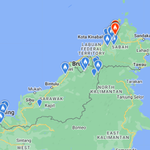
So what does this mean for registered records? Some bad news! All the Crocker birds look to us to be Plume-toed, as do all lower-elevation birds on Kinabalu. Lots of records to be scrapped.


Oft-mentioned differences in gloss shade are, in the field, probably useless. We also find possible bioacoustic differences, but the sample size is so small that we are cautious in them being overinterpreted until more data are collected.
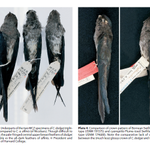
Yes! Well, almost certainly yes. In addition to being considerably smaller (difficult to determine in the field), Bornean Swiftlet is duller, best shown by a comparative lack of contrast between the face and crown, and is also subtly different in breast pattern (details in paper)


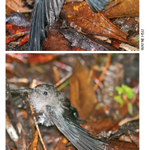
Almost all these records are from various elevations of Mt Kinabalu, and increasingly the Crocker Range. We reviewed the five specimens of Bornean Swiftlet (all from Kinabalu) and compared to those of Plume-toed. So can Bornean be identified?

Literature often claims Bornean Swiftlet to be inseparable from Bornean pops of Plume-toed Swiftlet (with which it overlaps), but despite this there is an intriguing number of accepted records of Bornean Swiftlet on eBird/ML

Citizen science is awesome! And, with the review systems in place on platforms like @Team_eBird, is pretty accurate. But with some taxonomic groups, it is inevitable there are problems. We highlight this using one of the trickiest: Bornean Swiftlet Collocalia dodgei.
New paper in JAO. Back in December 2022, I robbed Vietnam of two of its nine endemics: the Endangered Golden-winged Laughingthrush and Grey-crowned Crocias also occur in Laos. I also added Golden-breasted Fulvetta to the Lao list.


As is often the case, getting off the beaten track yields results, and is vastly more satisfying than twitching nearby eBird hotspots. That being said, I'd strongly advise no one to visit this area. "Logistic difficulties" might go down as the biggest understatement of my life..!

Full paper: researchgate.net/publication…
