


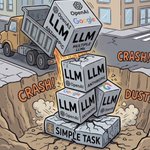


74% of enterprises believe they can catch an AI agent failure before it hits production.
Only 19% have an automated gate that actually blocks every bad release.
That’s the real agent infrastructure gap:
visibility ≠ control
The missing layer is deterministic enforcement between AI reasoning and execution.
The best AI agent should become less intelligent over time.
That sounds backwards, but hear me out.
When an AI agent encounters a new situation, probabilistic reasoning is useful.
But when it performs the same validated workflow for the 500th time, why are we still asking an LLM to reason through it from scratch?
We’re paying for inference we no longer need and reintroducing uncertainty into something we already know how to do.
I think production AI should evolve:
Unknown → reason
Repeated → observe
Validated → determinize
Known → execute
And when uncertainty returns → fall back to reasoning.
This is what we’ve learned building Relayn in real operational environments:
Determinism shouldn’t be imposed from day one. It should emerge from validated usage.
As the system learns its environment, it should require less inference, not more.
Intelligence can be probabilistic. Execution cannot.
1
1
60
I believe one of AI’s most important roles will be reducing human error where mistakes have serious consequences.
Not replacing humans. Helping us make fewer consequential mistakes.
In a hospital, someone can miss a drug interaction.
In critical infrastructure, someone can follow the wrong procedure, miss a dependency or make a decision without having all the relevant context.
Humans make mistakes.
Not because we’re incompetent, but because the systems we operate have become extraordinarily complex.
AI gives us something we’ve never had before: the ability to continuously process enormous amounts of information and surface what a human might miss.
But there is a paradox. If we use probabilistic AI to reduce human error, we can introduce an entirely new source of error: the AI itself.
That’s the problem we are solving at Relayn.
Use AI where intelligence, interpretation and context can help humans make better decisions. But when an action has to follow an exact rule, make sure that rule cannot simply be reasoned away by a model.
Use AI to reduce human error without replacing it with AI error.
1
36
Prompts are not policy.
“Never refund more than €5,000” inside a system prompt is an instruction to a probabilistic model.
If €5,000 is a hard business constraint, enforce it outside the model.
This is exactly the architectural shift we’re building Relayn around.
As agents become the intelligence layer, systems of record won’t disappear. Still something has to govern what agents can read, decide and execute across them.
We believe that missing layer is a deterministic operating layer between probabilistic intelligence and enterprise systems.

1
1
65
The first question in enterprise AI shouldn’t be: “Which model should we use?”
It should be: “Which decisions should a model be allowed to make at all?”
Model choice comes later. Architecture comes first.
32
AI can be probabilistic. Execution cannot.
A wrong answer is a model error. An agent that turns a wrong interpretation into an API call, payment or infrastructure change creates an operational event.
At @relayn_ we moved from AI that answers to AI that acts with critical infrastructure in mind.
1
3
59


Aleksandra Los retweeted

Life at the speed of play w/ @markpinc and @cyantist:
“This is kinda like an AA meeting. We all have the addiction […] my friends ask me why can’t you just go be happy with your success and retire and die? Because I know I’m capable of building so much more”
Goals.
The goal isn’t just to win but to never lose the love of playing while winning and working your ass off
The only way you can keep going: never stop playing

Aleksandra Los retweeted

Announcing the Inflection Fellowship at Edge City India 🇮🇳
A three-week, fully-funded fellowship for exceptional builders under 25, working at the frontier of tech, science, and society.
Run with @LongJourneyVC.
Applications close August 14. Apply ↓

Aleksandra Los retweeted

💸 You think this is crazy low but ~5% ownership probably the most common final % most VC funded startups will have when they work out, especially when you have a co-founder
Raising money is not free, people don't give you money out of charity, they buy a little slice of your company every time they invest, so in every funding round you sell a share of your company's ownership for money, that money you use then to grow more, in the hope that your part becomes more than the ownership you just gave away
Median ownership for single founders (via @cartainc):
Seed: ~56%
Series A: ~36%
Series B: ~23.5%
Series C: ~16.5%
Series D: ~10%
Series E: <10%
Now if you have one co-founder (most startups!):
Seed: ~28%
Series A: ~18%
Series B: ~11.75%
Series C: ~8.25%
Series D: ~5%
Series E: <5%
What if you're one of 4 co-founders:
Seed: ~14%
Series A: ~9%
Series B: ~5.875%
Series C: ~4.125%
Series D: ~2.5%
Series E: <2.5%
Now imagine you get acquired after one of these funding rounds for $1,000,000,000 ($1 billion is a lot!), how much are you left with?
Money made with $1B sale for single founders:
Seed: ~$560 million
Series A: ~$360 million
Series B: ~$235 million
Series C: ~$165 million
Series D: ~$100 million
Series E: <$100 million
Now if you have one co-founder (most startups!):
Seed: ~$280 million
Series A: ~$180 million
Series B: ~$117.5 million
Series C: ~$82.5 million
Series D: ~$50 million
Series E: <$50 million
What if you're one of 4 co-founders:
Seed: ~$140 million
Series A: ~$90 million
Series B: ~$59 million
Series C: ~$41 million
Series D: ~$25 million
Series E: <$25 million
But let's be more realistic, the median acquisition value for a VC-backed startup sits at approximately $71 million:
For single founders:
Seed: ~$39.8 million
Series A: ~$25.6 million
Series B: ~$16.7 million
Series C: ~$11.7 million
Series D: ~$7.1 million
Series E: <$7.1 million
Now if you have one co-founder (most startups):
Seed: ~$19.9 million
Series A: ~$12.8 million
Series B: ~$8.3 million
Series C: ~$5.9 million
Series D: ~$3.55 million
Series E: <$3.55 million
What if you're one of 4 co-founders:
Seed: ~$9.95 million
Series A: ~$6.4 million
Series B: ~$4.2 million
Series C: ~$2.9 million
Series D: ~$1.8 million
Series E: <$1.8 million
Okay last one (this post is getting too long 😊), we know 1) the median time of acquisition is around Series A (quite early actually), and 2) we know the median acquisition value is $71M, so now we can tell you the median expected outcome for a startup that gets acquired:
Single founders: ~$25.6 million
One co-founder: ~$12.8 million
One of 4 co-founders: ~$6.4 million
Getting acquired itself is a remarkable event though as most startups are by definition doomed to fail, only ~15% of startups ever get acquired, so the expected outcome with probability included is:
Single founder: ~$3.84 million
One of two co-founders: ~$1.92 million
One of four co-founders: ~$960,000
P.S. we did not include taxes and liquidation preferences, the investors may receive their preference before common shareholders receive anything, meaning founders receive even less, but we also didn't include taking money off the table in earlier rounds by founders to be fair, so they balance each other out a bit
Not saying this is bad btw, it's just how the VC game works but good to write it out and be aware of how it works
VC-backed startups shoot for the moon, it's one of the few ways you can have a crazy big payout and become an actual billionaire which is very rare as a bootstrapped founder with your own money!

Everyone is obsessed with building smarter AI agents.
We’re obsessed with making them cheaper and more predictable.
Production metrics:
• 1,200+ users
• ↓90% AI inference costs
• 71% deterministic execution
• Only 2% of requests need full agentic reasoning
1
3
71
Aleksandra Los retweeted

NEW: Cyan Banister's Legendary Track Record
Her first investment ever? SpaceX.
In 2007, she invested every dollar she had into SpaceX & never sold.
Combined, @cyantist & Scott Banister are easily the #1 angel investors in the world.
SpaceX. Anduril. Uber. PayPal. Affirm. Flexport. Postmates. Niantic. Opendoor. Carta. Together AI. Diamond Foundry. Crusoe. Flock Safety. Substrate. Brave. Depop. Calm. TrueMed. Turing. Crusoe
Cyan spent 4 years at Founders Fund, now Co-Founder & General Partner, @LongJourneyVC
Plus Founders Fund's Mafia, beating Phil Hellmuth in poker live, & free speech as her number one cause.
We cover
› The space between your values & your actions
› Human beings as why machines
› Why Marc Andreessen is wrong about introspection
› Peter Thiel University
› Nanotech & biotech
𝐓𝐈𝐌𝐄𝐒𝐓𝐀𝐌𝐏𝐒
(00:00) Cyan Banister, Long Journey Ventures
(01:13) Inside Long Journey HQ
(02:17) The wild story behind the office mural
(05:32) What Cyan's actual house looks like
(07:18) The candle ritual
(08:08) What the Long Journey logo actually means
(10:41) Mafia's breakout stars
(14:45) Cyan's strategy
(16:30) What really happens off-camera at Mafia
(18:58) The blooper reel nobody's seen yet
(23:54) Brian Singerman x $40 /mo board game club
(29:10) Confessions of an accidental poker legend
(33:37) What relentless optimism reveals about people
(35:42) Why so many people are scared to be weird
(37:32) The daily ritual she prescribes to everyone
(43:56) The "why" behind her biggest investments
(50:49) Why sci-fi movies keep predicting the future
(53:37) Should you even go to college right now?
(59:58) Unconventional investing philosophy
(1:01:57) Full list of Cyan's investments
(1:04:28) All-in on SpaceX
(1:08:57) Why she never sold a single SpaceX share
(1:12:53) Top Bets: Becoming Bio + Substrate
(1:15:52) America's reindustrialization moment is now
(1:19:16) Cyan's mentors
(1:22:54) Manifesting Rick Rubin
(1:24:00) Real take on the Peter Thiel events

Today, most AI agents are built in a surprisingly primitive way.
Need a new workflow? Add an LLM.
Need better accuracy? Add another model.
Need orchestration? Chain a few more together.
It works, but it’s often expensive, brittle, and hard to scale.
It’s like crossing a street with a jet.
Many business workflows don’t actually need more intelligence. They need better architecture. Using probabilistic models to run deterministic processes can introduce unnecessary cost, latency, and unpredictability.
We started asking a different question: “Does this problem require an LLM at all?” That led us to design more structured, graph-based workflows using LLMs selectively instead of by default.
The result: 90% lower compute costs. Full independence from frontier models. Determinism and privacy by design.

1
1
59
Aleksandra Los retweeted

Ninety-nine percent of people in the world are convinced they are incapable of achieving great things, so they aim for the mediocre.
The level of competition is thus fiercest for “realistic” goals, paradoxically making them the most time- and energy-consuming.
If you are insecure, guess what? The rest of the world is, too.
Do not overestimate the competition and underestimate yourself. You are better than you think.
Unreasonable and unrealistic goals are easier to achieve for yet another reason.
Having an unusually large goal is an adrenaline infusion that provides the endurance to overcome the inevitable trials and tribulations that go along with any goal. Realistic goals, goals restricted to the average ambition level, are uninspiring and will only fuel you through the first or second problem, at which point you throw in the towel.
If the potential payoff is mediocre or average, so is your effort.
The fishing is best where the fewest go, and the collective insecurity of the world makes it easy for people to hit home runs while everyone else is aiming for base hits.
There is just less competition for bigger goals.