

Newly promoted editor-in-chief of The Investment Skeptic
Southern California
Joined September 2016
- Tweets19.8K
- Following2.1K
- Followers1.4K
- Likes40.4K






Pinned Tweet
I disagree with Nick on the risk posed by Athene’s fixed-index annuity hedge portfolio.
I started to reply in X but I had too much to say about how index annuities work, how insurers hedge, counterparty risk, and where I think the real trouble lies.
open.substack.com/pub/invest…

Athene sells Fixed Indexed Annuities. The pitch to retirees: "You get some of the S&P 500's upside with none of the downside." To deliver that promise, Athene buys call options on the S&P 500 from investment banks. Market goes up, the option pays, Athene pays the retiree. The retiree thinks she owns a savings product. She owns the other side of a derivatives trade.
The numbers:
$8.1 billion in fair value derivative assets against $4.1 billion in capital. The derivative book alone is 2x the capital base.
78% is S&P 500 call options. 1-2 year maturities. The annuity liabilities they hedge last decades. Every year the hedges must roll — at whatever the market is charging. In a vol spike, option costs can triple. The cost of keeping the promise can exceed the profit earned on the entire investment portfolio.
Two French banks — Societe Generale ($2.04B) and BNP Paribas ($1.69B) — hold $3.7B in fair value derivative exposure. Nearly the entire $4.1B capital surplus is concentrated in two counterparties. Citibank's potential exposure alone is $590 million — 15% of total capital from one name.
$655 million in cash collateral posted. Hundreds of millions more in corporate bonds pledged as initial margin. In a liquidity crunch, that collateral is trapped.
The NAIC's own "Potential Exposure" metric — what Athene could lose if counterparties default — is $2.1 billion. Half the capital.
Estimated total notional: $120-160 billion against $4.1 billion in capital. 30-40x the capital in derivative exposure alone, stacked on top of 69:1 leverage on the invested asset portfolio.
This extends beyond Athene. The dealers who sold these calls — SocGen, BNP, Barclays, BofA — delta-hedge by holding S&P 500 stocks and futures. If the economics of rolling break in a vol spike, the dealers unwind those hedges. That is a sell program the equity market does not see coming because it is embedded in the options market. Athene is one insurer. The entire FIA industry runs the same playbook through the same 8-10 dealers. The collateral is pro-cyclical — market stress reduces collateral values, triggers margin calls, forces liquidation, reinforces the decline.
The derivative book is not a hedge that makes the company safer. It is a transmission mechanism connecting the S&P 500 options market, the European banking system, and American retirement savings into a single point of failure.
Max pain is a simultaneous equity sell-off and vol spike — Q4 2008 conditions. Equities drop, so the call options Athene holds lose value. Vol spikes, so the cost of rolling triples. Credit widens at the same time, impairing the bond and mortgage portfolio. Collateral values fall, triggering margin calls from the same French banks. Margin calls force liquidation of illiquid private credit at distressed prices. Realized losses erode capital. Rating agencies downgrade leading to more capital calls. Headlines hit. Policyholders surrender. Surrenders require cash. More liquidation. More losses. Dealers unwind delta hedges. More equity selling. More vol. The loop feeds itself.
The closest analog is AIG. AIG sold credit protection to banks. Athene buys equity protection from banks. The direction is reversed but the mechanic is the same — a massive concentrated derivative position with a handful of counterparties, on a balance sheet with insufficient capital to absorb a tail event, wrapped in an insurance company that the public trusts because the word "insurance" is in the name. AIG needed $182 billion from the Fed. Athene's balance sheet is comparable in size. This structure has never been stress-tested by a real crisis. It did not exist in 2008. This reads to me as lot like Leland O'Brien Rubinstein.
Page 9,599 has the verification table. Pages 6,401 through 9,598 have every individual position. The filing is public. I am inviting every derivative structurer, risk manager, and counterparty credit analyst to open Schedule DB and tell me what I am missing.
@jam_croissant
The filing: athene.com investor relations, AAIA Q4 2025 Annual Statement.

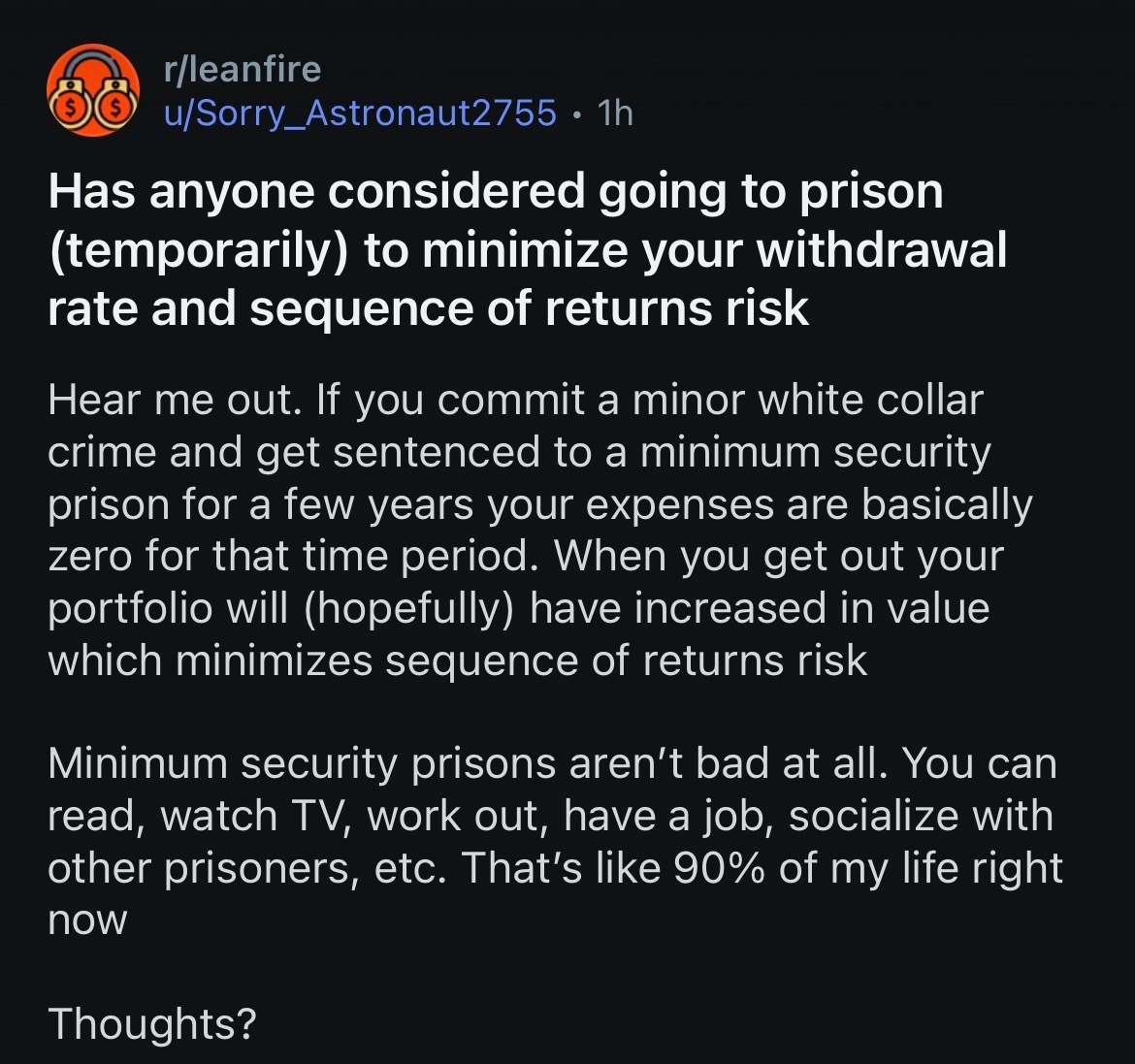
Pitch: tv series about a guy who tries this but can’t get caught. He keeps escalating until he becomes a kingpin of crime and a shell of his former self

Plus those Microsoft and Amazon’s valuations are based on 99.9% and 90.9% of their shares freely trading vs just 4.1% for SpaceX

SpaceX's market cap crossed above $3 trillion today in after hours trading.
That's higher than the market cap of Amazon ($2.65 trillion) & Microsoft ($2.97 trillion).
Microsoft Sales: $318 billion
Microsoft Net Income: $125 billion
Amazon Sales: $743 billion
Amazon Net Income: $91 billion
SpaceX Sales: $19 billion
SpaceX Net Income: -$9 billion
Mike L retweeted

Stateside, a gas station. I drank a frozen blue beverage too quickly, and was struck down by a punishment this entire nation knows, and accepts, and has named.
The drink is called a slush. Ice, sweetness, and a blue that does not occur in nature. The day was hot. I was thirsty. I drank like a soldier at a river.
The pain arrived in my skull like a war horn.
Behind the eyes. Above everything. Total. I gripped the roof of my car. I may have made a sound.
"Brain freeze," said the cashier through the door, with no urgency whatsoever.
It has a NAME. The affliction is so common it has a household name, like a cousin.
"Tongue on the roof of your mouth," called a man at the pumps. He did not look over. He prescribed the remedy mid-pump, casually, the way one mentions weather.
I pressed my tongue to the roof of my mouth. The war horn faded. The healer nodded at his pump, finished, and was gone in a Chevrolet.
In my land, punishment follows crime by way of courts and seasons. Here, the sentence is instant. Drink with greed, and the ice strikes the mind directly. No trial. No appeal. Perfectly fair.
And here is what moves me. EVERYONE has felt it. The cashier. The healer. Children. Elders. An entire nation united by the same small lightning, all taught the same cure, all passing it on to strangers at gas stations, free of charge.
You cannot fully distrust a country once you know it shares one pain.
The freeze does not punish thirst. It punishes haste.
I finished the slush slowly, like a scholar. Blue tongue. Clear mind.
Then at the door I forgot everything, drank deeply, and was struck down again.
"Tongue, hon," said the cashier, without looking up.
Discipline is a journey.

7 years ago I couldn't believe a single company was worth $1 trillion. Now there is one dude worth that much. (on paper)


Mike L retweeted

Wow, the S&P Dow Jones Indices has just officially announced that they will NOT be changing their inclusion rules to make it easier for “MegaCap” companies (such as @SpaceX) to be fast-tracked into the S&P 500.
Their reasoning:
"S&P DJI determined that exceptions to the financial viability, seasoning, and IWF requirements should not be granted solely based on market capitalization. The decision not to adopt the proposed exceptions preserves core index principles by maintaining consistent application of these key requirements. Although there may be trade-offs between strict adherence to these eligibility requirements and broad representativeness, the current methodology provides substantial market coverage and sector balance. As a result, the indices can continue to meet their stated objectives while preserving their role as representative and investable benchmarks for the U.S. equity market.
No changes will be made to the eligibility criteria including financial viability screens, seasoning period, or minimum IWF, for the S&P 500, S&P MidCap 400, or S&P SmallCap 600 as a result of the S&P Dow Jones Indices consultation on the treatment of MegaCap companies. Accordingly, there will be no changes to existing methodology for this index family."
This means that the earliest @SpaceX could be eligible to be added to the S&P 500 would now be June 2027.
The requirements that will now remain in place are:
• No changes to S&P 500 eligibility rules for mega-cap companies.
• Mega-cap companies will still need to wait 12 months after their IPO before being considered for S&P 500 inclusion.
• S&P will not waive profitability requirements for mega-cap companies. The company must have positive GAAP net income in the most recent quarter, and the sum of the most recent four consecutive quarters.
• S&P will not waive minimum public float requirements for mega-cap companies. At least 10% of a company's shares must be publicly tradable ("free float").
The S&P rejected proposals that would have:
• Reduced the IPO seasoning period from 12 months to 6 months
• Waived profitability requirements
• Waived minimum public float requirements


Here’s the original from 2015
youtu.be/PniJM5IwXfE?si=56-K…


You just know it’s gonna be a good week when you beat @MichaelKitces at Queens Monday morning


Mike L retweeted

𝐈𝐧𝐭𝐫𝐨𝐝𝐮𝐜𝐢𝐧𝐠 𝐭𝐡𝐞 𝐑𝐞𝐭𝐮𝐫𝐧 𝐒𝐭𝐚𝐜𝐤𝐞𝐝® 𝐈𝐧𝐭𝐞𝐫𝐧𝐚𝐭𝐢𝐨𝐧𝐚𝐥 𝐒𝐭𝐨𝐜𝐤𝐬 & 𝐌𝐚𝐧𝐚𝐠𝐞𝐝 𝐅𝐮𝐭𝐮𝐫𝐞𝐬 𝐄𝐓𝐅 – 𝐑𝐒𝐈𝐓.
For every $1 invested, RSIT is designed to provide $1 of international equity exposure and $1 of a managed futures trend-following strategy.
Learn more at returnstackedetfs.com/rsit.


Mike L retweeted

Imagining explaining to the Founding Fathers that the president imposed tariffs without an act of Congress and then removed them at the request of the King of England


