

Certified Data Analyst | Skilled in SQL | Power Bi | Advanced Excel | Tableau | Python | Big Query | R Programming
Delhi, India
Joined April 2025
- Tweets302
- Following43
- Followers42
- Likes651
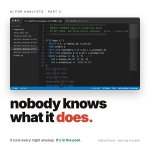




inherited a 412 line SQL query. "do not touch, ask Karan." Karan left.
what i asked AI:
explain it one CTE at a time
where does each output column come from
list every filter and the rule behind it
what breaks if i delete CTE 6 (nothing)
writing SQL is cheap. reading it isn't.

stakeholder requests, translated
"can you just add one filter" → the model needs a new table.
"quick sanity check?" → redo it all, faster.
"the number looks off" → it's lower than expected.
"roughly, no need to be exact" → quoted to the CEO as fact.
which did i miss? 👇


first hour with a new dataset, i don't ask AI for a single chart.
i ask:
one row per what?
which columns are empty?
where are the duplicates?
did any column change meaning halfway?
your analysis is only as good as your understanding of the data.

SQL traps #2
LEFT JOIN orders o ON o.customer_id = c.id
WHERE o.order_date >= '2026-01-01'
congrats, that's an INNER JOIN now.
unmatched rows have NULL dates. WHERE throws them out. no error.
move the filter into ON. the row count is your only clue.

analysts love making fun of excel.
stakeholders run the company on it.
your dashboard gets opened once. the spreadsheet gets forwarded, edited and argued over in a meeting you're not in.
the tool isn't the flex. the decision it helps someone make is.

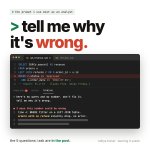
the most useful prompt i use as an analyst isn't "write this query".
it's "here's my number. tell me why it's wrong."
AI is decent at writing SQL. it's even better at finding the join that quietly dropped 200 rows.
don't use it to skip the thinking. use it to argue with it.

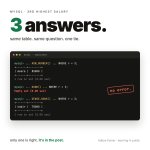
"find the 3rd highest salary."
salaries: 90k, 85k, 85k, 70k
ROW_NUMBER → 85k
RANK → empty set
DENSE_RANK → 70k
only one is right. the tie decides everything.
the dangerous one isn't the empty result. it's the confident wrong number.

things i'd tell myself 6 months ago:
the certificate is the receipt, not the skill.
3 problems a day beats one big weekend.
practice on messy data, not the clean course dataset.
AI makes writing the query cheap. checking it is still your job.
post before you feel ready.

wtf.
claude opus 5.5 wrote this entire motion piece in code.
then it wrote the music. also in code. there is no audio file.
900 frames. one conversation. i'm a data analyst, not a motion designer.
sound on 🔊

almost every analyst portfolio has the same three projects in it.
titanic survival. netflix viewing trends. a covid dashboard from 2021.
i'm not judging, mine had two of them. but if someone has already seen that exact notebook forty times this month, yours isn't telling them anything except that you finished the same tutorial everyone else did.
here's the reframe that helped me: a portfolio project isn't proof you can use the tools. it's proof you can pick a question and defend an answer.
which means the parts most people skip are the parts that actually count.
the data should be messy, and ideally yours. scraped, exported from some tool you use, pulled off a government site that formats dates four different ways. cleaning it isn't the boring bit before the real work. it is the work, and it's the one part a tutorial can't hand you.
the question should be yours too. not "analyse this dataset" but something you genuinely wanted to know. that's the difference between a chart and an argument.
there should be a decision at the end. nobody hires an analyst to produce charts. they hire you to change what someone does on monday. if your project stops at "here are the trends", it stops one step before the job starts.
and write down your thinking. what you checked, what surprised you, what you threw away, what you'd do with another week. that paragraph is worth more than the dashboard above it, because it's the only evidence that you think.
one finished small thing beats four half built impressive ones. a repo full of abandoned notebooks reads as a habit, not a portfolio.
what's in yours that you'd actually defend in an interview 👇
#dataanalytics #careeradvice #analytics #sql #datascience
the thing AI actually changed in my analytics work isn't what i expected.
it didn't make me a better analyst. it made producing analysis almost free, and it did nothing at all to the cost of being wrong.
those are two different problems, and only one of them was ever the hard part.
writing the query was never the expensive bit. knowing whether the answer is true is the expensive bit. a join that silently drops 4% of your rows still returns a clean-looking result. a column that quietly changed meaning in march still aggregates fine. AI hands you that number with exactly the same confidence it hands you a correct one, formatted neatly, ready to paste into a deck.
so here's the line i've landed on: i hand over anything i can verify faster than i could do it myself.
that covers more than i expected. syntax i look up every single time. translating a query between dialects. regex. explaining someone else's undocumented sql. the first pass of exploratory work. building the tool around the analysis, which used to take a week and now takes an afternoon.
what it doesn't cover is most of the actual job. deciding which question is worth asking. noticing when the data is lying to you. knowing why one city dipped that week when the rest didn't. choosing what to leave out, which is most of what makes an analysis useful to someone who has four minutes.
and the one nobody brings up: you still have to defend the number in a room full of people. "the model wrote it" has never once been an acceptable answer.
if you work with data, where's your line 👇
#dataanalytics #ai #sql #analytics #genai

if claude gets dumber the longer you talk to it, it's probably not the model.
it's what you've been feeding it.
you ask it to find where one function is defined. to answer, it opens fourteen files. it finds the function. good. but those fourteen files don't leave. they sit in the conversation for the rest of the session, taking up room your actual problem needed.
do that a few times and the thing you were building is buried under everything you looked at on the way to building it. the model isn't confused. it's reading a transcript that's 80% noise.
that's the problem subagents actually solve. not speed. i thought it was speed for weeks.
a subagent does the fourteen file dig in its own window and hands back one line: the file and the line number. your conversation stays about your problem. the noise ran somewhere else and never came back.
once i saw it that way, three things changed:
→ i delegate the looking, not the deciding. searching, reading, comparing, that goes out. the judgment call stays with me, because that's the part that needs the full picture.
→ i write the brief like the agent knows nothing, because it doesn't. it starts cold. most of my bad results traced back to a two line instruction that only made sense with everything i'd already seen.
→ i stopped spawning five when one would do. five agents means five summaries i now have to reconcile, and that reconciling happens in my main context, which was the thing i was trying to protect.
context is a budget, not a container. the skill isn't fitting more in. it's deciding what gets to sit in front of you.
what do you delegate to an agent, and what won't you let out of your own hands 👇
#ai #claudecode #agents #genai #learninpublic

5 Claude Academy certifications in 17 days 🟢
not by binge-watching the course library over a weekend. by actually opening claude code, agent skills, subagents, and MCP in something real the same week each course covered them.
claude code 101 (aug 19), claude code in action (aug 21), introduction to subagents (aug 22), introduction to agent skills (aug 27), and introduction to model context protocol, finished yesterday. five certificates, but the number that actually matters is how many of those concepts got used in something real within the same week they were learned.
what this reminded me:
→ a certificate means more when you use the concept before the course tab is even closed.
→ short, focused courses, 1 to 2.5 hours each, get finished. the long ones I'll "do this weekend" never do.
→ agent tooling clicks faster when you're building with it, not just reading about it.
thanks to @Anthropic and Claude Academy for putting out courses that are actually built to be used, not just watched. the stack here is claude specific, but the habit travels: learn the thing by shipping something with it the same week.
what's the last thing you learned that you actually used within the week 👇
#ClaudeCode #MCP #LearnInPublic #AI #GenAI

everyone's talking about how Unacademy lost $3.2 billion in valuation.
almost nobody's talking about what upGrad just did right.
what actually made this smart:
upGrad didn't fund the acquisition with its own cash. this was an all-stock deal. angel investors were cashed out separately, while the acquisition itself was a share swap.
upGrad tightened its own numbers before going shopping. FY26 EBITDA grew more than 8x on just 7% revenue growth. still a 130 crore net loss, so not a turnaround story yet, but the direction changed before they spent anything.
and the real reason: Unacademy has the part of the funnel upGrad never had at scale, students prepping for UPSC, JEE, NEET, GATE. upGrad has always played further down the education-to-career funnel, degrees, certifications, upskilling. this deal is upGrad buying the top of the funnel it didn't have.
is it risk-free? no. some are calling this upGrad papering over its own profitability pressure with someone else's user base. that's a fair question and worth asking.
but "smart distressed-asset buy with real strategic fit" and "acquirer with something to prove" aren't mutually exclusive. both can be true.
what do you think, genuinely smart move or upGrad solving its own problem with someone else's company 👇
#edtech #startups #upgrad #unacademy #mergersandacquisitions

I don't think I've learned a real skill in the last year without first building a tracker for it.
a new language, an interview, a certification. every single time, before I actually start learning, I build the checklist, the dashboard, the thing that tracks progress against a deadline.
it's not procrastination dressed up as productivity. building the tracker forces me to scope what I actually don't know, instead of vaguely feeling behind. a messy topic becomes a list. a list becomes a percentage. a percentage becomes something I can't lie to myself about.
the tool is never the point. it's just the fastest way I've found to turn "I should learn this" into "day 41 of 60, on pace."
if you're stuck starting something, stop trying to feel ready and go build the thing that'll tell you if you're behind.
what's your version of this? a spreadsheet, a notion board, a sticky note on your monitor 👇
#learninpublic #buildinpublic #productivity #careergrowth


Somewhere over the clouds right now, there is a version of me watching the ground I left behind get smaller, and a place I have never worked in yet getting closer.
That is what joining BCG feels like from here.
Not the ending of one thing. The boarding call for another. A new seat, a new set of instructions I have not fully read yet, and a runway I did not build myself, waiting on the other side.
And then the wheels touch down, right on top of @BCG Boston Consulting Group. One chapter ends exactly where the runway does. The next one starts the moment I step off this plane.
This is my new adventure, and I have not explored a single street of it yet. Time to go find out what it looks like.
What does your own version of this moment look like? 👇
#NewChapter #BCG #NextChapter #CareerGrowth #OpenToConnect

My last day at cityfurnish was July 31st. Taking a moment before diving into what's next to say this properly.
cityfurnish is where I actually became a data analyst, not just someone who knew SQL, and had the room to actually figure things out.
To everyone I worked with there, thank you for the trust, the patience while I was still learning, and the pushback when my first answer wasn't good enough. That combination is rarer than people think.
Closing this chapter with a lot of gratitude and no regrets. Excited for what's next.
#Gratitude #CareerJourney #DataAnalyst #NewBeginnings
