

Long-time paper & packaging analyst; I write about consumer spending and banking issues and the relationship between the two
Joined December 2015
- Tweets61
- Following31
- Followers801
- Likes2
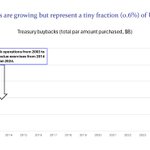



It wasn't long ago that Secretary Bessent expressed concerns about the government's excessive reliance on short-term debt issuance, and for good reason...
@rcwhalen @pboockvar
sakonnetresearch.com/remembe…
Buybacks represent a tiny fraction of the Treasury market even after being temporarily upsized, and need to be funded with yet more short-term debt. Treasury can't "print" money as the Fed can.
sakonnetresearch.com/despera…
@rcwhalen @pboockvar

Rob Armstrong of the FT was kind enough to mention my work in his excellent piece this morning on the struggles of the consumer packaged goods industry. My data shows that average sales volumes at the largest U.S. staples companies have been negative for much of the past four years.
@DiMartinoBooth
ft.com/content/e318cc17-a42d…

Adam Josephson retweeted

And finally, @Adam__Josephson of Sakonnet Research warns that the economy is being propped up by financial leverage, and talks about how investors can think defensively. ➡️ on.wsj.com/3LBGo5Q

Adam Josephson retweeted
Next, @Adam__Josephson of Sakonnet Research breaks down what positive big bank earnings are hiding about consumer spending. Plus, how are consumers adapting as wages stagnate and corporate profit margins boom?
Adam Josephson retweeted
First, @TelisDemos and @miriamgottfried discuss whether Nvidia can sustain its momentum after its stock has reached all-time highs. Then, it’s all about retail earnings: how do Walmart, Target, Home Depot, and Lowe’s survive a weakening consumer?
Adam Josephson retweeted
🚨 New pod alert! 🚨 This week on WSJ's Take On the Week, co-hosts @TelisDemos and @miriamgottfried are joined by @Adam__Josephson of Sakonnet Research to break down the disconnect between a buoyant financial economy and a struggling consumer. Listen: on.wsj.com/3LBGo5Q
Adam Josephson retweeted
The divide between Wall Street and Main Street keeps growing. @Adam__Josephson of Sakonnet Research joins @miriamgottfried and @telisdemos on WSJ’s Take On the Week to explain why high financial leverage is masking consumer weakness.
Listen🎧: on.wsj.com/3LBGo5Q
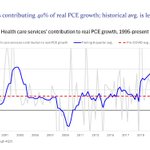
Health care continues to dominate job growth and spending growth.
adamjosephson.substack.com/p…

Despite obvious drawbacks to broker-dealers, their sponsored repos are surging because of growing balance sheet constraints. Dealers are experiencing these constraints just as funding markets are tightening, the latter as evidenced by a notable recent increase in repo rates.
Banks and broker-dealers are critical to the smooth functioning of the Treasury, repo and commercial paper markets, such that these trends are well worth monitoring.


The recent collapses of Tricolor and First Brands and other NDFI-related loan disclosures (see Zions Bank and Western Alliance) have focused attention on the substantial risks associated with the rapid growth of these types of loans.
That said, these loan problems ultimately involved “real economy” companies selling auto parts, used cars, etc. (As longtime readers know, I’ve been writing about the weakness in the real economy aside from AI spending for over a year.)
By contrast, a substantial amount of NDFI lending goes directly to the financial sector via broker-dealers, and that type of NDFI activity has ballooned over the past three years as evidenced by high primary dealer leverage (primary dealers account for a large fraction of the total activity of all securities dealers), record-high margin debt provided by broker-dealers, record-high primary dealer repurchase agreement (repo) lending, and record-high hedge fund borrowing/leverage.
See full comparison and notes here: adamjosephson.substack.com/p…


Yawning U.S. budget deficits post-COVID have been financed to a significant extent by Cayman Islands-domiciled hedge funds putting on the highly leveraged and rapidly growing Treasury basis trade, per Fed economists.
Assuming the hedge funds' purchases were all of notes and bonds, these purchases absorbed 37% of net issuance of notes and bonds from 2022 to the end of 2024, which the authors noted were nearly the same amount as all other foreign investors combined. That's a shaky foundation for the world's largest and most liquid market for government securities.
See commentary and data here:
adamjosephson.substack.com/p…


At the epicenter of the booming financial/asset economy is bank lending to nonbanks or nondepository financial institutions (NDFIs), which include broker-dealers, private credit/equity funds, hedge funds, securitization vehicles, subprime auto lenders, etc.
The “underlying” growth rate of these loans is impossible to know given the large and seemingly ongoing reclassifications of commercial & industrial (C&I) and consumer loans to NDFI loans, but what we know for sure is that NDFI loans have mushroomed in recent years, from 4% of bank loans ($350 billion) in 2015 to 13% ($1.7 trillion) today..
🔗 Full article: an in-depth look: lnkd.in/e5-RszaF

U.S. banks' exposures to NDFIs are far larger than just their loans; banks have also provided NDFIs with a substantial amount of unused lines/commitments. The combination of loans and unused lines is greater than many banks' Tier 1 capital, and could have a "substantial" impact on some of these banks' solvency ratios per the IMF.
Explore the data behind the headlines: adamjosephson.substack.com/p…


What do I think are the particular problems with consumer spending? To keep it simple, inflation and population trends (ignoring the recent resumption in student loan payments, which is also problematic for consumer spending).
Inflation has been above the Federal Reserve’s 2% target for nearly five years, with the trend heading in the wrong direction in recent months.
See the data and projections here:
🔗adamjosephson.substack.com/p…
#ConsumerTrends #Inflation #EconomicAnalysis #MacroEconomy

1,000 readers. Two parallel paths: consumer spending and the banks.
Thank you for supporting “As the Consumer Turns”.
Join the readership: adamjosephson.substack.com

📦 What falling cardboard box sales reveal about the US economy: Demand for boxes spans everything from TVs to frozen dinners — and when it drops, it’s a sign shoppers are tightening their belts.
bloomberg.com/news/articles/…

The State of Consumer Spending in 8 Charts:
Drug spending is surging, while much of the rest of the economy stalls.
CPG brands, retailers, restaurants, hotels, airlines, and automakers are not seeing the gains.
adamjosephson.substack.com/p…

P&G echoing what many other American consumer companies have been saying/reporting in recent months, notwithstanding large banks' characterization of the economy as "resilient."
wsj.com/business/retail/proc…

📉 While big U.S. banks describe the economy as “resilient,” consumer behavior tells a different story.
✈️ In my latest piece, I dive into the struggles facing major travel companies — some are seeing their steepest U.S. sales declines in years (excluding the pandemic).
🛍️ Discretionary spending is slipping, despite the upbeat economic narrative from the financial sector.
💡 A reminder to look beyond the headlines and pay attention to sector-specific trends.
adamjosephson.substack.com/p…
#Economy #ConsumerSpending #TravelIndustry #USMarkets #FinancialTrends #BusinessInsights #EconomicReality #LinkedInInsights #MarketUpdate