

ESA Research Fellow at ESTEC. Investigating the Sun's magnetic activity, solar wind connection science, and the spin-down of Sun-like stars. Prev. CEA, Exeter.
Noordwijk, Netherlands
Joined June 2012
- Tweets900
- Following617
- Followers1.9K
- Likes3.8K




Pinned Tweet
Solar Orbiter Nugget @esascience about our recent active region nest study. We used Solar Orbiter as a far side observer from April to October 2022 to survey magnetic activity over the entire solar surface. This shed light on the nesting of active regions: cosmos.esa.int/web/solar-orb…

@adamfinley.bsky.social retweeted
This World Smile Day 🙂, we bring you ....
... Let's Smile, the film 🎞️
Watch the European-Chinese Smile spacecraft come together – assembled in the Netherlands, tested, then launched from French Guiana 👇
esa.int/ESA_Multimedia/Video…

@adamfinley.bsky.social retweeted

ESA - Juice’s September 2026 Earth flyby: the movie esa.int/ESA_Multimedia/Video…

@adamfinley.bsky.social retweeted
Inspector Smile is ready for science! 🫡
This is Smile’s first ultraviolet view showing an auroral substorm.
With the ultraviolet camera now operational, Smile becomes the first spacecraft since 2008 to capture the full ring of northern lights around the north pole in ultraviolet light.
1/4
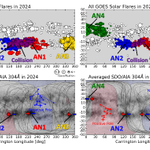
New paper day! Solar activity formed into three hot spots during solar maximum in 2024! Combining observations from near-Earth and ESA’s Solar Orbiter on the far-side we characterised the impact these region had on space weather and the heliosphere arxiv.org/abs/2608.26315 (1/6)

Nesting evolved into 2025, now with a northern hot spot. Their separation and matching east-west magnetic polarity, reinforced a tilted dipole in the solar corona. By anchoring the coronal magnetic field, active nests created favourable sources for solar wind connectivity. (5/6)

@adamfinley.bsky.social retweeted

Join us on Wednesday for live coverage of the total solar eclipse!
Live from Javalambre, Spain, from 19:30 CEST with:
🎤 interviews
📹 explainers
🔭 telescope feeds
🚁 drone shots
🔴 live feeds from different locations
Details: esa.int/Science_Exploration/…
#EuropeanSolarEclipse

@adamfinley.bsky.social retweeted
Missing the total solar eclipse on 12 August? We've got you covered.
Join our live broadcast on ESA Web TV 📺
🎤 interviews
📹 explainers
🔭 telescope feeds
🚁 drone shots
🔴 live feeds from different locations
We've put together an exciting programme for you. 1/2
#EuropeanSolarEclipse

ALT On a dark background, the Moon nearly covers the Sun, leaving only a bright crescent visible on the left-hand side. The Sun's surface looks active, with bright yellow glowing loops sticking out from it. The Sun emits a yellow-orange glow that extends around the dark Moon, and faintly lights up the Moon's left side. Craters are faintly visible on the Moon's surface. The top right has an ESA logo, and the bottom left has text reading “solar eclipse; coming to Europe
@adamfinley.bsky.social retweeted

As has been our tradition for over 30 years, Predictive Science is predicting the structure of the corona for the upcoming total solar eclipse on August 12, 2026!
buff.ly/e9WPME4
There are several new features in the model this year, keep reading for details!

@adamfinley.bsky.social retweeted
Ahead of the total solar eclipse on 12 August, scientists are forecasting the Sun’s corona using advanced 3D simulations.
This animation reveals the magnetic structures shaping the corona and helping improve space weather forecasts. 🌘☀️
🔗esa.int/Space_Safety/Space_w…
@esaoperations
@adamfinley.bsky.social retweeted
🌘 A total solar eclipse is coming to Europe on 12 August 2026.
Join us in León, Spain, or watch it live on ESA YouTube. #EuropeanSolarEclipse
🔗esa.int/Science_Exploration/…


A great review of the proposed mechanisms for switchback formation in the solar wind. These strong deflections in the local magnetic field are ubiquitous close to the Sun and have been linked to the heating and acceleration of the solar wind. arxiv.org/pdf/2604.16166

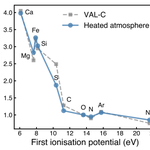
New paper day! To et al. studied the elemental fractionation in coronal loops with FIPpy, comparing the First Ionisation Potential (FIP) effect produced in an initial VAL-C chromosphere versus a heated chromosphere following impulsive nanoflare-like events arxiv.org/abs/2604.13174


@adamfinley.bsky.social retweeted
3️⃣ solar prominence eruptions captured by Proba-3️⃣
This animation resulted from ASPIICS observing the Sun during an active period on 21 September 2025, with one image taken every five minutes, capturing three prominence eruptions in five hours.
🔗 esa.int/ESA_Multimedia/Image…
@esascience @esaoperations @isro @NASA
Are you (or do you know of) an undergrad with an interest in solar physics? Check out the Leiden/ESA Astrophysics Program for Summer Students. Myself, Andy To and Henrik Eklund invite you to come work with us at ESTEC on "Catching the Solar Wind in Action" leaps.strw.leidenuniv.nl/#no…
New paper day! 🔥 George Cherry et al. use the Most Significant Frequency decomposition to investigate shocks, jets, and swirls in the Sun's atmosphere. The contribution of 3.5 and 5 mHz signals is up to 50% of the overall wave power. Published in A&A: aanda.org/articles/aa/full_h…
