









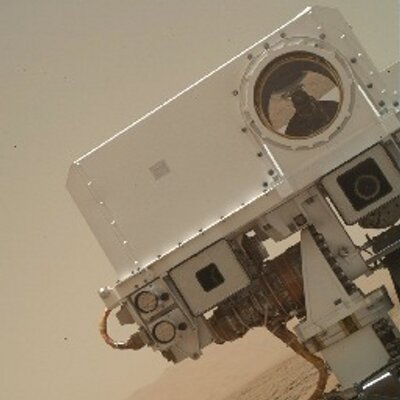

ALT A selfie taken by the Curiosity rover on Mars shows the six-wheeled robot positioned slightly right of center against the Martian landscape. The rover faces the bottom-left corner, its "head" rising just above the horizon in the distance. Its metal surfaces are lightly covered with red-orange Martian dust, with its silver and black surfaces below peeking through. The ground around the rover is mostly flat and covered in red-brown dirt and small- to medium-sized pebbles. The sky is a lighter shade of reddish-brown, with no clouds or features visible.




ALT The image is divided horizontally by an undulating line between a cloudscape forming a nebula along the bottom portion and a comparatively clear upper portion. Speckled across both portions is a starfield, showing innumerable stars of many sizes. The smallest of these are small, distant, and faint points of light. The largest of these appear larger, closer, brighter, and more fully resolved with 8-point diffraction spikes. The upper portion of the image is blueish, and has wispy translucent cloud-like streaks rising from the nebula below. The orangish cloudy formation in the bottom half varies in density and ranges from translucent to opaque. The stars vary in color, the majority of which, have a blue or orange hue. The cloud-like structure of the nebula contains ridges, peaks, and valleys – an appearance very similar to a mountain range. Three long diffraction spikes from the top right edge of the image suggest the presence of a large star just out of view.

ALT A group of five galaxies that appear close to each other in the sky: two in the middle, one toward the top, one to the upper left, and one toward the bottom. Four of the five appear to be touching. One is somewhat separated. In the image, the galaxies are large relative to the hundreds of much smaller (more distant) galaxies in the background. All five galaxies have bright white cores. Each has a slightly different size, shape, structure, and coloring. Scattered across the image, in front of the galaxies are number of foreground stars with diffraction spikes: bright white points, each with eight bright lines radiating out from the center.