

Viral claims and everyday mysteries about the mind and AI, checked against the real research. Sample size always stated.
Joined July 2015
- Tweets53
- Following0
- Followers3
- Likes27


Pinned Tweet
Students who practised maths with GPT-4 scored 48% higher than their classmates.
On the real exam, without it, they scored 17% lower.
That was about 1,000 high school students in Turkey, in a study Bastani and colleagues published in PNAS in 2025.
The researchers ran a third group with the same GPT-4, set up to give hints and refuse answers. That group scored 127% higher in practice, and the exam drop mostly disappeared.
The same pattern shows up in experts. In a 2025 Lancet study, endoscopists in Poland got used to AI-assisted colonoscopy. Back on their own, their rate of spotting precancerous growths fell from 28.4% to 22.4% within about three months.
Those were trained doctors, on real patients.
So before you ask AI for the answer next time, ask yourself which number you want to raise: your practice score or your exam score.
Can you still get around your own city without GPS?
Researchers tested 50 regular drivers. The ones who used GPS the most had worse spatial memory when they had to find their way without it.
Three years later, they retested 13 of them. The more someone had used GPS in between, the more their spatial memory had dropped.
It's a small study. The tests were done in a virtual town, not on real streets, and it shows a link, not proof that GPS causes the drop.
My take: if a skill stops getting used, it starts to fade. Try one drive this week without the map.

Source: Dahmani and Bohbot, "Habitual use of GPS negatively impacts spatial memory during self-guided navigation", Scientific Reports, 2020: doi.org/10.1038/s41598-020-6…
50 drivers, 13 retested about three years later. Virtual tasks, GPS use was self-reported, correlational.

1
An engineer who builds Claude says don't let the model judge its own work. Get an outside judge.
That's the whole idea of this account. AI gives you a claim. The original study decides if it holds.
My take: AI can sound sure and still be wrong. The more you lean on it, the more you need to check the source yourself.

Hi, I'm Felix. I'm an eng lead working on Claude. I love watching people take flight and do things they never thought possible.
We often describe that as "being more ambitious" when using AI, which is tricky advice to follow. I wrote a tutorial:
felixrieseberg.com/how-to-be…

Same TV show, two AI researchers, opposite answers.
@pmddomingos: "AI is an intelligence multiplier. The smarter you are, the more intelligent it will make you."
Stuart Russell: a loan officer leans on AI until he forgets the rules, and "pretty soon I am useless."
My take: both are right. Which one you become depends on what you keep doing yourself.
🤖 Made with AI

Both from the same interview, shared by Domingos here:
Domingos at 5:24, Russell at 19:06. xitter.cf/pmddomingos/status/212…

4
If you're under 25, is AI making it harder to land your first job?
Two big studies disagree.
US payroll data to mid-2026: companies hire fewer young people (22 to 25) into jobs AI can easily do. Their numbers sit 19% below the pace of other jobs. Experienced workers show no gap. The authors call it an early warning and say it doesn't prove AI is the cause.
Denmark, 25,000 workers in jobs AI can easily do: chatbots changed earnings or hours by less than 2% in the two years after ChatGPT launched.
Which one matches what you see?
Sources: Brynjolfsson, Chandar and Chen, "Canaries in the Coal Mine?", Stanford working paper, rev. Aug 2026: digitaleconomy.stanford.edu/… (descriptive; the gap shrinks with education controls).
Humlum and Vestergaard, NBER WP 33777, rev. Mar 2026: nber.org/papers/w33777 (Denmark, data to about 2024, not peer-reviewed).
3
Does AI make you better at your job? It depends on how good you already were.
Economists followed 5,172 customer-support agents at one large software firm after they were given an AI chat assistant.
Issues resolved per hour rose 15% on average. The least skilled agents gained about 36%. The most skilled saw almost no productivity gain and small drops in quality.
One firm, one job, an early GPT-3-based tool.
My take: AI lifts the floor faster than the ceiling. If you're already good, your edge has to come from what you still do yourself.

Source: Brynjolfsson, Li and Raymond, "Generative AI at Work", Quarterly Journal of Economics 140(2), 2025, Figure III, p. 912: doi.org/10.1093/qje/qjae044. About 3M chats at one Fortune 500 firm; the rollout was staggered, not randomized.

6
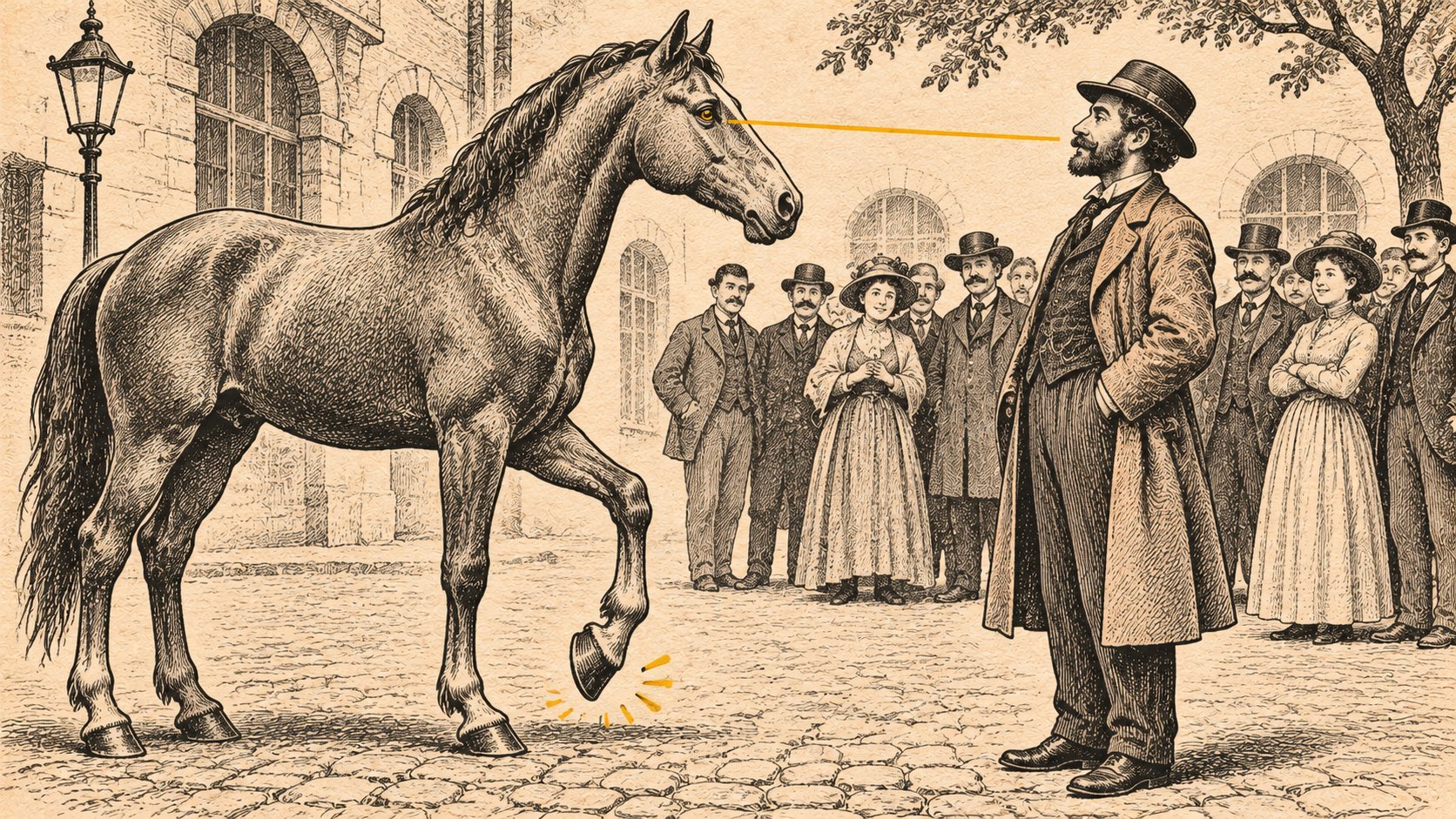
In early 1900s Berlin, a horse seemed to do arithmetic. Ask Clever Hans a sum and he tapped out the answer with his hoof.
Then psychologist Oskar Pfungst tested him. When the questioner knew the answer, Hans got 29 of 31 right. When nobody in the room knew it, he got 3.
He was reading tiny, involuntary cues from the people watching him.
AI does this too. A 2018 pneumonia AI could tell which hospital an X-ray came from almost perfectly. One hospital had far more pneumonia cases, so the hospital alone predicted pneumonia well. At a hospital it hadn't seen, it did worse.
Counterpoint: one shortcut doesn't make every AI a trick horse. Testing on data it has never seen is how you tell the difference.
My take: before you trust any AI result, ask what the horse was watching.
🤖 Made with AI
Sources: Pfungst, "Clever Hans" (1911 English edition): doi.org/10.5962/bhl.title.56… and Zech et al. 2018, PLOS Medicine (the pneumonia model): doi.org/10.1371/journal.pmed…
5
Developers who used AI believed it made them 20% faster. The stopwatch said they were 19% slower.
That was METR's 2025 trial: 16 experienced open-source developers, 246 real tasks from their own projects, each randomly assigned AI or no AI.
Before starting, they expected a 24% speed-up. After finishing, they still believed they'd had one.
In February 2026, METR marked those numbers out of date. Its follow-up with newer tools showed only weak signs of a speed-up, because many developers declined to join a study that meant working without AI.
The tools have improved since. The first finding still stands: 16 experts could not feel a 19% slowdown while it was happening.
When did you last check how long a task really takes you, with AI and without it?
Sources: METR, "Measuring the Impact of Early-2025 AI on Experienced Open-Source Developer Productivity" (July 2025): metr.org/blog/2025-07-10-ear…
METR's February 2026 update: metr.org/blog/2026-02-24-upl…

7
Sources: Forssmann's own report, "Die Sondierung des rechten Herzens," Klinische Wochenschrift, 1929. He shared the 1956 Nobel Prize in Physiology or Medicine with André Cournand and Dickinson Richards, who turned his self-experiment into a working clinical method.
nobelprize.org/prizes/medici…

4