

Advanced Placement courses give students access to college-level work in high school, helping them save time and money in college.
Joined November 2012
- Tweets19.4K
- Following1.1K
- Followers91.2K
- Likes712







“Mubeza Chair” by Kady Bez | AP 3-D Art and Design
Kady Bez’s work was selected for the 2025 AP Art and Design Digital Exhibit, which features exceptional artwork from AP students’ final portfolios.
🎨Learn more about Kady’s work: spr.ly/6018BHHcYw


“Unexpected Route to Luck” by Judith Carrillos | AP Drawing
Judith Carrillos's work was selected for the 2025 AP Art and Design Digital Exhibit, which features exceptional artwork from AP students’ final portfolios.
🎨 Learn more about Judith's work: spr.ly/6019BG2hY3

AP for Students retweeted

Now available for the 2026-27 school year: AP Cybersecurity. 💻🛡️
Explore our newest AP course, shaped by leading companies. Students who enroll will get hands-on experience in a growing tech field, plus a chance to earn college credit and an employer-endorsed credential.
Sign up for updates: spr.ly/6010BGFezG
#AP #Cybersecurity #APCareerKickstart

“Epileptic Entanglement” by Joshua Bleakley | AP 2-D Art and Design
Joshua Bleakley's work was selected for the 2025 AP Art and Design Digital Exhibit, which features exceptional artwork from AP students’ final portfolios.
🎨 Learn more about Joshua's work: spr.ly/6019BGs0Yd

“Above Water Basket Weaving” by Johuan Antnuez | AP 3-D Art and Design
Johuan Antnuez's work was selected for the 2025 AP Art and Design Digital Exhibit, which features exceptional artwork from AP students’ final portfolios.
🎨 Learn more about Johuan's work: spr.ly/6015BG5sXb

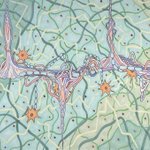
“Woven and Discarded, Abstract Layered Map of a Landfill” by Jessie O’Koon | AP 2-D Art and Design
Jessie O’Koon's work was selected for the 2025 AP Art and Design Digital Exhibit, which features exceptional artwork from AP students’ final portfolios.
🎨 Learn more about Jessie's work: spr.ly/6018BGTexC

“Digital Naivety” by Jacqueline Ibarra | AP Drawing
Jacqueline Ibarra's work was selected for the 2025 AP Art and Design Digital Exhibit, which features exceptional artwork from AP students’ final portfolios.
🎨 Learn more about Jacqueline's work: spr.ly/6010BGJXS0

“Oliver” by Isabelle Kelly | AP Drawing
Isabelle Kelly's work was selected for the 2025 AP Art and Design Digital Exhibit, which features exceptional artwork from AP students’ final portfolios.
🎨 Learn more about Isabelle's work: spr.ly/6014B1CYF8

“Mind Jam” by Isabella Earl | AP Drawing
Isabella Earl’s work was selected for the 2025 AP Art and Design Digital Exhibit, which features exceptional artwork from AP students’ final portfolios.
🎨 Learn more about Isabella's work: spr.ly/6011B1afQc

“Continuación” by Isabella Alvarez | AP Drawing
Isabella Alvarez’s work was selected for the 2025 AP Art and Design Digital Exhibit, which features exceptional artwork from AP students’ final portfolios.
🎨 Learn more about Isabella's work: spr.ly/6010B1Oe3p

“btw i did it afraid and was rewarded” by Hlumelo Notshulwana | AP 3-D Art and Design
Hlumelo Notshulwana’s work was selected for the 2025 AP Art and Design Digital Exhibit, which features exceptional artwork from AP students’ final portfolios.
🎨 Learn more about Hlumelo’s work: spr.ly/6010B160LA

“Spill The Beans” by Gabriella Silverstein | AP 2-D Art and Design
Gabriella Silverstein’s work was selected for the 2025 AP Art and Design Digital Exhibit, which features exceptional artwork from AP students’ final portfolios.
🎨 Learn more about Gabriella’s work: spr.ly/6019BELSR7

“4 Wholeness” by Gabriella Hanna | AP 3-D Art and Design
Gabriella Hanna’s work was selected for the 2025 AP Art and Design Digital Exhibit, which features exceptional artwork from AP students’ final portfolios.
🎨Learn more about Gabriella’s work: spr.ly/6016BEoOSA

“Eight Phases” by Farah Abdelhak | AP 3-D Art and Design
Farah Abdelhak’s work was selected for the 2025 AP Art and Design Digital Exhibit, which features exceptional artwork from AP students’ final portfolios.
🎨 Learn more about Farah’s work: spr.ly/6010BEZT8k

“Reboot Rebooted” by Denver Whaley | AP 3-D Art and Design
Denver Whaley's work was selected for the 2025 AP Art and Design Digital Exhibit, which features exceptional artwork from AP students’ final portfolios.
🎨Learn more about Denver's work: spr.ly/6012BEHbuC


AP for Students retweeted
2026 AP Exam scores are available to students starting today.
Students can view scores here: spr.ly/6012BE6Cbq

AP for Students retweeted

Ok, that’s a wrap – all of the 2026 AP Exam results have been posted.
Special thanks to my colleagues Priscyla and Karlie, who helped with the drafting, proofreading, and posting, as we’ve expanded the amount of commentary from ~40 pages to ~110 this year. Big thanks as well to the dozens of AP course experts who, after the fatigue of weeks of AP Readings, also provided help reviewing and improving the descriptions of the exam questions, as I’m (obviously) not a content expert across all 40+ subjects.
AP teachers, AP students: wishing you a restful and joyful summer break, and an extra note of gratitude to the 30,000 AP teachers and professors who scored more than 20 million essays and free-response questions these past few weeks.
Looking ahead . . .
Here’s a reminder of when and how STUDENTS can view their scores on July 6: apstudents.collegeboard.org/…
And here’s a reminder of when and how EDUCATORS can view scores on July 6: scores.collegeboard.org/
AP for Students retweeted
The 2026 AP Physics C: Electricity & Magnetism Exam scores:
5: 24%; 4: 24%; 3: 27%; 2: 17%; 1: 8%
The 2026 AP Physics C: Electricity & Magnetism Exam was taken by ~32,000 students — less than 1% of the U.S. high school population.
Multiple-Choice Questions
Students scored evenly and well across most topics of the course, but distinctly strongest on questions related to Electric Circuits (Unit 11). Students achieving AP 5s typically answered 100% of these questions correctly.
The questions about Electromagnetic Induction, overall, were slightly more challenging than the other units’ questions; 15% of students answered all of these questions right.
Free-Response Questions
apcentral.collegeboard.org/m…
FRQ #1, the Mathematical Routines question about Magnetic Fields and Forces due to Two Parallel Current-Carrying Wires, considers two long cylindrical wires carrying the same total current I₀ in opposite directions, where Wire S (radius 2a, centered at the origin) has a nonuniform current density that varies radially as J = Cr, and Wire T (radius a, centered at x = 10a) has uniform current density. In Part A, students applied Ampère’s law to derive the magnetic field in Wire S at x = a, requiring them to integrate over the nonuniform current density enclosed by the Amperian loop before applying the law. The students then sketched the magnitude of the total magnetic field as a function of position x along the x-axis from x = 2a to x = 9a, which is the region between the wires. In Part B, students derived the net magnetic force on a charged sphere moving with speed v in the +x-direction at x = 5a, requiring them to determine the superposition of fields from both wires at that location and apply F = qvB.
This was the distinctly the most difficult FRQ on this year’s exam, with three of the possible points proving especially useful in identifying the advanced proficiency characteristic of students achieving AP 5s.
FRQ #2, the Translation Between Representations question about Electric Fields, Electric Potential, and Superposition from Two Charged Rods, begins with two finite, uniformly charged rods: Rod S oriented along the x-axis from −3L to −L, and Rod T oriented along the y-axis from L to 3L, both with positive linear charge density +λ. In Part A, students drew the direction of the net electric field at Point P, located at (−2L, 2L), and at the origin, as well as the direction of the acceleration of a negatively charged sphere released at the origin. In Part B, students derived a symbolic expression for the magnitude of the net electric field at the origin by integrating over the rods and using superposition principles. In Part C, after Rod T is removed, students sketched the electric potential at the origin as Rod S moves away in the −x-direction. Finally, in Part D, students compared the sketch from Part C to the case where a negatively charged Rod W (charge density −λ) simultaneously recedes in the +y-direction at the same speed. This question showcases the full calculus machinery of the electrostatics units: vector field superposition, integration over finite charge distributions, and qualitative reasoning about potential as a scalar sum.
In contrast to FRQ 1, this FRQ provided multiple opportunities for students receiving AP 1s and AP 2s to demonstrate their knowledge and skills, such that this question best differentiated students receiving AP 2s, who were generally able to earn a significant number of points on this FRQ, from students receiving AP 1s, who could usually earn just a few.
FRQ #3, the Experimental Design and Analysis question about Inductance from LC Circuit Oscillation and RL Circuit Data Analysis, challenged students across two distinct experiments. In Experiment 1 (Parts A and B), multiple charged capacitors of known capacitance and a voltmeter that measures potential difference as a function of time are available. Each trial connects the inductor L₁ to a different capacitor in an LC circuit. In Part A, students identified which measured quantities would allow determination of L₁ via a linear graph − for example, by measuring the potential difference across the capacitor long enough to determine the period of oscillation. Students also described a method to reduce experimental uncertainty. In Part B, students identified the quantities to plot that would produce a linear relationship – for example, by recognizing that the oscillation period T is related to L₁ by T² = 4π²L₁C, so L₁ could be found from the slope of a plot of T² vs. C. In Experiment 2 (Parts C and D), a new inductor L₂ is connected to a 12 V battery and a 10 Ω resistor; five measured pairs of current I and rate of change of current dI/dt are provided. Students were expected to recognize that the Kirchhoff’s loop rule equation ε - IR - L(dI/dt) = 0 linearizes as LdI/dt = ε − IR. Therefore, one approach would be to plot ε – IR vs. dI/dt to yield a line whose slope equals L₂. The students then graphed the data, drew a best-fit line, and calculated L₂ from the slope.
Similar to FRQ #2, this FRQ, overall the least challenging on this year’s exam, provided multiple opportunities to differentiate between AP 1s, 2s, and 3s, with students achieving 3+ scores typically able to earn the majority of the points, and students earning AP 2s able to obtain significantly more points across these various tasks than students receiving AP 1s.
FRQ #4, the Qualitative/Quantitative Translation question about Electromagnetic Induction in a Square Conducting Loop, asked students to reason about the induced current in a square conducting loop held in a time-varying magnetic field Bz = B₀ cos(2πt/t₁) initially directed in the +z-direction. In Part A, students indicated the direction of the induced current during the interval 0 < t < t₁/4 using Lenz’s law and justified the answer using qualitative reasoning that addressed the magnetic field due to the induced current in the loop opposing the change in the external magnetic field. In Part B, the students derived a symbolic expression for the induced current I as a function of time by applying Faraday’s law and Ohm’s law. In Part C, the students compared the maximum induced current in a new loop with both side length and resistance doubled relative to the original loop and justified their answer by referencing the functional dependence of the expression for the induced current derived in Part B – specifically, that the maximum emf is proportional to s² and inversely proportional to resistance, so I₂ = 2I₁.
This final question focused squarely on the more advanced students in the course, providing many opportunities for students earning AP 3s to distinguish themselves from performance at the AP 2 level. Students achieving AP 5s typically earned perfect scores on this FRQ, so if you’re wondering whether you’re on track for a 5, take another look at this question, and if you can answer all parts of it thoroughly and accurately, odds are that you’re among this year’s AP 5s.
All subjects’ AP score distributions for 2026 will be posted here when available: apstudents.org/score-distrib…

AP for Students retweeted
The 2026 AP Physics C: Mechanics Exam scores:
5: 20%; 4: 25%; 3: 27%; 2: 17%; 1: 11%
The 2026 AP Physics C: Mechanics exam was taken by ~70,000 students — less than 1% of the U.S. high school population.
Multiple-Choice Questions
Students soared through the questions related to Linear Momentum (Unit 4): an impressive 41% earned perfect scores across this topic area.
Students also generally scored well on questions related to Unit 5 (Torque and Rotational Dynamics) and Unit 6 (Energy and Momentum of Rotating Systems). Students achieving AP 5s typically missed no more than a single point across all of these questions.
Free-Response Questions
apcentral.collegeboard.org/m…
FRQ #1, a question about Velocity-Dependent Resistive Forces, Normal Force, Friction, and a Sliding Cube Inside a Decelerating Box, opened the exam with a rich, multi-layered application of Newton’s second law. A box of mass M decelerates horizontally under a resistive force F_r = −bv, while a cube of equal mass M remains against the box’s interior right wall. Because the resistive force is velocity-dependent, the deceleration is not constant — it decreases over time as the system slows — and so the normal force F_N exerted on the cube by the wall decreases with time as well. The nonzero normal force causes friction between the cube and the wall, preventing the cube from moving down the wall until the normal forces decreases to a critical value. In Part A, students determined the acceleration of the cube in terms of F_N, derived F_N as an explicit function of time (requiring them to solve the equation of motion for the decelerating box-cube system, yielding F_N = ) 1/2 b(v_0)e^(-bt/2M) for the combined system), and sketched the frictional force on the cube versus time — a curve that begins at a constant value and later decreases exponentially, proportional to F_N, after static friction can no longer support the cube’s weight. In Part B, students derived t_crit, the moment when the decreasing friction force can no longer support the cube’s weight against gravity, which requires setting the maximum static friction equal to Mg and solving for the time at which the exponentially decaying F_N causes the friction force to cross that threshold.
This was an exceptionally challenging FRQ, by far the toughest of this year’s exam, aimed at providing the most advanced students – students qualifying for AP 5s -- with opportunities to demonstrate their knowledge and thereby differentiate themselves from students receiving other scores, who could not typically earn most of the possible points across this beast of an FRQ.
FRQ #2, the longest question on the exam (suggested 30 minutes), about Projectile Motion, Midair Explosion, Momentum Conservation, and Center-of-Mass Kinematics, requires students to translate concepts across several different representations. A projectile of mass 4M is launched at angle θ with speed v_0; at the apex of its trajectory, it explodes into Piece Q (mass M) and Piece R (mass 3M), with the pieces separating horizontally. Piece Q lands back at x = 0; Piece R lands at x = x_2. Across four parts, students drew scaled momentum bar diagrams for each piece at the moment of explosion — requiring them to apply momentum conservation graphically and recognize that Piece Q’s horizontal momentum is one fourth the magnitude of and opposite to the center-of-mass momentum, and that both pieces have zero vertical momentum at the apex — then derived a symbolic expression for x_2 starting from conservation of momentum, extended a velocity-vs-time graph from pre-explosion through post-explosion for both pieces and the center of mass (Piece Q moving backward at speed (v_0)cosθ to land at x = 0, Piece R moving forward faster than (v_0)cosθ, and the center of mass continuing at (v_0)cosθ as required by Newton’s first law for the system), and finally reasoned whether Piece R lands farther when Piece Q instead drops straight down — correctly concluding x_new < x_2 because Piece Q retaining zero horizontal velocity results in less horizontal momentum for Piece R than when Q moves backward.
This was a challenging question, and provided students earning AP scores of 3+ with multiple opportunities to earn points and show their proficiency in calculus-based physics, differentiating themselves from students receiving AP 2s, who generally earned just 1 of the available points here.
FRQ #3, a question about Kinetic Friction Measurement with a Spring and Block, and Spring Constant Determination via Energy Conservation, challenged students across two experiments. In Experiment 1 (Parts A and B), a block of known mass m rests against a spring of known constant k; beyond position x = 0, there is friction. Students — with only a meterstick — identified which distances to measure, proposed an uncertainty-reduction method, and designed a linearizing graph: by measuring the initial compression x_0 and the distance d the block slides before stopping on the rough surface, energy conservation gives 1/2 k(x_0)^2 = (μ_k)mgd, so plotting x_0^2 vs. d yields a line whose slope is 2(μ_k)mg/k. In Experiment 2 (Parts C and D), a new spring k_new launches a 2.0 kg block up a ramp with negligible friction; students measure maximum height h for five compression distances s and are given five (s, h) data pairs. Energy conservation gives 1/2(k_new)s^2 = mgh, so plotting h vs. s^2 yields a line through the origin with slope k_new/(2mg). Students graphed the data, drew a best-fit line, and extracted k_new from the slope.
Students overall earned higher scores on this FRQ than any of the others on this year’s exam, and provided students across the range of AP 2-5 with opportunities to show how far they could go along the spectrum of skills measured by this FRQ, as the distribution of points across these different levels of proficiency was very even.
Part B served to differentiate AP 4s and AP 5s from other students, as this was the most difficult section of this FRQ. In turn, Part D served to differentiate AP 4s from AP 3s, as AP 3s generally found Part D to be beyond their skills.
FRQ #4, a question about Rotational Dynamics, Work-Energy Theorem, and the Effect of Crank Arm Length on a Unicycle Wheel, asked students to reason about three scenarios involving a unicycle wheel of rotational inertia I_W being spun by a crank arm with a constant perpendicular force F. In Scenario 1 (crank arm length ℓ_1), in Scenario 2 (crank arm length ℓ_2 > ℓ_1), and in Scenario 3 (the wheel on the ground, free to roll without slipping). In Part A, students indicated that ω_2 > ω_1 and justified conceptually that the longer crank arm exerts a greater torque and does more work over one full rotation (the force travels a larger arc length 2πℓ_2 vs. 2πℓ_1), so the wheel gains more rotational kinetic energy. In Part B, they derived ω_1 from the work-energy theorem: the work done is F·2πℓ_1 (force times arc length of one rotation), setting this equal to 1/2 (I_W)(ω_1)^2 and solving. In Part C, students argued that ω_3 < ω_1 because when the unicycle is on the ground, the same applied torque must now also accelerate the translational motion of the unicycle — the wheel’s rotational kinetic energy and the system’s translational kinetic energy are both supplied by the same work input F·2πℓ_1, leaving less energy available for rotation alone.
Students receiving AP 2s could typically begin the question and earn a point, but it was sufficiently challenging to serve primarily for providing a range of difficulties well suited to distinguishing between AP 3s, 4s, and 5s.
All subjects' AP score distributions for 2026 will be posted here when available: apstudents.org/score-distrib…

AP for Students retweeted
The 2026 AP Physics 2 Exam scores:
5: 20%; 4: 29%; 3: 23%; 2: 21%; 1: 7%
The 2026 AP Physics 2 exam was taken by approximately 25,000 students — less than 1% of the U.S. high school population.
Multiple-Choice Questions
Students scored highest on questions related to Thermodynamics (Unit 9); 15% of students earned perfect marks across all of these questions.
Overall, the most challenging sections were related to Electric Force, Field, and Potential (Unit 10) and Waves, Sound, and Physics Optics (Unit 14). 8% of students earned all of the points possible across the questions for these units.
Free-Response Questions
apcentral.collegeboard.org/m…
FRQ #1, a Mathematical Routines question about Ideal Gas Behavior, Maxwell-Boltzmann Distributions, and Thermal Energy Transfer, initially presented students with a scenario that included a monatomic, ideal gas in a fixed-volume container that also contained a very small, thermally conducting sphere. The students sketched a Maxwell-Boltzmann distribution representing the number of atoms per unit speed as a function of atom speed for the gas after a heating process, based on a similar distribution for the gas at a lower temperature. The students then derived expressions for both the temperature change of the gas due to the heating process and the specific heat of the sphere. The students were then presented with a scenario in which a thermally conducting sphere was submerged in a liquid, with the initial temperature of the sphere greater than that of the liquid. The students had to qualitatively justify why the absolute value of the temperature change of the sphere had to exceed that of the liquid, given that the sphere had both smaller mass and smaller specific heat. This question illustrates the connection between microscopic models of ideal gas behavior, as represented by Maxwell-Boltzmann distributions, and macroscopic thermal energy transfer, as described by changes in temperature and specific heat.
This question contained a number of tasks generally attainable by students receiving AP 2s, providing opportunities for these students to earn a number of points. Student attaining an AP 3 or higher needed to earn the majority of this FRQ’s points, and students achieving AP 5s typically earned all points possible here.
FRQ #2, a Translation Between Representations question about Energy Levels of a Hypothetical Atom, Photon Emission from an Atom in an Excited State, and the Classical and Modern Theories of Electromagnetic Radiation, initially presented students with a scenario that included an energy-level diagram of a hypothetical atom. The students were asked to draw arrows on the diagram to represent all possible transitions that resulted in the emission of a photon. The students then derived an expression for the wavelength of the highest-energy photon that could be emitted from the hypothetical atom. The students were then presented with a scenario in which a device could emit electromagnetic radiation across a continuous range of wavelengths. The students sketched a graph of photon energy as a function of wavelength and then made and justified a claim about whether the hypothetical atom could emit a photon with the same energy as a photon of a particular energy that could be emitted by the device. This question illustrates the distinction between quantized energy levels, as described by the modern theory of electromagnetic radiation, and the continuous spectrum available from a device, as described by the classical theory of electromagnetic radiation.
Part A of this FRQ contributed to differentiating between scores of 1, 2, and 3, as some points here were attainable by less proficient students, while students receiving AP 3s were typically able to earn full points on Part A. What set AP 5s apart here is their general ability to earn all 12 points possible across the full scope of this FRQ.
FRQ #3, an Experimental Design and Analysis question about Electric and Magnetic Forces Exerted on a Charged Sphere and the Circular Motion of Charged Particles in a Uniform Magnetic Field, presented students with two different experiments. In Experiment 1, the students analyzed a velocity selector that used a variable-emf power supply and parallel, charged, conducting plates to balance the electric and magnetic forces exerted on charged spheres. The students identified which quantities to measure with the available equipment to determine the magnitude of the magnetic field, indicated a method to reduce uncertainty, and designed a linearized graph whose slope could be used to determine the magnitude of the magnetic field. In Experiment 2, identical, charged particles were launched into an external, uniform magnetic field of varying, known magnitude between trials, and the resulting circular orbital radii were provided. The students had to identify which quantities to plot to linearize the relationship between the magnitude of the magnetic field and the orbital radius of the charged particles, plot the provided data, draw a best-fit line, and calculate the mass of the particles based on the slope of the best-fit line. This question illustrates the connection between the physics of charged objects in external fields and the methodology of experimental design and graphical data analysis.
Part A differentiated between AP scores of 3 and 2, as students achieving AP 3s were consistently able to earn full marks on Part A, whereas students receiving AP 2s typically could not.
Part B differentiated AP 3s from AP 4s and 5s; the higher scoring students typically earned full points on Part B, whereas AP 3s earned partial.
Part C was relatively easy, serving to differentiate students receiving AP 2s, who did not usually attain all of the points possible on this part, from students earning 3+ scores, who did.
Part D was the playground for AP 4s and 5s, providing opportunities for them to show their knowledge and skills, as other students generally could not obtain these points.
FRQ #4, a Qualitative/Quantitative Translation question about Electric Potential, Kinetic Energy, and Conservation of Energy Associated with a Charged Sphere in an Electric Field, initially presented students with a scenario in which an electric field was represented by equipotential lines and a positively charged sphere moved from a lower electric potential to a higher electric potential between two indicated points. The students had to indicate and justify whether the final speed of the positively charged sphere was greater than, less than, or equal to the initial speed of the positively charged sphere. The students then derived an expression for the final kinetic energy of the positively charged sphere. Lastly, the students were then presented with a scenario in which a negatively charged sphere with the same mass and initial speed as the original positively charged sphere moved from a lower electric potential to a higher electric potential between the two original indicated points. The students were asked to compare the final kinetic energy of the negatively charged sphere to that of the positively charged sphere. This question illustrates the relationship between electric potential energy of a charged sphere-electric field system, kinetic energy, and the sign of the charge when applying conservation of energy to the motion of charged objects in an electric field represented by equipotential lines.
Too challenging for students receiving AP 1s, the difficulty of these points ranged from a point that students receiving AP 2s could typically earn, to a significant number of advanced points designed to separate students achieving AP 5s, who usually earned all points possible on this FRQ, from students earning AP 4s, who could earn mot but not all of the advanced points.
All subjects' AP score distributions for 2026 will be posted here when available: apstudents.org/score-distrib…
