
Interested in Islamic Studies.
Joined June 2023
- Tweets2.6K
- Following0
- Followers2.4K
- Likes63.7K




The “Men Of Fajr” is not a Bid’ah
The “Salaf” used to hand out prizes to children who attended the prayer in the Masjid!
Were it a government initiative, the very people barking would be the first to praise the eagerness of said government in bringing kids to the Masjid.


The Athar is a mere *illustration* & not an evidence for the “Men of Fajr”initiative.
The question one ought to ask their shaykh is whether encouraging/rewarding children to get them to do a specific act of worship is bid’ah or not.
We say it’s NOT and the practices are plenty


FYP comes clutch again.
Not one sound made when this was done by Saudi organisations.
Because it didn’t go viral & have the potential to wake up a generation.
The fear is in a movement that can potentially arise.
The enemy knows this.
Hence why they screaming bid’ah

The Prophet ﷺ went to Qubāʾ every Saturday to pray two rakʿah
This shows it's permissible to set certain days for certain good deeds and keep to them
Zubayd called boys to pray with walnuts
These people exist ONLY to block anything that might rebuild the Muslim mindset.

آل معلم 2 retweeted

This is just coming in: there appears to be a major fire on the upper floors of one of the towers of the World Trade Center in New York City.
Reports claim that a small plane, either a Cessna or a private jet, accidentally flew into the tower around the 80th floor, due to either an air traffic control communications error or a malfunction on the aircraft.
The dozens of victims are in our thoughts. We will continue to monitor rescue and repair surrounding this alarming accident.

آل معلم 2 retweeted
Absolute humiliation in this life when the innocent of the most oppressed Muslims of this generation are disgusted with you to this extent.
Repent from this way.

Another point to those who say these people’s Takfir is politically motivated.
Also by modern Salafi quietist logic, Ibn Baz ought to be labelled a Kharijite..


The arguments all roll to:
“He doesn’t sit with us”
“He sits with the opps”
“so he’s a threat to what we got going on”


I had a relative with feminist
ideas and after marriage the issues she had with how “ Islam treats women in marriage” completely went away.
Why?
Because she married a *good* *upstanding* man.
Not an abusive one.
It all comes back to men.
If you’re upright, your folk will be too.

آل معلم 2 retweeted
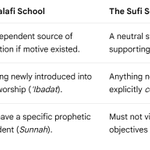
Understanding the roots behind Mawlid debate between Salafis & Sufis
Both sides agree that the early generations (al-Salaf al-Salih) knew the date of the Prophet's birth, yet they never celebrated it annually.
The principle Salafis (and a minority of latecomer jurists) hold onto is that an omission (tark) of a religious act when:
1. the motive to perform it was present during the prophetic era
2. there was no preventing obstacle
means that the act is legally rejected or considered a blameworthy innovation (bid'ah).
Thus, Mawlid = blameworthy innovation
But Sufis hold onto the principle that tark alone does not automatically equate to a prohibition unless there is a specific textual prohibition or evidence showing it was forbidden.
And so they divide innovations into the five famous legal categories (Obligatory, Recommended, Permissible, Disliked, Forbidden) based on how the new act aligns with existing texts.
An un-enacted practice backed by general texts of gratitude, charity, or Dhikr is a good innovation (Bid'ah Hasanah) rather than blameworthy innovation.
Thus Mawlid = a good innovation